

Scheme 4. The benzylic protons are ready for many chemical reactions, such as
halogenation, oxidation, and metallation. Many functionalization reactions take
place exclusively at the p-CH 3 position. Therefore, the polymer backbone is
untouched during functionalization and the extent of functionalization is governed
by the concentration of p-MS groups. Figure 5 shows an
1
H NMR spectra of three
functionalized PEs that were derived from the same PE-p-MS containing 1 mol% of
p-MS units. In the carboxylated PE that was synthesized by bubbling CO 2 gas
through a tetrahydrofuran (THF) slurry of the lithiated PE-p-MS copolymer, there
are two new peaks at around 3.65 ppm and 7.1–7.4 ppm (see Fig. 5, curve a),
corresponding to benzylic protons adjacent to the carboxylic acid (–COOH) group
and p-CH 2 COOH substituted aromatic protons, respectively. The degree of the
carboxylation reaction (the ratio between [p-CH 2 COOH] in the copolymer to
[p-CH 3 ] in the starting copolymer) is 60.3%. By bubbling ethylene oxide gas
through the lithiated PE-p-MS/THF suspension solution, a hydroxylated PE polymer
containing p-(1-hydroxypropyl)styrene units was obtained. The
1 H NMR spectrum
of the resulting polymer is shown in Fig. 5, curve b, with three new peaks at 3.71,
2.73, and 2.17 ppm corresponding to three types of CH 2 protons between the
aromatic ring and the OH group. The efficiency of the functionalization reaction is
76.3%. The lithiated PE-p-MS suspended in THF solution was also reacted with
methoxyl-9-BBN at room temperature, gave a borane-containing polymer, then
converted to benzylic alcohol groups by hydrolyzing in the presence of NaOH/
H 2 O 2 in THF. Figure 5, curve c, shows the
1 H NMR spectrum of the resulting
polymer. Two new peaks around 4.7 ppm and 7.1–7.4 ppm correspond to the
benzylic protons next to the OH group and the aromatic protons of benzylic alcohol.
In addition, we also studied diene comonomers containing a styrenic moiety
[45–48]. The objective was to incorporate pendant styrene groups into the polyolefin side chains, which are highly versatile for a broad range of reactions, including
free radical, cationic, and anionic processes. With the advantages of metallocene
catalysis, it is possible to select an active site with a specific stereo-opening that
exhibits selectivity in olefin enchainment to provides high diene incorporation into
-60.0
DSC
-40.0
(c)
(b)
(a)
-20.0
0.0
20.0
Temperature (°C)
40.0
60.0
80.0
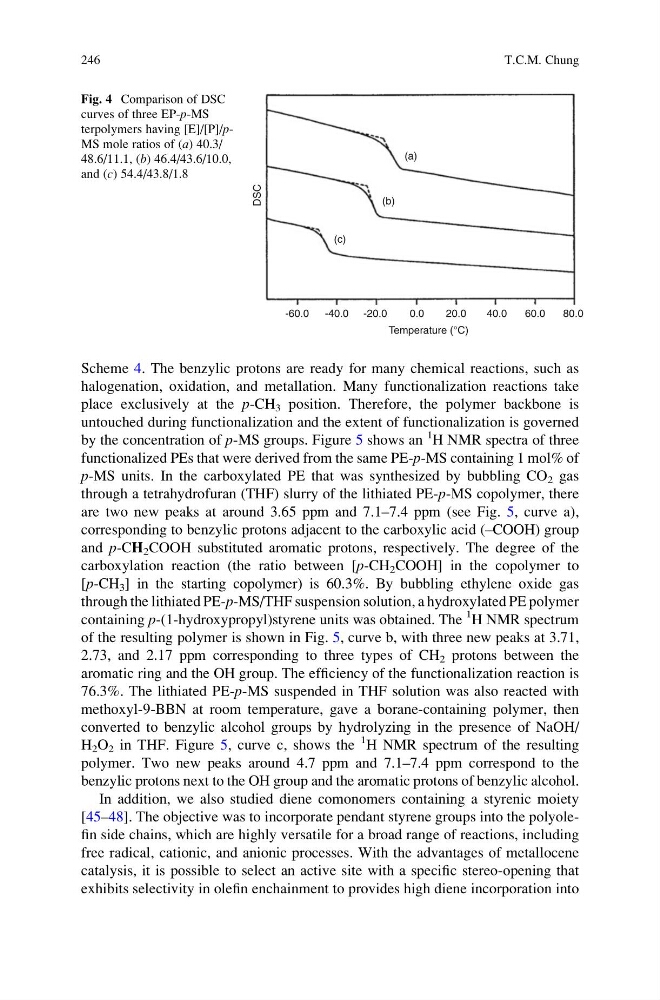
Fig. 4 Comparison of DSC
curves of three EP-p-MS
terpolymers having [E]/[P]/pMS mole ratios of (a) 40.3/
48.6/11.1, (b) 46.4/43.6/10.0,
and (c) 54.4/43.8/1.8
246
T.C.M. Chung
halogenation, oxidation, and metallation. Many functionalization reactions take
place exclusively at the p-CH 3 position. Therefore, the polymer backbone is
untouched during functionalization and the extent of functionalization is governed
by the concentration of p-MS groups. Figure 5 shows an
1
H NMR spectra of three
functionalized PEs that were derived from the same PE-p-MS containing 1 mol% of
p-MS units. In the carboxylated PE that was synthesized by bubbling CO 2 gas
through a tetrahydrofuran (THF) slurry of the lithiated PE-p-MS copolymer, there
are two new peaks at around 3.65 ppm and 7.1–7.4 ppm (see Fig. 5, curve a),
corresponding to benzylic protons adjacent to the carboxylic acid (–COOH) group
and p-CH 2 COOH substituted aromatic protons, respectively. The degree of the
carboxylation reaction (the ratio between [p-CH 2 COOH] in the copolymer to
[p-CH 3 ] in the starting copolymer) is 60.3%. By bubbling ethylene oxide gas
through the lithiated PE-p-MS/THF suspension solution, a hydroxylated PE polymer
containing p-(1-hydroxypropyl)styrene units was obtained. The
1 H NMR spectrum
of the resulting polymer is shown in Fig. 5, curve b, with three new peaks at 3.71,
2.73, and 2.17 ppm corresponding to three types of CH 2 protons between the
aromatic ring and the OH group. The efficiency of the functionalization reaction is
76.3%. The lithiated PE-p-MS suspended in THF solution was also reacted with
methoxyl-9-BBN at room temperature, gave a borane-containing polymer, then
converted to benzylic alcohol groups by hydrolyzing in the presence of NaOH/
H 2 O 2 in THF. Figure 5, curve c, shows the
1 H NMR spectrum of the resulting
polymer. Two new peaks around 4.7 ppm and 7.1–7.4 ppm correspond to the
benzylic protons next to the OH group and the aromatic protons of benzylic alcohol.
In addition, we also studied diene comonomers containing a styrenic moiety
[45–48]. The objective was to incorporate pendant styrene groups into the polyolefin side chains, which are highly versatile for a broad range of reactions, including
free radical, cationic, and anionic processes. With the advantages of metallocene
catalysis, it is possible to select an active site with a specific stereo-opening that
exhibits selectivity in olefin enchainment to provides high diene incorporation into
-60.0
DSC
-40.0
(c)
(b)
(a)
-20.0
0.0
20.0
Temperature (°C)
40.0
60.0
80.0
Fig. 4 Comparison of DSC
curves of three EP-p-MS
terpolymers having [E]/[P]/pMS mole ratios of (a) 40.3/
48.6/11.1, (b) 46.4/43.6/10.0,
and (c) 54.4/43.8/1.8
246
T.C.M. Chung