

expected to be sufficient to hinder the electronic influence of silicon. Still, the
polymerization performance of phenylsilane-containing monomer raises some
questions from the perspective of the (active) benzyl ring because it has been
found to interact with the electron-deficient metal centers through the π-aromatic
system [158]. To study the polymerization performance of 7-octenyl-Si(CH 3 ) 2 Ph, it
was polymerized with ethylene [24] and propylene [25] and the microstructures of
the formed copolymers (e.g., end groups, regio- and stereo-defects) were analyzed
thoroughly. Finally, the results were compared with those obtained for polyethylene-co-1-decene and polypropylene-1-dodecene, but no clear deviations were
observed. This indicated that there was no real interaction between the phenylsilane
moiety and the cationic metal center of the metallocene catalyst [24, 25].
5.41
5.27
5.24
4.79
6.0
5.5
5.0
4.5
Chemical Shift (ppm)
4.79
4.85
a
b
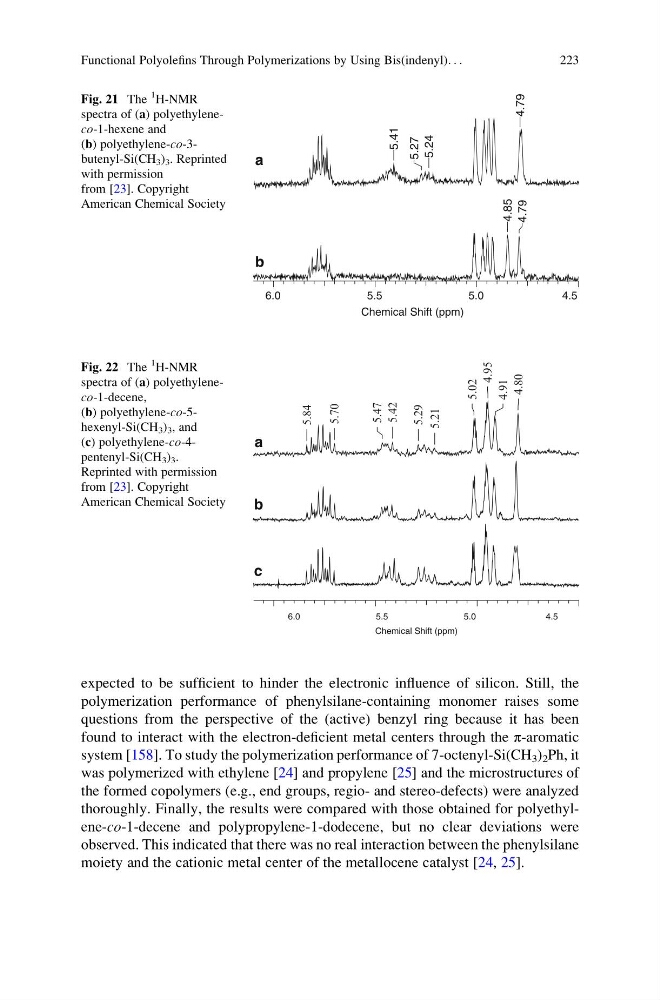
Fig. 21 The
1
H-NMR
spectra of (a) polyethyleneco-1-hexene and
(b) polyethylene-co-3butenyl-Si(CH 3 ) 3 . Reprinted
with permission
from [23]. Copyright
American Chemical Society
4.80
4.91
4.95
5.02
5.21
5.29
5.42
5.47
5.70
5.84
6.0
5.5
5.0
4.5
Chemical Shift (ppm)
a
b
c
Fig. 22 The
1
H-NMR
spectra of (a) polyethyleneco-1-decene,
(b) polyethylene-co-5hexenyl-Si(CH 3 ) 3 , and
(c) polyethylene-co-4pentenyl-Si(CH 3 ) 3 .
Reprinted with permission
from [23]. Copyright
American Chemical Society
Functional Polyolefins Through Polymerizations by Using Bis(indenyl). . .
223
polymerization performance of phenylsilane-containing monomer raises some
questions from the perspective of the (active) benzyl ring because it has been
found to interact with the electron-deficient metal centers through the π-aromatic
system [158]. To study the polymerization performance of 7-octenyl-Si(CH 3 ) 2 Ph, it
was polymerized with ethylene [24] and propylene [25] and the microstructures of
the formed copolymers (e.g., end groups, regio- and stereo-defects) were analyzed
thoroughly. Finally, the results were compared with those obtained for polyethylene-co-1-decene and polypropylene-1-dodecene, but no clear deviations were
observed. This indicated that there was no real interaction between the phenylsilane
moiety and the cationic metal center of the metallocene catalyst [24, 25].
5.41
5.27
5.24
4.79
6.0
5.5
5.0
4.5
Chemical Shift (ppm)
4.79
4.85
a
b
Fig. 21 The
1
H-NMR
spectra of (a) polyethyleneco-1-hexene and
(b) polyethylene-co-3butenyl-Si(CH 3 ) 3 . Reprinted
with permission
from [23]. Copyright
American Chemical Society
4.80
4.91
4.95
5.02
5.21
5.29
5.42
5.47
5.70
5.84
6.0
5.5
5.0
4.5
Chemical Shift (ppm)
a
b
c
Fig. 22 The
1
H-NMR
spectra of (a) polyethyleneco-1-decene,
(b) polyethylene-co-5hexenyl-Si(CH 3 ) 3 , and
(c) polyethylene-co-4pentenyl-Si(CH 3 ) 3 .
Reprinted with permission
from [23]. Copyright
American Chemical Society
Functional Polyolefins Through Polymerizations by Using Bis(indenyl). . .
223