

5 Functional Copolymers as Compatibilizers in Polyolefin
Blends and Composites
Polymer–polymer blends are finding extensive application in the development of
new materials. As an example, immiscible blends of polyolefins and engineering
plastics offer novel types of polymers that synergistically combine the properties of
their components [159]. Key to the physical properties of these blends is their
morphology, i.e., the size and shape of the dispersed phase [160]. The phase
morphology and its stability are largely controlled by interfacial adhesion.
In addition to polymer–polymer blends, new kinds of material can be obtained
by adding fillers to the polyolefin matrix. The fillers are usually inorganic materials
with polar hydrophilic surfaces and therefore they attract each other by van der
Waals forces. This complicates their homogeneous compounding with hydrophobic
nonpolar polyolefins, especially when high filler loadings or submicron sized fillers
are used. If any form of aggregate remains in the polymer matrix, they can act as
flaws (crack) resulting in a drastic decrease in the toughness of the composite. In
addition, most of the fillers are less than optimally bonded with the nonpolar
polyolefin matrix. Strong adhesion strength between these phases is usually
required to ensure adequate mechanical properties of the composites [161–163].
One way to control the blend morphology, as well the filler dispersion and filler/
matrix interaction in polyolefin composites, is to apply a compatibilizer, which acts
as an interfacial agent promoting adhesion between the phases. Functionalized
copolymers prepared by coordination copolymerization have many advantages
over functionalized polyolefins prepared by radical polymerization or grafting.
Coordination polymerization gives access to stereocontrol as well as to precise
control of composition, crystallinity, molar mass, and their distributions.
Complex after
2,1 inserted comonomer
β− hydrogen abstarction Triplets (t) at ~5.4-5.5 ppm (cis +trans)
Zr
Zr–H
Secondary inserted comonomer +
unfinished β−hydrogen abstraction
Zr
Allylic activation +
ethylene insertion
Zr–H
Zr
dt at 5.4–5.5 ppm
dd at 5.2–5.3 ppm
H
H
H
(CH 3 ) 3 Si
(CH 3 ) 3 Si
H
H
H
H
H
P
P
P
P
P
⊕
⊕
⊕
⊕
⊕
+
a
b
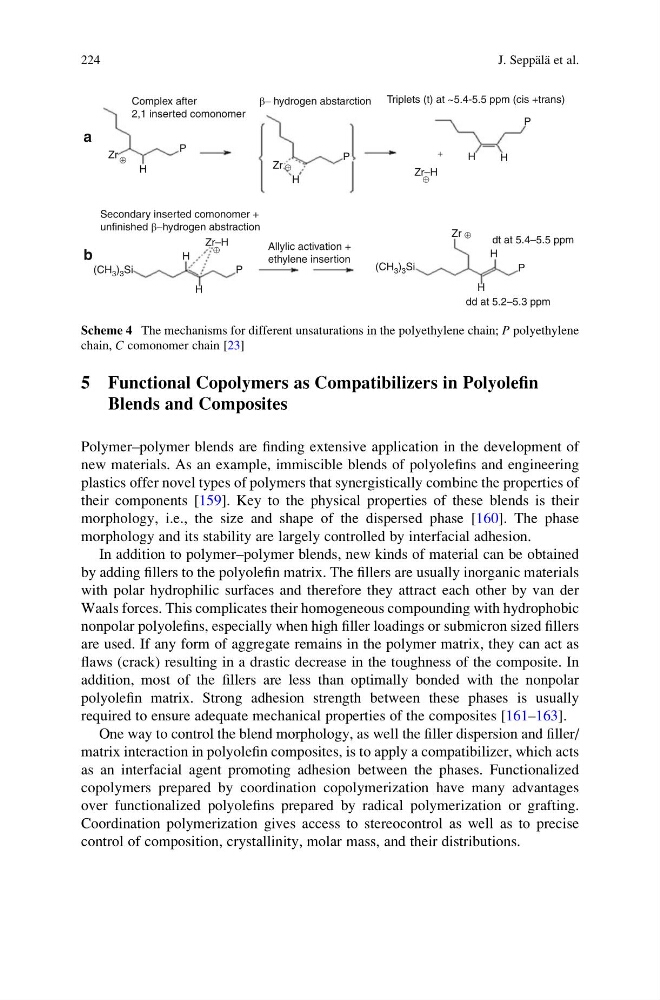
Scheme 4 The mechanisms for different unsaturations in the polyethylene chain; P polyethylene
chain, C comonomer chain [23]
224
J. Seppa ¨la ¨ et al.
Blends and Composites
Polymer–polymer blends are finding extensive application in the development of
new materials. As an example, immiscible blends of polyolefins and engineering
plastics offer novel types of polymers that synergistically combine the properties of
their components [159]. Key to the physical properties of these blends is their
morphology, i.e., the size and shape of the dispersed phase [160]. The phase
morphology and its stability are largely controlled by interfacial adhesion.
In addition to polymer–polymer blends, new kinds of material can be obtained
by adding fillers to the polyolefin matrix. The fillers are usually inorganic materials
with polar hydrophilic surfaces and therefore they attract each other by van der
Waals forces. This complicates their homogeneous compounding with hydrophobic
nonpolar polyolefins, especially when high filler loadings or submicron sized fillers
are used. If any form of aggregate remains in the polymer matrix, they can act as
flaws (crack) resulting in a drastic decrease in the toughness of the composite. In
addition, most of the fillers are less than optimally bonded with the nonpolar
polyolefin matrix. Strong adhesion strength between these phases is usually
required to ensure adequate mechanical properties of the composites [161–163].
One way to control the blend morphology, as well the filler dispersion and filler/
matrix interaction in polyolefin composites, is to apply a compatibilizer, which acts
as an interfacial agent promoting adhesion between the phases. Functionalized
copolymers prepared by coordination copolymerization have many advantages
over functionalized polyolefins prepared by radical polymerization or grafting.
Coordination polymerization gives access to stereocontrol as well as to precise
control of composition, crystallinity, molar mass, and their distributions.
Complex after
2,1 inserted comonomer
β− hydrogen abstarction Triplets (t) at ~5.4-5.5 ppm (cis +trans)
Zr
Zr–H
Secondary inserted comonomer +
unfinished β−hydrogen abstraction
Zr
Allylic activation +
ethylene insertion
Zr–H
Zr
dt at 5.4–5.5 ppm
dd at 5.2–5.3 ppm
H
H
H
(CH 3 ) 3 Si
(CH 3 ) 3 Si
H
H
H
H
H
P
P
P
P
P
⊕
⊕
⊕
⊕
⊕
+
a
b
Scheme 4 The mechanisms for different unsaturations in the polyethylene chain; P polyethylene
chain, C comonomer chain [23]
224
J. Seppa ¨la ¨ et al.