

22a, b). The multiple/overlapping resonances at 5.4–5.5 ppm in
1 H-NMR spectrum
are ordinarily explained by the internal vinylene unsaturation (cis + trans) formed
after chain termination of secondary inserted 1-alkene (Scheme 4a), while the
small resonances at 5.2–5.3 ppm are excluded [154]. However, now these
resonances formed a clear coupling pattern (Fig. 22c, two doublets at
5.21–5.29 ppm., J(d) ¼ 8 Hz, J(dd) ¼ 15 Hz; and two triplets at 5.41 and
5.46 ppm., J(t) ¼ 6 Hz, J(dt) ¼ 15 Hz), which can be assigned to microstructure
where the internal trans-vinylene unsaturation locates next to the branching point
[153]. These kinds of internal unsaturations can be explained by the “allylic
activation” mechanism [76, 142, 153, 155–157], which is also in agreement with
our results (allylic activation and propagation after chain termination of
2,1-inserted comonomer; Scheme 4b) [23].
Finally, the polymerization performance of 5-hexenyl-Si(CH 3 ) 3 resembles well
that obtained for 1-alkenes (Table 7, compare runs 12–13 with runs 14–15). Both of
the comonomers resulted in similar results regarding the catalyst activities (positive
comonomer effect) and the comonomer uptake. Also, the molar masses were
decreased as much when compared with the molar mass of the homopolyethylene
(Table 7, run 1) [23].
The study was extended by polymerizing olefins with monomer containing a
dimethylphenylsilane group. The phenylsilane moiety was separated from the
double bond by six methylene groups [7-octenyl-Si(CH 3 ) 2 Ph] and that was
5.85
5.71
5.19
5.03
4.93
4.73
4.63
Si
P
Si
Si
H
H
H
Internal vinylene
triplet (t) at 5.19 ppm.
Chain head vinylidene
4.63 ppm., 4.73 ppm
6.0
5.9
5.8
5.7
5.6
5.5
5.4
5.3
5.2
5.1
5.0
4.9
4.8
4.7
4.6 4.5
Chemical Shift (ppm)
4.83
4.75
P
Si
CH 3
H
H
H
H
Chain head vinylidene
4.75 ppm
Internal vinylidene
4.83 ppm
a
b
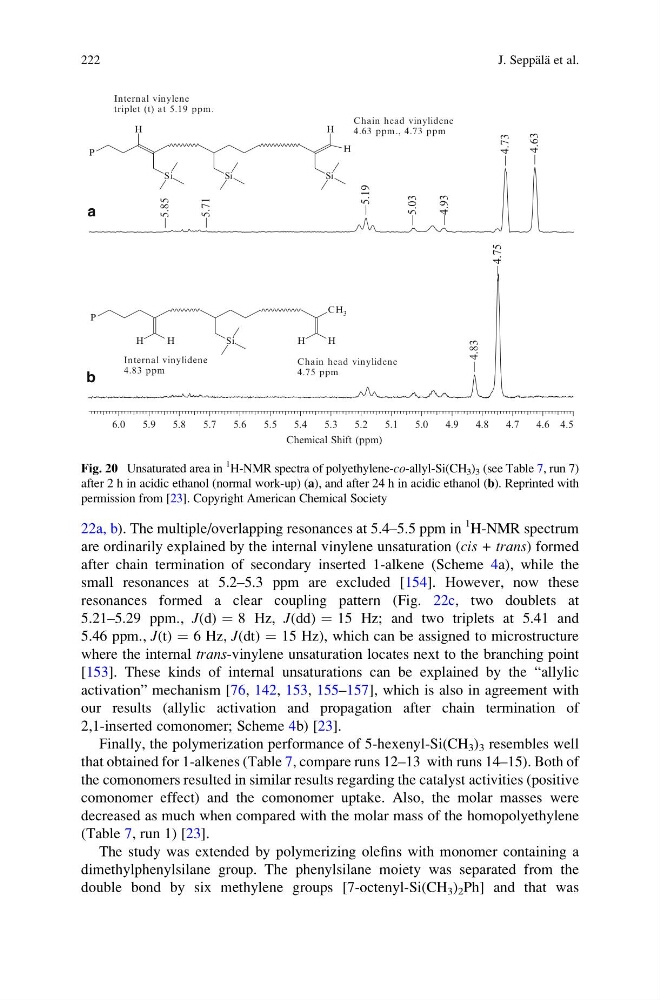
Fig. 20 Unsaturated area in
1
H-NMR spectra of polyethylene-co-allyl-Si(CH 3 ) 3 (see Table 7, run 7)
after 2 h in acidic ethanol (normal work-up) (a), and after 24 h in acidic ethanol (b). Reprinted with
permission from [23]. Copyright American Chemical Society
222
J. Seppa ¨la ¨ et al.
1 H-NMR spectrum
are ordinarily explained by the internal vinylene unsaturation (cis + trans) formed
after chain termination of secondary inserted 1-alkene (Scheme 4a), while the
small resonances at 5.2–5.3 ppm are excluded [154]. However, now these
resonances formed a clear coupling pattern (Fig. 22c, two doublets at
5.21–5.29 ppm., J(d) ¼ 8 Hz, J(dd) ¼ 15 Hz; and two triplets at 5.41 and
5.46 ppm., J(t) ¼ 6 Hz, J(dt) ¼ 15 Hz), which can be assigned to microstructure
where the internal trans-vinylene unsaturation locates next to the branching point
[153]. These kinds of internal unsaturations can be explained by the “allylic
activation” mechanism [76, 142, 153, 155–157], which is also in agreement with
our results (allylic activation and propagation after chain termination of
2,1-inserted comonomer; Scheme 4b) [23].
Finally, the polymerization performance of 5-hexenyl-Si(CH 3 ) 3 resembles well
that obtained for 1-alkenes (Table 7, compare runs 12–13 with runs 14–15). Both of
the comonomers resulted in similar results regarding the catalyst activities (positive
comonomer effect) and the comonomer uptake. Also, the molar masses were
decreased as much when compared with the molar mass of the homopolyethylene
(Table 7, run 1) [23].
The study was extended by polymerizing olefins with monomer containing a
dimethylphenylsilane group. The phenylsilane moiety was separated from the
double bond by six methylene groups [7-octenyl-Si(CH 3 ) 2 Ph] and that was
5.85
5.71
5.19
5.03
4.93
4.73
4.63
Si
P
Si
Si
H
H
H
Internal vinylene
triplet (t) at 5.19 ppm.
Chain head vinylidene
4.63 ppm., 4.73 ppm
6.0
5.9
5.8
5.7
5.6
5.5
5.4
5.3
5.2
5.1
5.0
4.9
4.8
4.7
4.6 4.5
Chemical Shift (ppm)
4.83
4.75
P
Si
CH 3
H
H
H
H
Chain head vinylidene
4.75 ppm
Internal vinylidene
4.83 ppm
a
b
Fig. 20 Unsaturated area in
1
H-NMR spectra of polyethylene-co-allyl-Si(CH 3 ) 3 (see Table 7, run 7)
after 2 h in acidic ethanol (normal work-up) (a), and after 24 h in acidic ethanol (b). Reprinted with
permission from [23]. Copyright American Chemical Society
222
J. Seppa ¨la ¨ et al.