

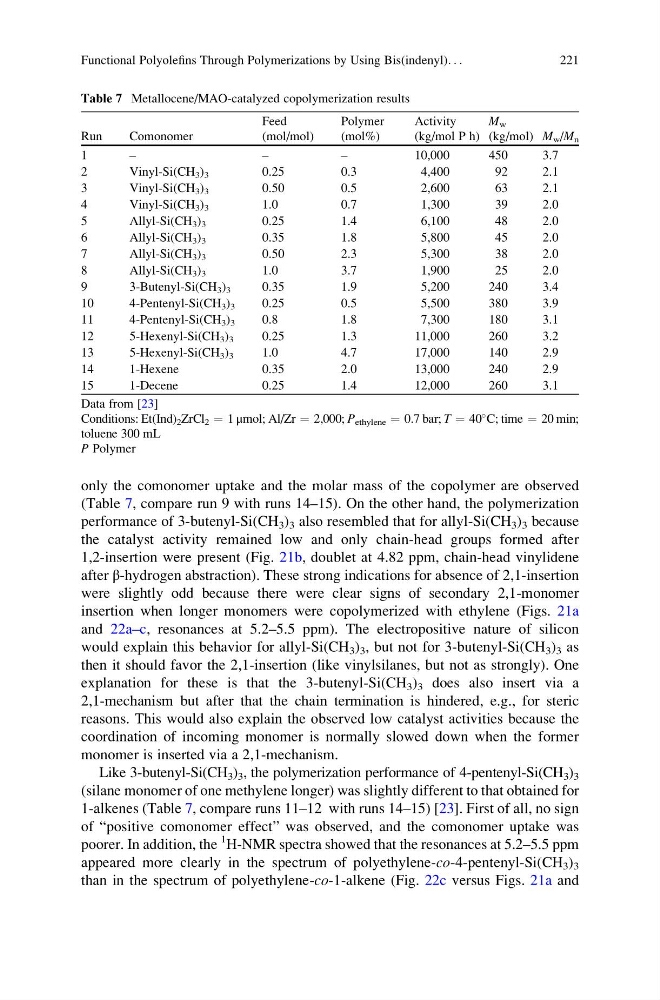
only the comonomer uptake and the molar mass of the copolymer are observed
(Table 7, compare run 9 with runs 14–15). On the other hand, the polymerization
performance of 3-butenyl-Si(CH 3 ) 3 also resembled that for allyl-Si(CH 3 ) 3 because
the catalyst activity remained low and only chain-head groups formed after
1,2-insertion were present (Fig. 21b, doublet at 4.82 ppm, chain-head vinylidene
after β-hydrogen abstraction). These strong indications for absence of 2,1-insertion
were slightly odd because there were clear signs of secondary 2,1-monomer
insertion when longer monomers were copolymerized with ethylene (Figs. 21a
and 22a–c, resonances at 5.2–5.5 ppm). The electropositive nature of silicon
would explain this behavior for allyl-Si(CH 3 ) 3 , but not for 3-butenyl-Si(CH 3 ) 3 as
then it should favor the 2,1-insertion (like vinylsilanes, but not as strongly). One
explanation for these is that the 3-butenyl-Si(CH 3 ) 3 does also insert via a
2,1-mechanism but after that the chain termination is hindered, e.g., for steric
reasons. This would also explain the observed low catalyst activities because the
coordination of incoming monomer is normally slowed down when the former
monomer is inserted via a 2,1-mechanism.
Like 3-butenyl-Si(CH 3 ) 3 , the polymerization performance of 4-pentenyl-Si(CH 3 ) 3
(silane monomer of one methylene longer) was slightly different to that obtained for
1-alkenes (Table 7, compare runs 11–12 with runs 14–15) [23]. First of all, no sign
of “positive comonomer effect” was observed, and the comonomer uptake was
poorer. In addition, the
1 H-NMR spectra showed that the resonances at 5.2–5.5 ppm
appeared more clearly in the spectrum of polyethylene-co-4-pentenyl-Si(CH 3 ) 3
than in the spectrum of polyethylene-co-1-alkene (Fig. 22c versus Figs. 21a and
Table 7 Metallocene/MAO-catalyzed copolymerization results
Run
Comonomer
Feed
(mol/mol)
Polymer
(mol%)
Activity
(kg/mol P h)
M w
(kg/mol) M w /M n
1
–
–
–
10,000
450
3.7
2
Vinyl-Si(CH 3 ) 3
0.25
0.3
4,400
92
2.1
3
Vinyl-Si(CH 3 ) 3
0.50
0.5
2,600
63
2.1
4
Vinyl-Si(CH 3 ) 3
1.0
0.7
1,300
39
2.0
5
Allyl-Si(CH 3 ) 3
0.25
1.4
6,100
48
2.0
6
Allyl-Si(CH 3 ) 3
0.35
1.8
5,800
45
2.0
7
Allyl-Si(CH 3 ) 3
0.50
2.3
5,300
38
2.0
8
Allyl-Si(CH 3 ) 3
1.0
3.7
1,900
25
2.0
9
3-Butenyl-Si(CH 3 ) 3
0.35
1.9
5,200
240
3.4
10
4-Pentenyl-Si(CH 3 ) 3
0.25
0.5
5,500
380
3.9
11
4-Pentenyl-Si(CH 3 ) 3
0.8
1.8
7,300
180
3.1
12
5-Hexenyl-Si(CH 3 ) 3
0.25
1.3
11,000
260
3.2
13
5-Hexenyl-Si(CH 3 ) 3
1.0
4.7
17,000
140
2.9
14
1-Hexene
0.35
2.0
13,000
240
2.9
15
1-Decene
0.25
1.4
12,000
260
3.1
Data from [23]
Conditions: Et(Ind) 2 ZrCl 2 ¼ 1 μmol; Al/Zr ¼ 2,000; P ethylene ¼ 0.7 bar; T ¼ 40
C; time ¼ 20 min;
toluene 300 mL
P Polymer
Functional Polyolefins Through Polymerizations by Using Bis(indenyl). . .
221
(Table 7, compare run 9 with runs 14–15). On the other hand, the polymerization
performance of 3-butenyl-Si(CH 3 ) 3 also resembled that for allyl-Si(CH 3 ) 3 because
the catalyst activity remained low and only chain-head groups formed after
1,2-insertion were present (Fig. 21b, doublet at 4.82 ppm, chain-head vinylidene
after β-hydrogen abstraction). These strong indications for absence of 2,1-insertion
were slightly odd because there were clear signs of secondary 2,1-monomer
insertion when longer monomers were copolymerized with ethylene (Figs. 21a
and 22a–c, resonances at 5.2–5.5 ppm). The electropositive nature of silicon
would explain this behavior for allyl-Si(CH 3 ) 3 , but not for 3-butenyl-Si(CH 3 ) 3 as
then it should favor the 2,1-insertion (like vinylsilanes, but not as strongly). One
explanation for these is that the 3-butenyl-Si(CH 3 ) 3 does also insert via a
2,1-mechanism but after that the chain termination is hindered, e.g., for steric
reasons. This would also explain the observed low catalyst activities because the
coordination of incoming monomer is normally slowed down when the former
monomer is inserted via a 2,1-mechanism.
Like 3-butenyl-Si(CH 3 ) 3 , the polymerization performance of 4-pentenyl-Si(CH 3 ) 3
(silane monomer of one methylene longer) was slightly different to that obtained for
1-alkenes (Table 7, compare runs 11–12 with runs 14–15) [23]. First of all, no sign
of “positive comonomer effect” was observed, and the comonomer uptake was
poorer. In addition, the
1 H-NMR spectra showed that the resonances at 5.2–5.5 ppm
appeared more clearly in the spectrum of polyethylene-co-4-pentenyl-Si(CH 3 ) 3
than in the spectrum of polyethylene-co-1-alkene (Fig. 22c versus Figs. 21a and
Table 7 Metallocene/MAO-catalyzed copolymerization results
Run
Comonomer
Feed
(mol/mol)
Polymer
(mol%)
Activity
(kg/mol P h)
M w
(kg/mol) M w /M n
1
–
–
–
10,000
450
3.7
2
Vinyl-Si(CH 3 ) 3
0.25
0.3
4,400
92
2.1
3
Vinyl-Si(CH 3 ) 3
0.50
0.5
2,600
63
2.1
4
Vinyl-Si(CH 3 ) 3
1.0
0.7
1,300
39
2.0
5
Allyl-Si(CH 3 ) 3
0.25
1.4
6,100
48
2.0
6
Allyl-Si(CH 3 ) 3
0.35
1.8
5,800
45
2.0
7
Allyl-Si(CH 3 ) 3
0.50
2.3
5,300
38
2.0
8
Allyl-Si(CH 3 ) 3
1.0
3.7
1,900
25
2.0
9
3-Butenyl-Si(CH 3 ) 3
0.35
1.9
5,200
240
3.4
10
4-Pentenyl-Si(CH 3 ) 3
0.25
0.5
5,500
380
3.9
11
4-Pentenyl-Si(CH 3 ) 3
0.8
1.8
7,300
180
3.1
12
5-Hexenyl-Si(CH 3 ) 3
0.25
1.3
11,000
260
3.2
13
5-Hexenyl-Si(CH 3 ) 3
1.0
4.7
17,000
140
2.9
14
1-Hexene
0.35
2.0
13,000
240
2.9
15
1-Decene
0.25
1.4
12,000
260
3.1
Data from [23]
Conditions: Et(Ind) 2 ZrCl 2 ¼ 1 μmol; Al/Zr ¼ 2,000; P ethylene ¼ 0.7 bar; T ¼ 40
C; time ¼ 20 min;
toluene 300 mL
P Polymer
Functional Polyolefins Through Polymerizations by Using Bis(indenyl). . .
221