

decreased catalyst activity (Table 7, compare run 1 with runs 2–4). The strong
presence of secondary insertion was confirmed by
1 H-NMR analysis, which
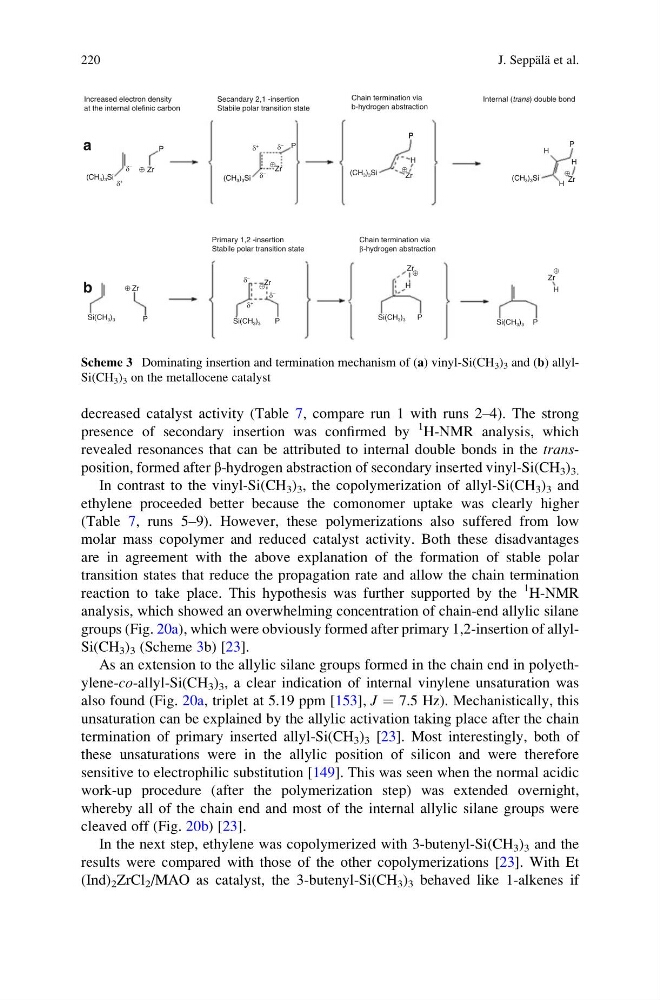
revealed resonances that can be attributed to internal double bonds in the transposition, formed after β-hydrogen abstraction of secondary inserted vinyl-Si(CH 3 ) 3.
In contrast to the vinyl-Si(CH 3 ) 3 , the copolymerization of allyl-Si(CH 3 ) 3 and
ethylene proceeded better because the comonomer uptake was clearly higher
(Table 7, runs 5–9). However, these polymerizations also suffered from low
molar mass copolymer and reduced catalyst activity. Both these disadvantages
are in agreement with the above explanation of the formation of stable polar
transition states that reduce the propagation rate and allow the chain termination
reaction to take place. This hypothesis was further supported by the
1 H-NMR
analysis, which showed an overwhelming concentration of chain-end allylic silane
groups (Fig. 20a), which were obviously formed after primary 1,2-insertion of allylSi(CH 3 ) 3 (Scheme 3b) [23].
As an extension to the allylic silane groups formed in the chain end in polyethylene-co-allyl-Si(CH 3 ) 3 , a clear indication of internal vinylene unsaturation was
also found (Fig. 20a, triplet at 5.19 ppm [153], J ¼ 7.5 Hz). Mechanistically, this
unsaturation can be explained by the allylic activation taking place after the chain
termination of primary inserted allyl-Si(CH 3 ) 3 [23]. Most interestingly, both of
these unsaturations were in the allylic position of silicon and were therefore
sensitive to electrophilic substitution [149]. This was seen when the normal acidic
work-up procedure (after the polymerization step) was extended overnight,
whereby all of the chain end and most of the internal allylic silane groups were
cleaved off (Fig. 20b) [23].
In the next step, ethylene was copolymerized with 3-butenyl-Si(CH 3 ) 3 and the
results were compared with those of the other copolymerizations [23]. With Et
(Ind) 2 ZrCl 2 /MAO as catalyst, the 3-butenyl-Si(CH 3 ) 3 behaved like 1-alkenes if
Increased electron density
at the internal olefinic carbon
Secandary 2,1 -insertion
Stabile polar transition state
Chain termination via
b-hydrogen abstraction
Internal (trans) double bond
(CH3)3Si
Si(CH3)3
(CH3)3Si
Si(CH3)3
Si(CH3)3
Si(CH3)3
(CH3)3Si
(CH3)3Si
δ +
δ +
δ +
δ –
δ –
δ –
δ –
δ –
⊕
⊕
⊕
⊕
⊕
⊕
⊕
⊕
Zr
Zr
Zr
Zr
Zr
Zr
Zr
Zr
P
P
P
P
P P
P
H
H
H
P
P
H
H
H
Primary 1,2 -insertion
Stabile polar transition state
Chain termination via
β-hydrogen abstraction
a
b
Scheme 3 Dominating insertion and termination mechanism of (a) vinyl-Si(CH 3 ) 3 and (b) allylSi(CH 3 ) 3 on the metallocene catalyst
220
J. Seppa ¨la ¨ et al.
presence of secondary insertion was confirmed by
1 H-NMR analysis, which
revealed resonances that can be attributed to internal double bonds in the transposition, formed after β-hydrogen abstraction of secondary inserted vinyl-Si(CH 3 ) 3.
In contrast to the vinyl-Si(CH 3 ) 3 , the copolymerization of allyl-Si(CH 3 ) 3 and
ethylene proceeded better because the comonomer uptake was clearly higher
(Table 7, runs 5–9). However, these polymerizations also suffered from low
molar mass copolymer and reduced catalyst activity. Both these disadvantages
are in agreement with the above explanation of the formation of stable polar
transition states that reduce the propagation rate and allow the chain termination
reaction to take place. This hypothesis was further supported by the
1 H-NMR
analysis, which showed an overwhelming concentration of chain-end allylic silane
groups (Fig. 20a), which were obviously formed after primary 1,2-insertion of allylSi(CH 3 ) 3 (Scheme 3b) [23].
As an extension to the allylic silane groups formed in the chain end in polyethylene-co-allyl-Si(CH 3 ) 3 , a clear indication of internal vinylene unsaturation was
also found (Fig. 20a, triplet at 5.19 ppm [153], J ¼ 7.5 Hz). Mechanistically, this
unsaturation can be explained by the allylic activation taking place after the chain
termination of primary inserted allyl-Si(CH 3 ) 3 [23]. Most interestingly, both of
these unsaturations were in the allylic position of silicon and were therefore
sensitive to electrophilic substitution [149]. This was seen when the normal acidic
work-up procedure (after the polymerization step) was extended overnight,
whereby all of the chain end and most of the internal allylic silane groups were
cleaved off (Fig. 20b) [23].
In the next step, ethylene was copolymerized with 3-butenyl-Si(CH 3 ) 3 and the
results were compared with those of the other copolymerizations [23]. With Et
(Ind) 2 ZrCl 2 /MAO as catalyst, the 3-butenyl-Si(CH 3 ) 3 behaved like 1-alkenes if
Increased electron density
at the internal olefinic carbon
Secandary 2,1 -insertion
Stabile polar transition state
Chain termination via
b-hydrogen abstraction
Internal (trans) double bond
(CH3)3Si
Si(CH3)3
(CH3)3Si
Si(CH3)3
Si(CH3)3
Si(CH3)3
(CH3)3Si
(CH3)3Si
δ +
δ +
δ +
δ –
δ –
δ –
δ –
δ –
⊕
⊕
⊕
⊕
⊕
⊕
⊕
⊕
Zr
Zr
Zr
Zr
Zr
Zr
Zr
Zr
P
P
P
P
P P
P
H
H
H
P
P
H
H
H
Primary 1,2 -insertion
Stabile polar transition state
Chain termination via
β-hydrogen abstraction
a
b
Scheme 3 Dominating insertion and termination mechanism of (a) vinyl-Si(CH 3 ) 3 and (b) allylSi(CH 3 ) 3 on the metallocene catalyst
220
J. Seppa ¨la ¨ et al.