

The melting points of the propylene homopolymers synthesized by zirconocene
catalysts rac-Et(Ind) 2 ZrCl 2 and rac-Me 2 Si(2-MeInd) 2 ZrCl 2 were 138
C and
148
C, respectively. In the case of amide 23, a 12
lowering of the melting point
(T m ) was obtained with incorporation of 1 mol% comonomer. All copolymers
exhibited just one melting transition, which once again is an indication of homogeneous structure.
4.2 Polymerization of Weakly Interacting Comonomers
The metallocene-catalyzed polymerizations of Lewis acidic monomers normally
proceed well if the electronic influence of the heteroatom (B, Si, Al) is diminished
by a long spacer. However, when the heteroatom locates in the vicinity of the
double bond, its behavior at the metallocene cation is altered. This was clearly seen
in the studies of Guram et al. [147, 148], where the vinyl-Si(CH 3 ) 3 was found to
coordinate with the cationic metallocene strongly via a secondary 2,1-insertion
mechanism. This was explained as being due to the electropositive nature of silicon,
which drives the electron density at the internal olefinic carbon and therefore favors
the 2,1-insertion (Scheme 3a) [147, 148]. In contrast to vinyl-Si(CH 3 ) 3 , allyl-Si(CH 3 ) 3
was found to coordinate with the metallocene catalyst via the primary 1,2-insertion
mechanism [147]. The behavior of allylsilanes was rationalized on the basis of the
formed polar transition state (Scheme 3b), which was stabilized by the β-effect of
silicon [149]. This was also the reason for the promoted β-hydrogen abstraction after
allylsilane insertions in the studies of Guram [148], Byun [150], Brandow [151], and
Casey [152].
In our studies [23], ethylene was copolymerized with vinyl-Si(CH 3 ) 3 using Et
(Ind) 2 ZrCl 2 /MAO catalyst, and the influence of the 2,1-insertion in the polymerization performance was seen in the weak comonomer uptake, low molar mass, and
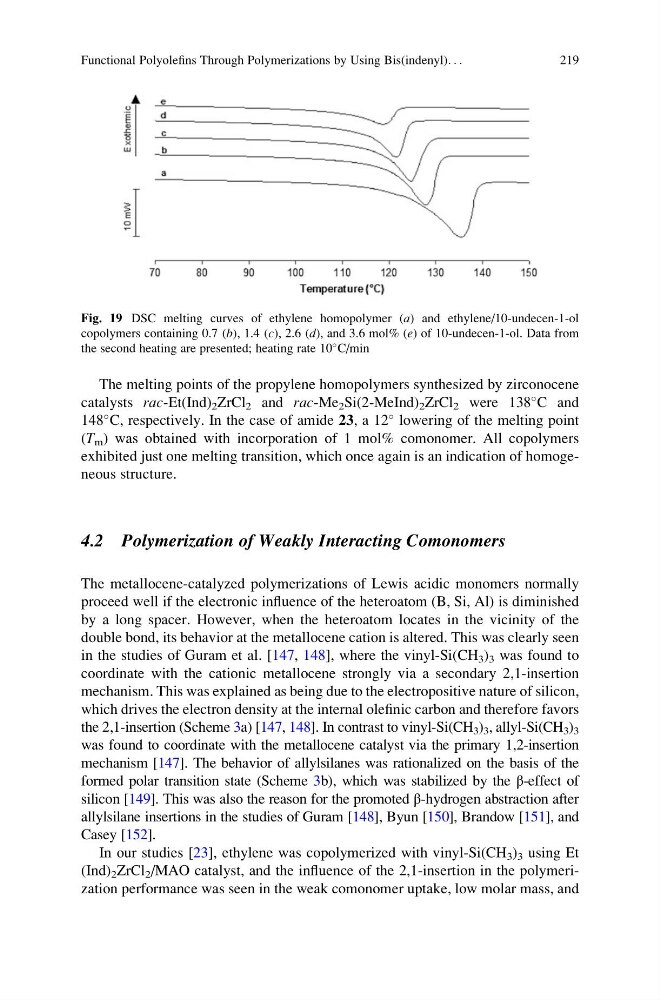
Fig. 19 DSC melting curves of ethylene homopolymer (a) and ethylene/10-undecen-1-ol
copolymers containing 0.7 (b), 1.4 (c), 2.6 (d), and 3.6 mol% (e) of 10-undecen-1-ol. Data from
the second heating are presented; heating rate 10
C/min
Functional Polyolefins Through Polymerizations by Using Bis(indenyl). . .
219
catalysts rac-Et(Ind) 2 ZrCl 2 and rac-Me 2 Si(2-MeInd) 2 ZrCl 2 were 138
C and
148
C, respectively. In the case of amide 23, a 12
lowering of the melting point
(T m ) was obtained with incorporation of 1 mol% comonomer. All copolymers
exhibited just one melting transition, which once again is an indication of homogeneous structure.
4.2 Polymerization of Weakly Interacting Comonomers
The metallocene-catalyzed polymerizations of Lewis acidic monomers normally
proceed well if the electronic influence of the heteroatom (B, Si, Al) is diminished
by a long spacer. However, when the heteroatom locates in the vicinity of the
double bond, its behavior at the metallocene cation is altered. This was clearly seen
in the studies of Guram et al. [147, 148], where the vinyl-Si(CH 3 ) 3 was found to
coordinate with the cationic metallocene strongly via a secondary 2,1-insertion
mechanism. This was explained as being due to the electropositive nature of silicon,
which drives the electron density at the internal olefinic carbon and therefore favors
the 2,1-insertion (Scheme 3a) [147, 148]. In contrast to vinyl-Si(CH 3 ) 3 , allyl-Si(CH 3 ) 3
was found to coordinate with the metallocene catalyst via the primary 1,2-insertion
mechanism [147]. The behavior of allylsilanes was rationalized on the basis of the
formed polar transition state (Scheme 3b), which was stabilized by the β-effect of
silicon [149]. This was also the reason for the promoted β-hydrogen abstraction after
allylsilane insertions in the studies of Guram [148], Byun [150], Brandow [151], and
Casey [152].
In our studies [23], ethylene was copolymerized with vinyl-Si(CH 3 ) 3 using Et
(Ind) 2 ZrCl 2 /MAO catalyst, and the influence of the 2,1-insertion in the polymerization performance was seen in the weak comonomer uptake, low molar mass, and
Fig. 19 DSC melting curves of ethylene homopolymer (a) and ethylene/10-undecen-1-ol
copolymers containing 0.7 (b), 1.4 (c), 2.6 (d), and 3.6 mol% (e) of 10-undecen-1-ol. Data from
the second heating are presented; heating rate 10
C/min
Functional Polyolefins Through Polymerizations by Using Bis(indenyl). . .
219