

low because the complexes that were used are not capable of forming high molarmass polypropylene.
As discussed above, NMR studies suggested that chain transfer to aluminum is
an important chain-transfer mechanism especially in the copolymerizations involving amides or amines as comonomers. A comparison with the nonfunctional
1-undecene also demonstrates that the functional comonomers have a greater effect
on the molar masses than do simple α-olefins [21]. In all cases, the molar mass
distributions remained narrow, as is typical for single-site catalysts. This finding is
contradictory to the results reported for ethylene-10-undecen-1-ol copolymerizations carried out with non-bridged zirconocene/MAO, where significant broadening of the molar mass distributions was observed [146]. The melting points of the
homopolyethylenes prepared with the metallocene catalyst rac-Et(Ind) 2 ZrCl 2 were
measured by differential scanning calorimetry (DSC) to be 135–137
C.
Incorporation of functional comonomer as side chains to the polyethylene chain
resulted in a decrease in the melting temperatures of the copolymer, as illustrated in
Fig. 19. The lower heat of fusion values with the increasing comonomer content
provide additional support for lowering of the polymer crystallinity due to side
chains. In a comparison with the nonfunctional comonomer 1-undecene [21], the
change in the melting point with functional comonomers was found to follow
approximately the same trend. This demonstrates that the incorporation of functional comonomers is random, and that the chain structure of the functionalized
copolymers is similar to that of ethylene-α-olefin copolymers prepared with singlesite catalysts.
65
60
55
50
45
40
35
30
25
20
15
ppm
N
O
30.5
27.3
34.6
38.2
34.6
27.3
30.5
34.6
27.3
30.5
29.6
25.9
33.6
41.4
41.4
14.2
14.2
32.2
22.9
14.1
33.9
HO
63.4
33.4
26.2
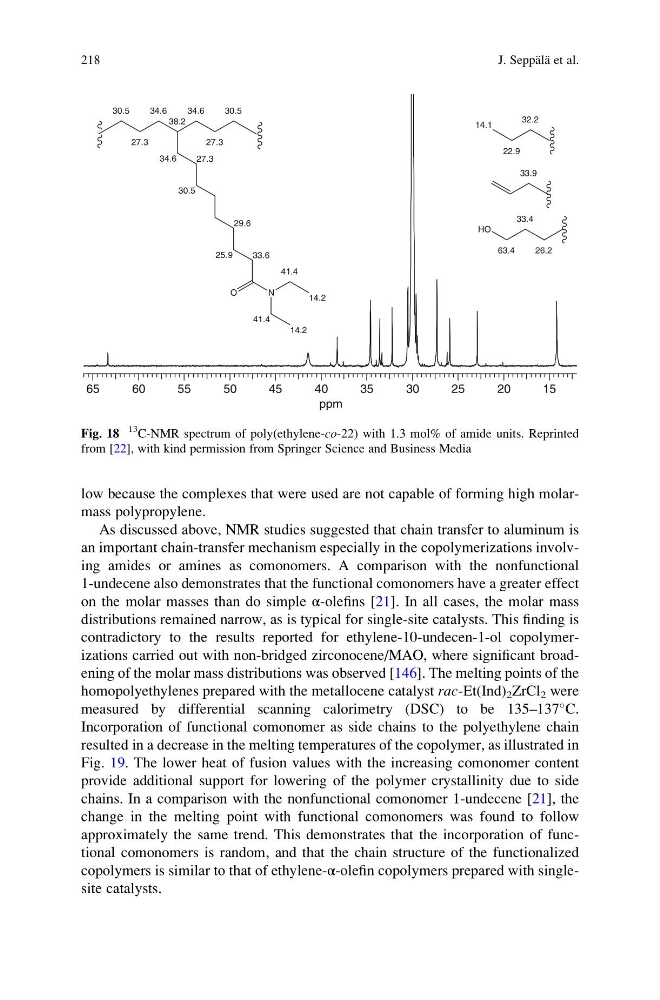
Fig. 18
13
C-NMR spectrum of poly(ethylene-co-22) with 1.3 mol% of amide units. Reprinted
from [22], with kind permission from Springer Science and Business Media
218
J. Seppa ¨la ¨ et al.
As discussed above, NMR studies suggested that chain transfer to aluminum is
an important chain-transfer mechanism especially in the copolymerizations involving amides or amines as comonomers. A comparison with the nonfunctional
1-undecene also demonstrates that the functional comonomers have a greater effect
on the molar masses than do simple α-olefins [21]. In all cases, the molar mass
distributions remained narrow, as is typical for single-site catalysts. This finding is
contradictory to the results reported for ethylene-10-undecen-1-ol copolymerizations carried out with non-bridged zirconocene/MAO, where significant broadening of the molar mass distributions was observed [146]. The melting points of the
homopolyethylenes prepared with the metallocene catalyst rac-Et(Ind) 2 ZrCl 2 were
measured by differential scanning calorimetry (DSC) to be 135–137
C.
Incorporation of functional comonomer as side chains to the polyethylene chain
resulted in a decrease in the melting temperatures of the copolymer, as illustrated in
Fig. 19. The lower heat of fusion values with the increasing comonomer content
provide additional support for lowering of the polymer crystallinity due to side
chains. In a comparison with the nonfunctional comonomer 1-undecene [21], the
change in the melting point with functional comonomers was found to follow
approximately the same trend. This demonstrates that the incorporation of functional comonomers is random, and that the chain structure of the functionalized
copolymers is similar to that of ethylene-α-olefin copolymers prepared with singlesite catalysts.
65
60
55
50
45
40
35
30
25
20
15
ppm
N
O
30.5
27.3
34.6
38.2
34.6
27.3
30.5
34.6
27.3
30.5
29.6
25.9
33.6
41.4
41.4
14.2
14.2
32.2
22.9
14.1
33.9
HO
63.4
33.4
26.2
Fig. 18
13
C-NMR spectrum of poly(ethylene-co-22) with 1.3 mol% of amide units. Reprinted
from [22], with kind permission from Springer Science and Business Media
218
J. Seppa ¨la ¨ et al.