

conformation. Non-chiral ansa metallocenes such as [(CH 3 ) 2 Si(Flu) 2 ]ZrCl 2 (see
Fig. 6) produce again atactic polypropylene. Detailed information on propene
polymerization by ansa metallocene catalysts can be found in the chapters by
Brintzinger and Fischer [87] and Razavi [88].
Surprisingly, it was also possible to homopolymerize cyclic olefins such as
cyclobutene, cyclopentene, and norbornene by metallocene/MAO catalysts to partially
crystalline materials and to copolymerize them with ethene [89]. We observed only
double bond opening by the homo- and copolymerization of cyclic olefins, in contrast
to Ziegler–Natta catalysts where ring and double bond opening occur simultaneously.
Poly(cyclopentene), synthesized by isotactically working metallocene catalysts are
crystalline, have a low solubility, and a melting temperature of about 395
C. The
unusual formation of 100% of 1,3-enchainments for poly(cyclopentene) was shown
by Collins [90]. The melting point of crystalline polynorbornene obtained by
metallocene/MAO catalysts is higher than the decomposition temperature of about
400
C. It is therefore difficult to process such a polymer [91].
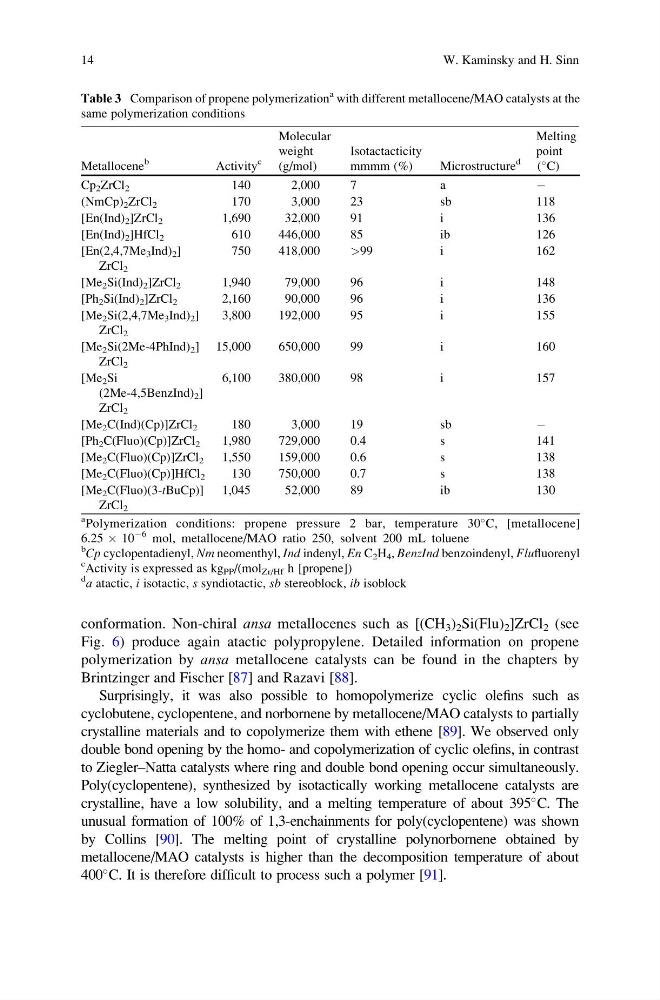
Table 3 Comparison of propene polymerization
a with different metallocene/MAO catalysts at the
same polymerization conditions
Metallocene
b
Activity
c
Molecular
weight
(g/mol)
Isotactacticity
mmmm (%)
Microstructure
d
Melting
point
(
C)
Cp 2 ZrCl 2
140
2,000
7
a
À
(NmCp) 2 ZrCl 2
170
3,000
23
sb
118
[En(Ind) 2 ]ZrCl 2
1,690
32,000
91
i
136
[En(Ind) 2 ]HfCl 2
610
446,000
85
ib
126
[En(2,4,7Me 3 Ind) 2 ]
ZrCl 2
750
418,000
>99
i
162
[Me 2 Si(Ind) 2 ]ZrCl 2
1,940
79,000
96
i
148
[Ph 2 Si(Ind) 2 ]ZrCl 2
2,160
90,000
96
i
136
[Me 2 Si(2,4,7Me 3 Ind) 2 ]
ZrCl 2
3,800
192,000
95
i
155
[Me 2 Si(2Me-4PhInd) 2 ]
ZrCl 2
15,000
650,000
99
i
160
[Me 2 Si
(2Me-4,5BenzInd) 2 ]
ZrCl 2
6,100
380,000
98
i
157
[Me 2 C(Ind)(Cp)]ZrCl 2
180
3,000
19
sb
À
[Ph 2 C(Fluo)(Cp)]ZrCl 2
1,980
729,000
0.4
s
141
[Me 2 C(Fluo)(Cp)]ZrCl 2 1,550
159,000
0.6
s
138
[Me 2 C(Fluo)(Cp)]HfCl 2
130
750,000
0.7
s
138
[Me 2 C(Fluo)(3-tBuCp)]
ZrCl 2
1,045
52,000
89
ib
130
a Polymerization conditions: propene pressure 2 bar, temperature 30
C, [metallocene]
6.25 Â 10
À6 mol, metallocene/MAO ratio 250, solvent 200 mL toluene
b
Cp cyclopentadienyl, Nm neomenthyl, Ind indenyl, En C 2 H 4 , BenzInd benzoindenyl, Flufluorenyl
c
Activity is expressed as kg PP /(mol Zr/Hf h [propene])
d
a atactic, i isotactic, s syndiotactic, sb stereoblock, ib isoblock
14
W. Kaminsky and H. Sinn
Fig. 6) produce again atactic polypropylene. Detailed information on propene
polymerization by ansa metallocene catalysts can be found in the chapters by
Brintzinger and Fischer [87] and Razavi [88].
Surprisingly, it was also possible to homopolymerize cyclic olefins such as
cyclobutene, cyclopentene, and norbornene by metallocene/MAO catalysts to partially
crystalline materials and to copolymerize them with ethene [89]. We observed only
double bond opening by the homo- and copolymerization of cyclic olefins, in contrast
to Ziegler–Natta catalysts where ring and double bond opening occur simultaneously.
Poly(cyclopentene), synthesized by isotactically working metallocene catalysts are
crystalline, have a low solubility, and a melting temperature of about 395
C. The
unusual formation of 100% of 1,3-enchainments for poly(cyclopentene) was shown
by Collins [90]. The melting point of crystalline polynorbornene obtained by
metallocene/MAO catalysts is higher than the decomposition temperature of about
400
C. It is therefore difficult to process such a polymer [91].
Table 3 Comparison of propene polymerization
a with different metallocene/MAO catalysts at the
same polymerization conditions
Metallocene
b
Activity
c
Molecular
weight
(g/mol)
Isotactacticity
mmmm (%)
Microstructure
d
Melting
point
(
C)
Cp 2 ZrCl 2
140
2,000
7
a
À
(NmCp) 2 ZrCl 2
170
3,000
23
sb
118
[En(Ind) 2 ]ZrCl 2
1,690
32,000
91
i
136
[En(Ind) 2 ]HfCl 2
610
446,000
85
ib
126
[En(2,4,7Me 3 Ind) 2 ]
ZrCl 2
750
418,000
>99
i
162
[Me 2 Si(Ind) 2 ]ZrCl 2
1,940
79,000
96
i
148
[Ph 2 Si(Ind) 2 ]ZrCl 2
2,160
90,000
96
i
136
[Me 2 Si(2,4,7Me 3 Ind) 2 ]
ZrCl 2
3,800
192,000
95
i
155
[Me 2 Si(2Me-4PhInd) 2 ]
ZrCl 2
15,000
650,000
99
i
160
[Me 2 Si
(2Me-4,5BenzInd) 2 ]
ZrCl 2
6,100
380,000
98
i
157
[Me 2 C(Ind)(Cp)]ZrCl 2
180
3,000
19
sb
À
[Ph 2 C(Fluo)(Cp)]ZrCl 2
1,980
729,000
0.4
s
141
[Me 2 C(Fluo)(Cp)]ZrCl 2 1,550
159,000
0.6
s
138
[Me 2 C(Fluo)(Cp)]HfCl 2
130
750,000
0.7
s
138
[Me 2 C(Fluo)(3-tBuCp)]
ZrCl 2
1,045
52,000
89
ib
130
a Polymerization conditions: propene pressure 2 bar, temperature 30
C, [metallocene]
6.25 Â 10
À6 mol, metallocene/MAO ratio 250, solvent 200 mL toluene
b
Cp cyclopentadienyl, Nm neomenthyl, Ind indenyl, En C 2 H 4 , BenzInd benzoindenyl, Flufluorenyl
c
Activity is expressed as kg PP /(mol Zr/Hf h [propene])
d
a atactic, i isotactic, s syndiotactic, sb stereoblock, ib isoblock
14
W. Kaminsky and H. Sinn