

gives atactic polypropylene by a much slower polymerization rate. Stereo-errors in
the polypropylene chain produced especially by [En(Ind) 2 ]HfCl 2 /MAO are randomly distributed along the polymer chain, whereas in polypropylene made with
Ziegler–Natta catalysts the errors are concentrated at chain ends and in oligomers.
Researchers of the Hoechst company later optimized the structure of ansa
zirconocene complexes by using different bridges and substituents at the indenyl
rings, such as [Me 2 Si(2Me-4PhInd) 2 ]ZrCl 2 or [(CH 3 ) 2 Si(2-CH 3 -4-Naph-Ind) 2 ] ZrCl 2
(structure shown in Fig. 6) [84]. They were able to obtain iPP with an activity of
15,000 kg PP /mol Zr h, a molecular weight of 650,000 g/mol, an isotacticity of 99%,
and a melting point of 160
C. At a polymerization temperature of 70
C in liquid
propene, the activity can reach 875,000 kg PP /mol Zr h.
In 1987, Ewen, Jones, and Razavi [85] obtained pure syndiotactic polypropylene
using a C s -symmetric [Me 2 C(Flu)(Cp)]ZrCl 2 complex with a bridged cyclopentadienyl and a fluorenyl ring. This metallocene offers two different bonding
positions for the inserted propylene and forms an alternating polypropylene structure. Higher activities are obtained if a [Ph 2 C(Cp)(Flu)]ZrCl 2 /MAO catalyst is used
with phenyl groups in the bridge (see Fig. 6 and Table 3).
Table 3 compares the activities of the propene polymerization by different
metallocene/MAO catalysts, the molecular weights, the isotacticities calculated
from the
13
C NMR-measured mesopentades (mmmm), the microstructures, and the
melting points of the obtained polypropylenes. The activities vary between 130 and
15,000 kg PP /mol Zr h at 30
C and the molecular weights between 2,000 and
750,000 g/mol. Bridged bisindenyl zirconocenes are more active than hafnocenes.
The highest isotacticity of 99% was obtained using [En(2,4,7-Me 3 Ind) 2 ]ZrCl 2 as
catalyst component. Unsubstituted bisindenyl-zirconocenes such as [En(Ind) 2 ]ZrCl 2
or [Me 2 Si(Ind) 2 ]ZrCl 2 produce polypropylenes with melting points below 160
C
because there are stereo-errors along the polymer chain. One propene unit is inserted
in a wrong position and the others have the same stereo-position. This metallocene
iso-block polypropylene (see Fig. 6) is characterized by a higher film transparency
because the crystal size is in the nanoscale.
We discovered that unbridged biscyclopentadienyl zirconocenes with bulky
substitutions such as neomentyl produce syndioblock polypropylenes with elastic
properties [86]. Such a bulky ligand could stabilize an asymmetric (chiral) active
site for a short time. During this time, some propene units could be inserted with the
same stereospecificity, forming an isotactic block, followed by a change in
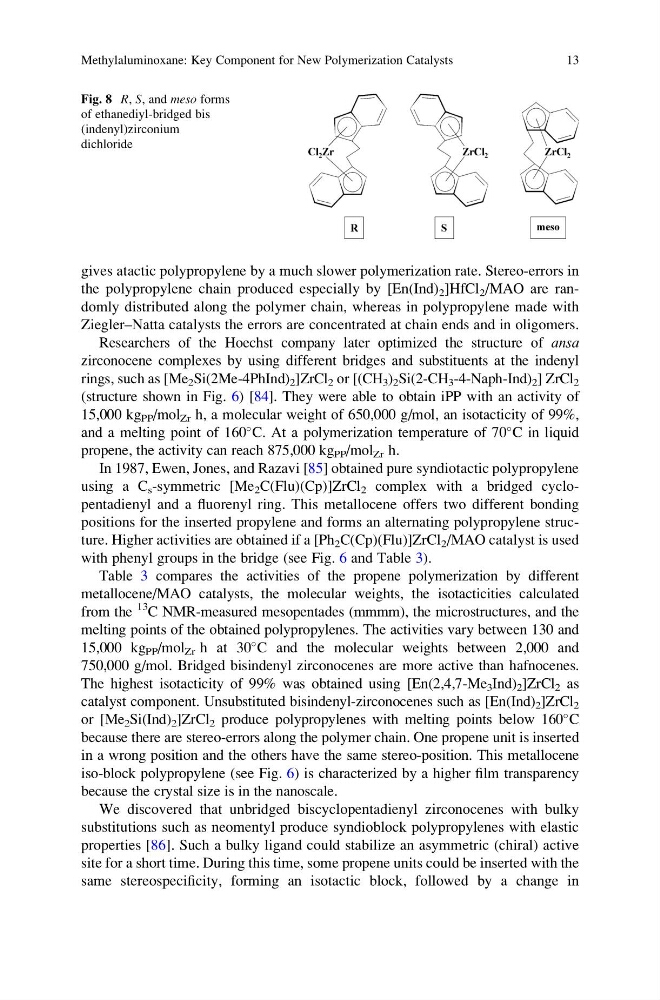
Fig. 8 R, S, and meso forms
of ethanediyl-bridged bis
(indenyl)zirconium
dichloride
Methylaluminoxane: Key Component for New Polymerization Catalysts
13
the polypropylene chain produced especially by [En(Ind) 2 ]HfCl 2 /MAO are randomly distributed along the polymer chain, whereas in polypropylene made with
Ziegler–Natta catalysts the errors are concentrated at chain ends and in oligomers.
Researchers of the Hoechst company later optimized the structure of ansa
zirconocene complexes by using different bridges and substituents at the indenyl
rings, such as [Me 2 Si(2Me-4PhInd) 2 ]ZrCl 2 or [(CH 3 ) 2 Si(2-CH 3 -4-Naph-Ind) 2 ] ZrCl 2
(structure shown in Fig. 6) [84]. They were able to obtain iPP with an activity of
15,000 kg PP /mol Zr h, a molecular weight of 650,000 g/mol, an isotacticity of 99%,
and a melting point of 160
C. At a polymerization temperature of 70
C in liquid
propene, the activity can reach 875,000 kg PP /mol Zr h.
In 1987, Ewen, Jones, and Razavi [85] obtained pure syndiotactic polypropylene
using a C s -symmetric [Me 2 C(Flu)(Cp)]ZrCl 2 complex with a bridged cyclopentadienyl and a fluorenyl ring. This metallocene offers two different bonding
positions for the inserted propylene and forms an alternating polypropylene structure. Higher activities are obtained if a [Ph 2 C(Cp)(Flu)]ZrCl 2 /MAO catalyst is used
with phenyl groups in the bridge (see Fig. 6 and Table 3).
Table 3 compares the activities of the propene polymerization by different
metallocene/MAO catalysts, the molecular weights, the isotacticities calculated
from the
13
C NMR-measured mesopentades (mmmm), the microstructures, and the
melting points of the obtained polypropylenes. The activities vary between 130 and
15,000 kg PP /mol Zr h at 30
C and the molecular weights between 2,000 and
750,000 g/mol. Bridged bisindenyl zirconocenes are more active than hafnocenes.
The highest isotacticity of 99% was obtained using [En(2,4,7-Me 3 Ind) 2 ]ZrCl 2 as
catalyst component. Unsubstituted bisindenyl-zirconocenes such as [En(Ind) 2 ]ZrCl 2
or [Me 2 Si(Ind) 2 ]ZrCl 2 produce polypropylenes with melting points below 160
C
because there are stereo-errors along the polymer chain. One propene unit is inserted
in a wrong position and the others have the same stereo-position. This metallocene
iso-block polypropylene (see Fig. 6) is characterized by a higher film transparency
because the crystal size is in the nanoscale.
We discovered that unbridged biscyclopentadienyl zirconocenes with bulky
substitutions such as neomentyl produce syndioblock polypropylenes with elastic
properties [86]. Such a bulky ligand could stabilize an asymmetric (chiral) active
site for a short time. During this time, some propene units could be inserted with the
same stereospecificity, forming an isotactic block, followed by a change in
Fig. 8 R, S, and meso forms
of ethanediyl-bridged bis
(indenyl)zirconium
dichloride
Methylaluminoxane: Key Component for New Polymerization Catalysts
13