

heterogeneous catalyst is formed by adding the metallocene and then the same
technical process as for heterogeneous Ziegler–Natta catalysts can be used (dropin technology) [79]. By this procedure, a better particle morphology control is
possible and there is less reactor walling. Another advantage is that the ratio
MAO/metallocene can be decreased to a ratio Al(MAO)/Zr ¼ 100. On the other
hand, the activity decreases to about half that of the homogeneous system.
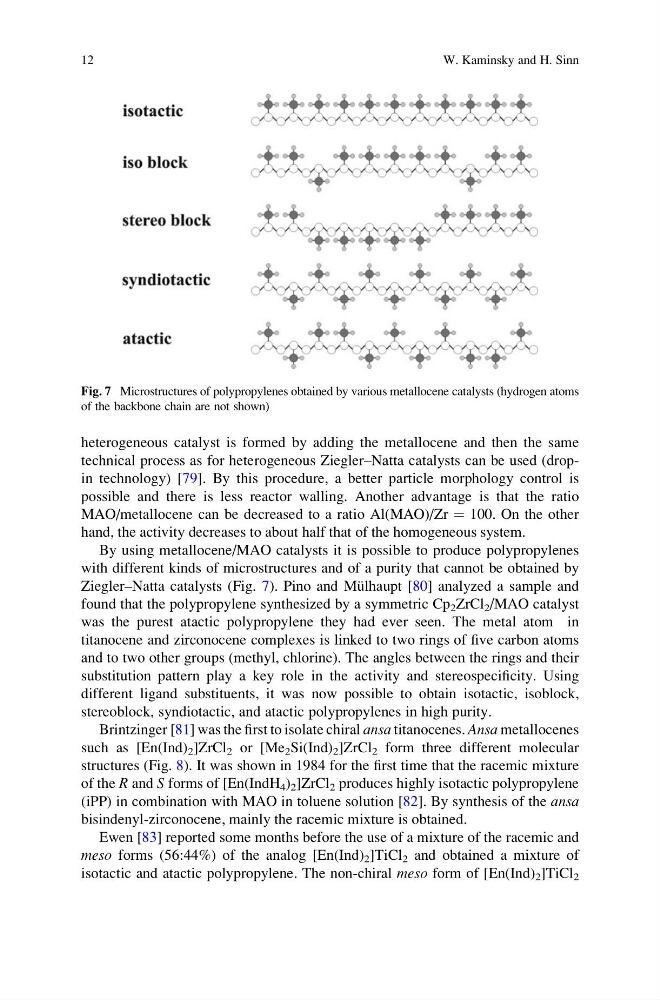
By using metallocene/MAO catalysts it is possible to produce polypropylenes
with different kinds of microstructures and of a purity that cannot be obtained by
Ziegler–Natta catalysts (Fig. 7). Pino and Mu ¨lhaupt [80] analyzed a sample and
found that the polypropylene synthesized by a symmetric Cp 2 ZrCl 2 /MAO catalyst
was the purest atactic polypropylene they had ever seen. The metal atom in
titanocene and zirconocene complexes is linked to two rings of five carbon atoms
and to two other groups (methyl, chlorine). The angles between the rings and their
substitution pattern play a key role in the activity and stereospecificity. Using
different ligand substituents, it was now possible to obtain isotactic, isoblock,
stereoblock, syndiotactic, and atactic polypropylenes in high purity.
Brintzinger [81] was the first to isolate chiral ansa titanocenes. Ansa metallocenes
such as [En(Ind) 2 ]ZrCl 2 or [Me 2 Si(Ind) 2 ]ZrCl 2 form three different molecular
structures (Fig. 8). It was shown in 1984 for the first time that the racemic mixture
of the R and S forms of [En(IndH 4 ) 2 ]ZrCl 2 produces highly isotactic polypropylene
(iPP) in combination with MAO in toluene solution [82]. By synthesis of the ansa
bisindenyl-zirconocene, mainly the racemic mixture is obtained.
Ewen [83] reported some months before the use of a mixture of the racemic and
meso forms (56:44%) of the analog [En(Ind) 2 ]TiCl 2 and obtained a mixture of
isotactic and atactic polypropylene. The non-chiral meso form of [En(Ind) 2 ]TiCl 2
Fig. 7 Microstructures of polypropylenes obtained by various metallocene catalysts (hydrogen atoms
of the backbone chain are not shown)
12
W. Kaminsky and H. Sinn
technical process as for heterogeneous Ziegler–Natta catalysts can be used (dropin technology) [79]. By this procedure, a better particle morphology control is
possible and there is less reactor walling. Another advantage is that the ratio
MAO/metallocene can be decreased to a ratio Al(MAO)/Zr ¼ 100. On the other
hand, the activity decreases to about half that of the homogeneous system.
By using metallocene/MAO catalysts it is possible to produce polypropylenes
with different kinds of microstructures and of a purity that cannot be obtained by
Ziegler–Natta catalysts (Fig. 7). Pino and Mu ¨lhaupt [80] analyzed a sample and
found that the polypropylene synthesized by a symmetric Cp 2 ZrCl 2 /MAO catalyst
was the purest atactic polypropylene they had ever seen. The metal atom in
titanocene and zirconocene complexes is linked to two rings of five carbon atoms
and to two other groups (methyl, chlorine). The angles between the rings and their
substitution pattern play a key role in the activity and stereospecificity. Using
different ligand substituents, it was now possible to obtain isotactic, isoblock,
stereoblock, syndiotactic, and atactic polypropylenes in high purity.
Brintzinger [81] was the first to isolate chiral ansa titanocenes. Ansa metallocenes
such as [En(Ind) 2 ]ZrCl 2 or [Me 2 Si(Ind) 2 ]ZrCl 2 form three different molecular
structures (Fig. 8). It was shown in 1984 for the first time that the racemic mixture
of the R and S forms of [En(IndH 4 ) 2 ]ZrCl 2 produces highly isotactic polypropylene
(iPP) in combination with MAO in toluene solution [82]. By synthesis of the ansa
bisindenyl-zirconocene, mainly the racemic mixture is obtained.
Ewen [83] reported some months before the use of a mixture of the racemic and
meso forms (56:44%) of the analog [En(Ind) 2 ]TiCl 2 and obtained a mixture of
isotactic and atactic polypropylene. The non-chiral meso form of [En(Ind) 2 ]TiCl 2
Fig. 7 Microstructures of polypropylenes obtained by various metallocene catalysts (hydrogen atoms
of the backbone chain are not shown)
12
W. Kaminsky and H. Sinn