

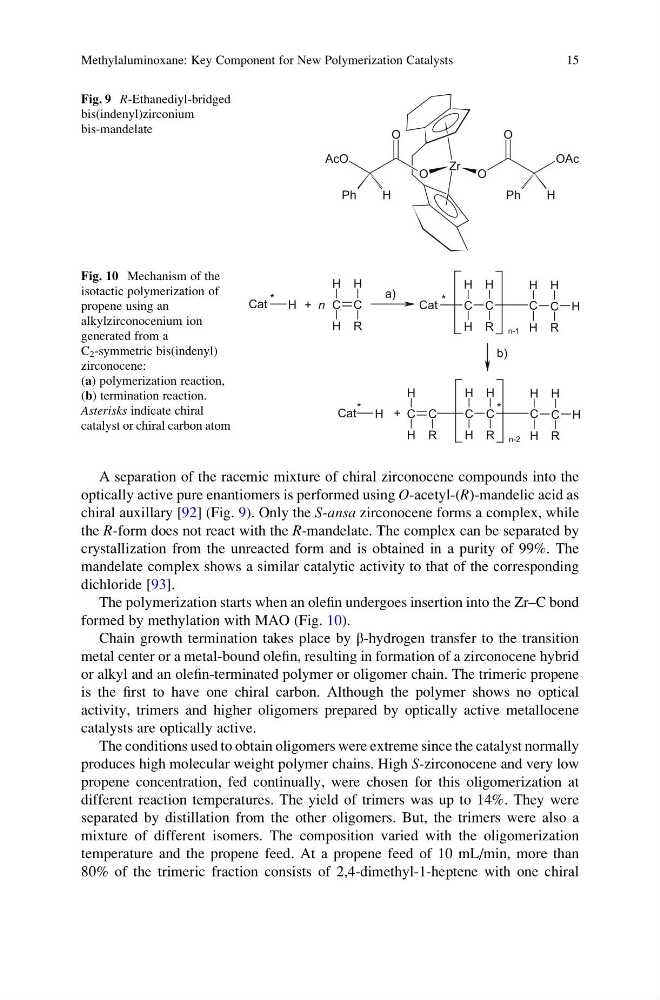
A separation of the racemic mixture of chiral zirconocene compounds into the
optically active pure enantiomers is performed using O-acetyl-(R)-mandelic acid as
chiral auxillary [92] (Fig. 9). Only the S-ansa zirconocene forms a complex, while
the R-form does not react with the R-mandelate. The complex can be separated by
crystallization from the unreacted form and is obtained in a purity of 99%. The
mandelate complex shows a similar catalytic activity to that of the corresponding
dichloride [93].
The polymerization starts when an olefin undergoes insertion into the Zr–C bond
formed by methylation with MAO (Fig. 10).
Chain growth termination takes place by β-hydrogen transfer to the transition
metal center or a metal-bound olefin, resulting in formation of a zirconocene hybrid
or alkyl and an olefin-terminated polymer or oligomer chain. The trimeric propene
is the first to have one chiral carbon. Although the polymer shows no optical
activity, trimers and higher oligomers prepared by optically active metallocene
catalysts are optically active.
The conditions used to obtain oligomers were extreme since the catalyst normally
produces high molecular weight polymer chains. High S-zirconocene and very low
propene concentration, fed continually, were chosen for this oligomerization at
different reaction temperatures. The yield of trimers was up to 14%. They were
separated by distillation from the other oligomers. But, the trimers were also a
mixture of different isomers. The composition varied with the oligomerization
temperature and the propene feed. At a propene feed of 10 mL/min, more than
80% of the trimeric fraction consists of 2,4-dimethyl-1-heptene with one chiral
Zr O
O
O
OAc
H
Ph
O
AcO
H
Ph
Fig. 9 R-Ethanediyl-bridged
bis(indenyl)zirconium
bis-mandelate
b)
C C
H H
H R
C C
H H
H R
C C
H H
H R
H
H
Cat *
+ n
a)
Cat
n-1
*
C C
H H
H R
C C
H H
H R
H
C C
H
H R
H
Cat *
n-2
+
*
Fig. 10 Mechanism of the
isotactic polymerization of
propene using an
alkylzirconocenium ion
generated from a
C 2 -symmetric bis(indenyl)
zirconocene:
(a) polymerization reaction,
(b) termination reaction.
Asterisks indicate chiral
catalyst or chiral carbon atom
Methylaluminoxane: Key Component for New Polymerization Catalysts
15
optically active pure enantiomers is performed using O-acetyl-(R)-mandelic acid as
chiral auxillary [92] (Fig. 9). Only the S-ansa zirconocene forms a complex, while
the R-form does not react with the R-mandelate. The complex can be separated by
crystallization from the unreacted form and is obtained in a purity of 99%. The
mandelate complex shows a similar catalytic activity to that of the corresponding
dichloride [93].
The polymerization starts when an olefin undergoes insertion into the Zr–C bond
formed by methylation with MAO (Fig. 10).
Chain growth termination takes place by β-hydrogen transfer to the transition
metal center or a metal-bound olefin, resulting in formation of a zirconocene hybrid
or alkyl and an olefin-terminated polymer or oligomer chain. The trimeric propene
is the first to have one chiral carbon. Although the polymer shows no optical
activity, trimers and higher oligomers prepared by optically active metallocene
catalysts are optically active.
The conditions used to obtain oligomers were extreme since the catalyst normally
produces high molecular weight polymer chains. High S-zirconocene and very low
propene concentration, fed continually, were chosen for this oligomerization at
different reaction temperatures. The yield of trimers was up to 14%. They were
separated by distillation from the other oligomers. But, the trimers were also a
mixture of different isomers. The composition varied with the oligomerization
temperature and the propene feed. At a propene feed of 10 mL/min, more than
80% of the trimeric fraction consists of 2,4-dimethyl-1-heptene with one chiral
Zr O
O
O
OAc
H
Ph
O
AcO
H
Ph
Fig. 9 R-Ethanediyl-bridged
bis(indenyl)zirconium
bis-mandelate
b)
C C
H H
H R
C C
H H
H R
C C
H H
H R
H
H
Cat *
+ n
a)
Cat
n-1
*
C C
H H
H R
C C
H H
H R
H
C C
H
H R
H
Cat *
n-2
+
*
Fig. 10 Mechanism of the
isotactic polymerization of
propene using an
alkylzirconocenium ion
generated from a
C 2 -symmetric bis(indenyl)
zirconocene:
(a) polymerization reaction,
(b) termination reaction.
Asterisks indicate chiral
catalyst or chiral carbon atom
Methylaluminoxane: Key Component for New Polymerization Catalysts
15