

have a tendency to form slightly alternating structures because of the lower relative
reactivity of the bulkier comonomer at the comonomer propagating end [142]. The
NMR and FTIR investigations revealed that in most cases the functional group in
the copolymer was the same as that in the comonomer before polymerization. An
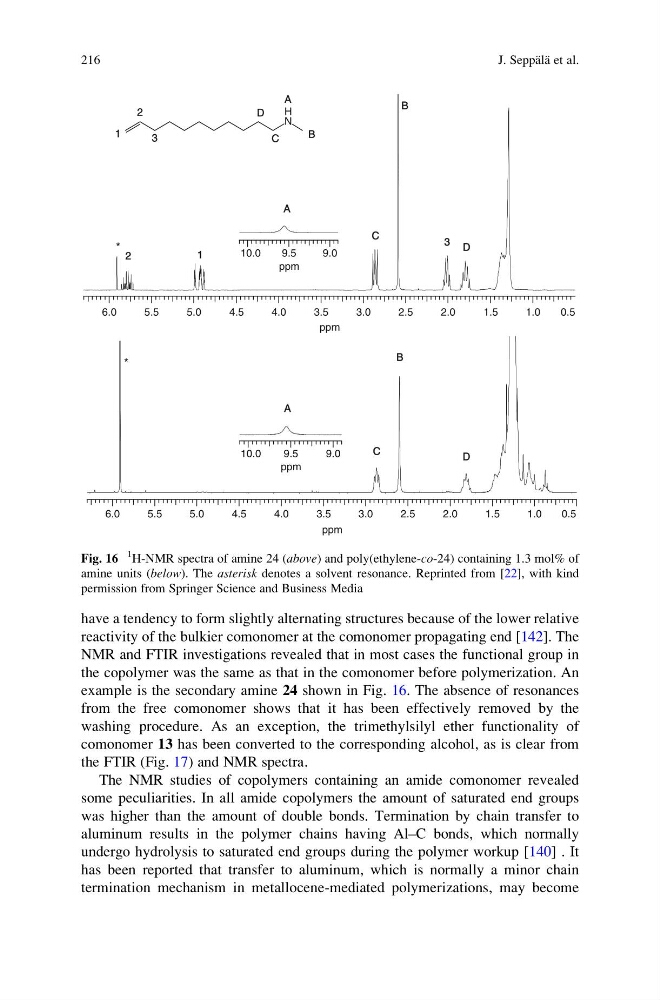
example is the secondary amine 24 shown in Fig. 16. The absence of resonances
from the free comonomer shows that it has been effectively removed by the
washing procedure. As an exception, the trimethylsilyl ether functionality of
comonomer 13 has been converted to the corresponding alcohol, as is clear from
the FTIR (Fig. 17) and NMR spectra.
The NMR studies of copolymers containing an amide comonomer revealed
some peculiarities. In all amide copolymers the amount of saturated end groups
was higher than the amount of double bonds. Termination by chain transfer to
aluminum results in the polymer chains having Al–C bonds, which normally
undergo hydrolysis to saturated end groups during the polymer workup [140] . It
has been reported that transfer to aluminum, which is normally a minor chain
termination mechanism in metallocene-mediated polymerizations, may become
6.0
5.5
5.0
4.5
4.0
3.5
3.0
2.5
2.0
1.5
1.0
0.5
ppm
10.0
9.5
9.0
ppm
H
N
1
2
3
A
D
C
B
1
2
3
C
D
A
B
*
6.0
5.5
5.0
4.5
4.0
3.5
3.0
2.5
2.0
1.5
1.0
0.5
ppm
10.0
9.5
9.0
ppm
A
B
C
D
*
Fig. 16
1 H-NMR spectra of amine 24 (above) and poly(ethylene-co-24) containing 1.3 mol% of
amine units (below). The asterisk denotes a solvent resonance. Reprinted from [22], with kind
permission from Springer Science and Business Media
216
J. Seppa ¨la ¨ et al.
reactivity of the bulkier comonomer at the comonomer propagating end [142]. The
NMR and FTIR investigations revealed that in most cases the functional group in
the copolymer was the same as that in the comonomer before polymerization. An
example is the secondary amine 24 shown in Fig. 16. The absence of resonances
from the free comonomer shows that it has been effectively removed by the
washing procedure. As an exception, the trimethylsilyl ether functionality of
comonomer 13 has been converted to the corresponding alcohol, as is clear from
the FTIR (Fig. 17) and NMR spectra.
The NMR studies of copolymers containing an amide comonomer revealed
some peculiarities. In all amide copolymers the amount of saturated end groups
was higher than the amount of double bonds. Termination by chain transfer to
aluminum results in the polymer chains having Al–C bonds, which normally
undergo hydrolysis to saturated end groups during the polymer workup [140] . It
has been reported that transfer to aluminum, which is normally a minor chain
termination mechanism in metallocene-mediated polymerizations, may become
6.0
5.5
5.0
4.5
4.0
3.5
3.0
2.5
2.0
1.5
1.0
0.5
ppm
10.0
9.5
9.0
ppm
H
N
1
2
3
A
D
C
B
1
2
3
C
D
A
B
*
6.0
5.5
5.0
4.5
4.0
3.5
3.0
2.5
2.0
1.5
1.0
0.5
ppm
10.0
9.5
9.0
ppm
A
B
C
D
*
Fig. 16
1 H-NMR spectra of amine 24 (above) and poly(ethylene-co-24) containing 1.3 mol% of
amine units (below). The asterisk denotes a solvent resonance. Reprinted from [22], with kind
permission from Springer Science and Business Media
216
J. Seppa ¨la ¨ et al.