

the increased bulkiness around nitrogen was found slightly to favor the catalyst
activity.
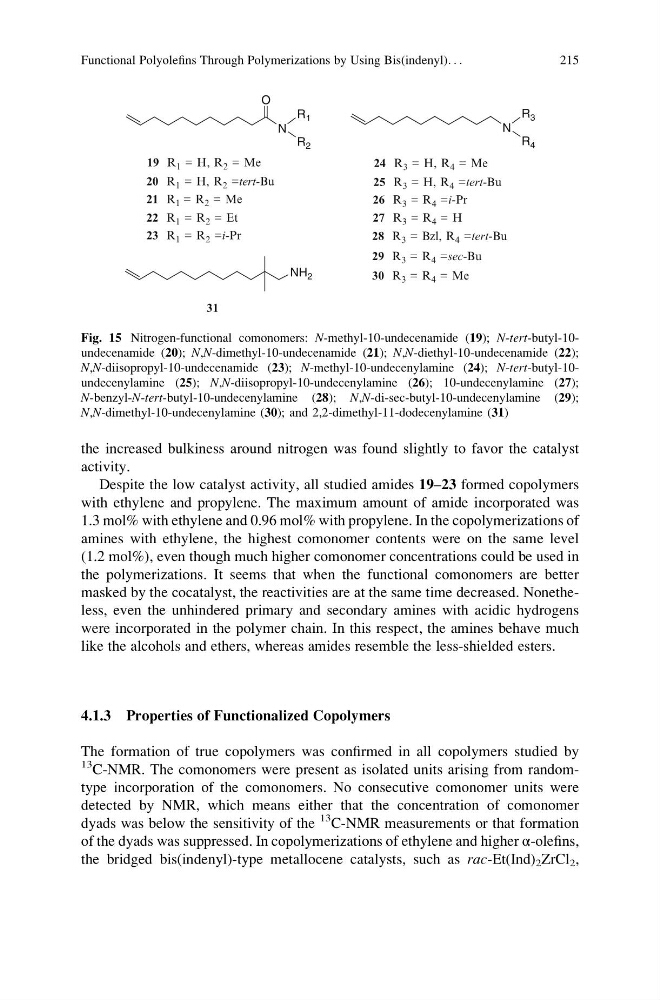
Despite the low catalyst activity, all studied amides 19–23 formed copolymers
with ethylene and propylene. The maximum amount of amide incorporated was
1.3 mol% with ethylene and 0.96 mol% with propylene. In the copolymerizations of
amines with ethylene, the highest comonomer contents were on the same level
(1.2 mol%), even though much higher comonomer concentrations could be used in
the polymerizations. It seems that when the functional comonomers are better
masked by the cocatalyst, the reactivities are at the same time decreased. Nonetheless, even the unhindered primary and secondary amines with acidic hydrogens
were incorporated in the polymer chain. In this respect, the amines behave much
like the alcohols and ethers, whereas amides resemble the less-shielded esters.
4.1.3 Properties of Functionalized Copolymers
The formation of true copolymers was confirmed in all copolymers studied by
13 C-NMR. The comonomers were present as isolated units arising from randomtype incorporation of the comonomers. No consecutive comonomer units were
detected by NMR, which means either that the concentration of comonomer
dyads was below the sensitivity of the
13 C-NMR measurements or that formation
of the dyads was suppressed. In copolymerizations of ethylene and higher α-olefins,
the bridged bis(indenyl)-type metallocene catalysts, such as rac-Et(Ind) 2 ZrCl 2 ,
NH 2
N
O
R 1
R 2
N
R 3
R 4
31
19 R 1 = H, R 2 = Me
20 R 1 = H, R 2 =tert-Bu
21 R 1 = R 2 = Me
22 R 1 = R 2 = Et
23 R 1 = R 2 =i-Pr
24 R 3 = H, R 4 = Me
25 R 3 = H, R 4 =tert-Bu
26 R 3 = R 4 =i-Pr
27 R 3 = R 4 = H
28 R 3 = Bzl, R 4 =tert-Bu
29 R 3 = R 4 =sec-Bu
30 R 3 = R 4 = Me
Fig. 15 Nitrogen-functional comonomers: N-methyl-10-undecenamide (19); N-tert-butyl-10undecenamide (20); N,N-dimethyl-10-undecenamide (21); N,N-diethyl-10-undecenamide (22);
N,N-diisopropyl-10-undecenamide (23); N-methyl-10-undecenylamine (24); N-tert-butyl-10undecenylamine (25); N,N-diisopropyl-10-undecenylamine (26); 10-undecenylamine (27);
N-benzyl-N-tert-butyl-10-undecenylamine (28); N,N-di-sec-butyl-10-undecenylamine (29);
N,N-dimethyl-10-undecenylamine (30); and 2,2-dimethyl-11-dodecenylamine (31)
Functional Polyolefins Through Polymerizations by Using Bis(indenyl). . .
215
activity.
Despite the low catalyst activity, all studied amides 19–23 formed copolymers
with ethylene and propylene. The maximum amount of amide incorporated was
1.3 mol% with ethylene and 0.96 mol% with propylene. In the copolymerizations of
amines with ethylene, the highest comonomer contents were on the same level
(1.2 mol%), even though much higher comonomer concentrations could be used in
the polymerizations. It seems that when the functional comonomers are better
masked by the cocatalyst, the reactivities are at the same time decreased. Nonetheless, even the unhindered primary and secondary amines with acidic hydrogens
were incorporated in the polymer chain. In this respect, the amines behave much
like the alcohols and ethers, whereas amides resemble the less-shielded esters.
4.1.3 Properties of Functionalized Copolymers
The formation of true copolymers was confirmed in all copolymers studied by
13 C-NMR. The comonomers were present as isolated units arising from randomtype incorporation of the comonomers. No consecutive comonomer units were
detected by NMR, which means either that the concentration of comonomer
dyads was below the sensitivity of the
13 C-NMR measurements or that formation
of the dyads was suppressed. In copolymerizations of ethylene and higher α-olefins,
the bridged bis(indenyl)-type metallocene catalysts, such as rac-Et(Ind) 2 ZrCl 2 ,
NH 2
N
O
R 1
R 2
N
R 3
R 4
31
19 R 1 = H, R 2 = Me
20 R 1 = H, R 2 =tert-Bu
21 R 1 = R 2 = Me
22 R 1 = R 2 = Et
23 R 1 = R 2 =i-Pr
24 R 3 = H, R 4 = Me
25 R 3 = H, R 4 =tert-Bu
26 R 3 = R 4 =i-Pr
27 R 3 = R 4 = H
28 R 3 = Bzl, R 4 =tert-Bu
29 R 3 = R 4 =sec-Bu
30 R 3 = R 4 = Me
Fig. 15 Nitrogen-functional comonomers: N-methyl-10-undecenamide (19); N-tert-butyl-10undecenamide (20); N,N-dimethyl-10-undecenamide (21); N,N-diethyl-10-undecenamide (22);
N,N-diisopropyl-10-undecenamide (23); N-methyl-10-undecenylamine (24); N-tert-butyl-10undecenylamine (25); N,N-diisopropyl-10-undecenylamine (26); 10-undecenylamine (27);
N-benzyl-N-tert-butyl-10-undecenylamine (28); N,N-di-sec-butyl-10-undecenylamine (29);
N,N-dimethyl-10-undecenylamine (30); and 2,2-dimethyl-11-dodecenylamine (31)
Functional Polyolefins Through Polymerizations by Using Bis(indenyl). . .
215