

continually to increase towards the low stress values, with strong strain hardening
character.
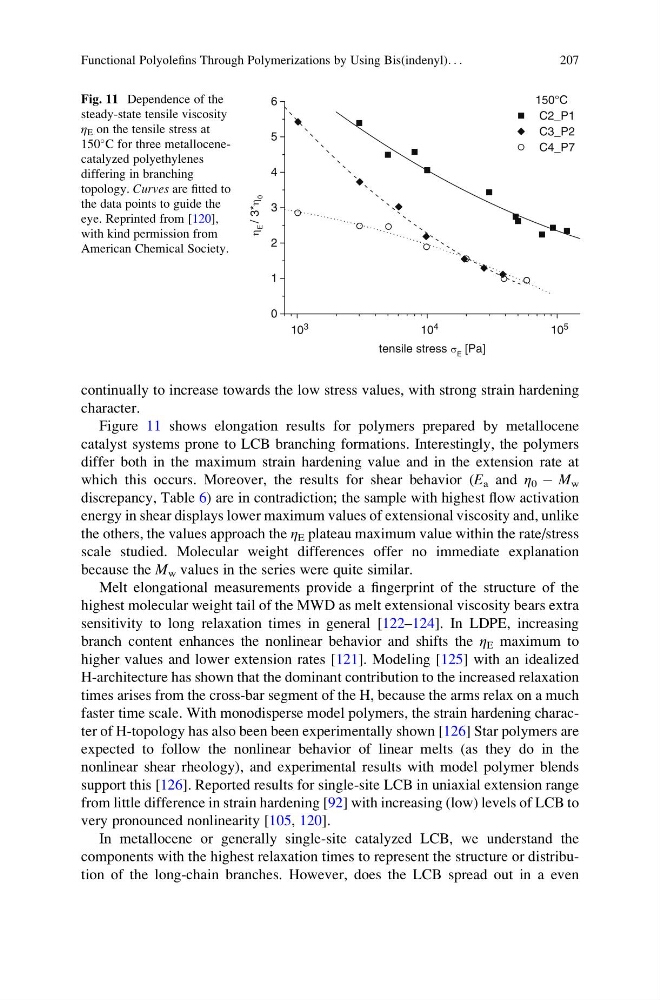
Figure 11 shows elongation results for polymers prepared by metallocene
catalyst systems prone to LCB branching formations. Interestingly, the polymers
differ both in the maximum strain hardening value and in the extension rate at
which this occurs. Moreover, the results for shear behavior (E a and η 0 À M w
discrepancy, Table 6) are in contradiction; the sample with highest flow activation
energy in shear displays lower maximum values of extensional viscosity and, unlike
the others, the values approach the η E plateau maximum value within the rate/stress
scale studied. Molecular weight differences offer no immediate explanation
because the M w values in the series were quite similar.
Melt elongational measurements provide a fingerprint of the structure of the
highest molecular weight tail of the MWD as melt extensional viscosity bears extra
sensitivity to long relaxation times in general [122–124]. In LDPE, increasing
branch content enhances the nonlinear behavior and shifts the η E maximum to
higher values and lower extension rates [121]. Modeling [125] with an idealized
H-architecture has shown that the dominant contribution to the increased relaxation
times arises from the cross-bar segment of the H, because the arms relax on a much
faster time scale. With monodisperse model polymers, the strain hardening character of H-topology has also been been experimentally shown [126] Star polymers are
expected to follow the nonlinear behavior of linear melts (as they do in the
nonlinear shear rheology), and experimental results with model polymer blends
support this [126]. Reported results for single-site LCB in uniaxial extension range
from little difference in strain hardening [92] with increasing (low) levels of LCB to
very pronounced nonlinearity [105, 120].
In metallocene or generally single-site catalyzed LCB, we understand the
components with the highest relaxation times to represent the structure or distribution of the long-chain branches. However, does the LCB spread out in a even
10 3
10 4
10 5
0
1
2
3
4
5
6
150°C
C2_P1
C3_P2
C4_P7
η
E
/ 3*η
0
tensile stress σ E [Pa]
Fig. 11 Dependence of the
steady-state tensile viscosity
η E on the tensile stress at
150
C for three metallocenecatalyzed polyethylenes
differing in branching
topology. Curves are fitted to
the data points to guide the
eye. Reprinted from [120],
with kind permission from
American Chemical Society.
Functional Polyolefins Through Polymerizations by Using Bis(indenyl). . .
207
character.
Figure 11 shows elongation results for polymers prepared by metallocene
catalyst systems prone to LCB branching formations. Interestingly, the polymers
differ both in the maximum strain hardening value and in the extension rate at
which this occurs. Moreover, the results for shear behavior (E a and η 0 À M w
discrepancy, Table 6) are in contradiction; the sample with highest flow activation
energy in shear displays lower maximum values of extensional viscosity and, unlike
the others, the values approach the η E plateau maximum value within the rate/stress
scale studied. Molecular weight differences offer no immediate explanation
because the M w values in the series were quite similar.
Melt elongational measurements provide a fingerprint of the structure of the
highest molecular weight tail of the MWD as melt extensional viscosity bears extra
sensitivity to long relaxation times in general [122–124]. In LDPE, increasing
branch content enhances the nonlinear behavior and shifts the η E maximum to
higher values and lower extension rates [121]. Modeling [125] with an idealized
H-architecture has shown that the dominant contribution to the increased relaxation
times arises from the cross-bar segment of the H, because the arms relax on a much
faster time scale. With monodisperse model polymers, the strain hardening character of H-topology has also been been experimentally shown [126] Star polymers are
expected to follow the nonlinear behavior of linear melts (as they do in the
nonlinear shear rheology), and experimental results with model polymer blends
support this [126]. Reported results for single-site LCB in uniaxial extension range
from little difference in strain hardening [92] with increasing (low) levels of LCB to
very pronounced nonlinearity [105, 120].
In metallocene or generally single-site catalyzed LCB, we understand the
components with the highest relaxation times to represent the structure or distribution of the long-chain branches. However, does the LCB spread out in a even
10 3
10 4
10 5
0
1
2
3
4
5
6
150°C
C2_P1
C3_P2
C4_P7
η
E
/ 3*η
0
tensile stress σ E [Pa]
Fig. 11 Dependence of the
steady-state tensile viscosity
η E on the tensile stress at
150
C for three metallocenecatalyzed polyethylenes
differing in branching
topology. Curves are fitted to
the data points to guide the
eye. Reprinted from [120],
with kind permission from
American Chemical Society.
Functional Polyolefins Through Polymerizations by Using Bis(indenyl). . .
207