

Metallocene-catalyzed LCB polyethylene thus consists of a mixture of linear
and LCB chains, where the LCB structures make up only a small fraction of the
total number of chains. Assuming the different ability of catalysts to incorporate
vinyl-ended macromonomers in polymerization, it appears rational to expect
differences in the amount, but also in the distribution, of the long-chain branches.
Thereby, uneven LCB distribution (a few multiply branched chains versus several
with only one branch) would lead to species with even longer relaxation times,
which, even if present only in minor amounts, could be expected to alter the melt
flow behavior even more than a star-like branch would do. In addition to increased
LCB amount, multiple branched structures of high molar mass give a possible
explanation for a gelation-resembling rheological response like the ones shown in
Figs. 5 and 8.
Additional evidence on differences in distribution or structure of LCB was
gained from elongation rheological experiments. Uniaxial elongation studies in
the nonlinear range and low shear studies for polymers in the linear viscoelastic
(LVE)-regime arranged the polymers in a different order in terms of apparently
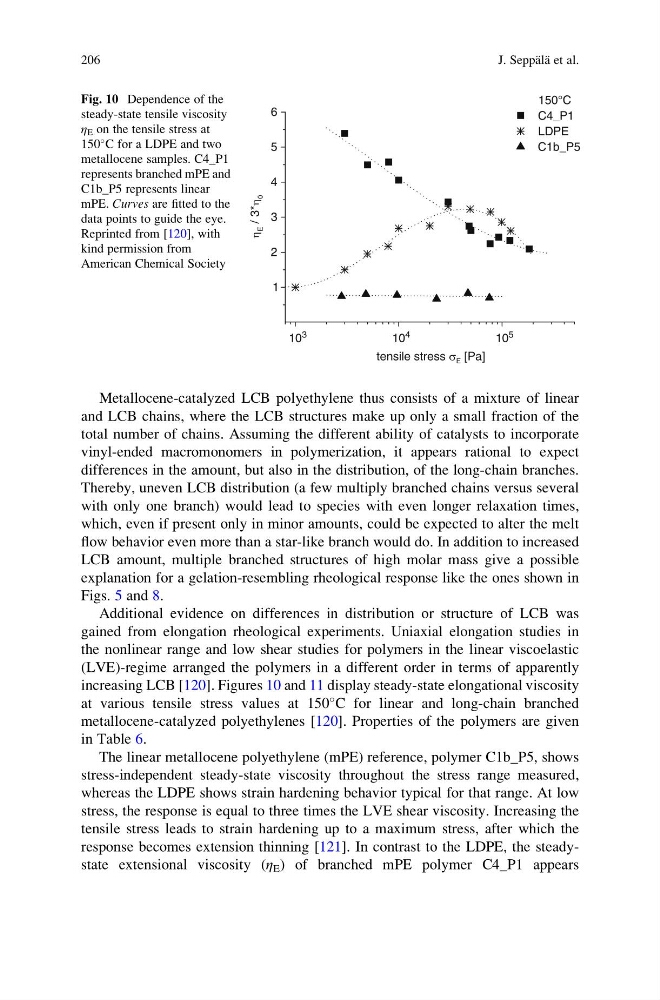
increasing LCB [120]. Figures 10 and 11 display steady-state elongational viscosity
at various tensile stress values at 150
C for linear and long-chain branched
metallocene-catalyzed polyethylenes [120]. Properties of the polymers are given
in Table 6.
The linear metallocene polyethylene (mPE) reference, polymer C1b_P5, shows
stress-independent steady-state viscosity throughout the stress range measured,
whereas the LDPE shows strain hardening behavior typical for that range. At low
stress, the response is equal to three times the LVE shear viscosity. Increasing the
tensile stress leads to strain hardening up to a maximum stress, after which the
response becomes extension thinning [121]. In contrast to the LDPE, the steadystate extensional viscosity (η E ) of branched mPE polymer C4_P1 appears
10 3
10 4
10 5
150°C
C4_P1
LDPE
C1b_P5
1
2
3
4
5
6
η
E
/ 3*η
0
tensile stress σ E [Pa]
Fig. 10 Dependence of the
steady-state tensile viscosity
η E on the tensile stress at
150
C for a LDPE and two
metallocene samples. C4_P1
represents branched mPE and
C1b_P5 represents linear
mPE. Curves are fitted to the
data points to guide the eye.
Reprinted from [120], with
kind permission from
American Chemical Society
206
J. Seppa ¨la ¨ et al.
and LCB chains, where the LCB structures make up only a small fraction of the
total number of chains. Assuming the different ability of catalysts to incorporate
vinyl-ended macromonomers in polymerization, it appears rational to expect
differences in the amount, but also in the distribution, of the long-chain branches.
Thereby, uneven LCB distribution (a few multiply branched chains versus several
with only one branch) would lead to species with even longer relaxation times,
which, even if present only in minor amounts, could be expected to alter the melt
flow behavior even more than a star-like branch would do. In addition to increased
LCB amount, multiple branched structures of high molar mass give a possible
explanation for a gelation-resembling rheological response like the ones shown in
Figs. 5 and 8.
Additional evidence on differences in distribution or structure of LCB was
gained from elongation rheological experiments. Uniaxial elongation studies in
the nonlinear range and low shear studies for polymers in the linear viscoelastic
(LVE)-regime arranged the polymers in a different order in terms of apparently
increasing LCB [120]. Figures 10 and 11 display steady-state elongational viscosity
at various tensile stress values at 150
C for linear and long-chain branched
metallocene-catalyzed polyethylenes [120]. Properties of the polymers are given
in Table 6.
The linear metallocene polyethylene (mPE) reference, polymer C1b_P5, shows
stress-independent steady-state viscosity throughout the stress range measured,
whereas the LDPE shows strain hardening behavior typical for that range. At low
stress, the response is equal to three times the LVE shear viscosity. Increasing the
tensile stress leads to strain hardening up to a maximum stress, after which the
response becomes extension thinning [121]. In contrast to the LDPE, the steadystate extensional viscosity (η E ) of branched mPE polymer C4_P1 appears
10 3
10 4
10 5
150°C
C4_P1
LDPE
C1b_P5
1
2
3
4
5
6
η
E
/ 3*η
0
tensile stress σ E [Pa]
Fig. 10 Dependence of the
steady-state tensile viscosity
η E on the tensile stress at
150
C for a LDPE and two
metallocene samples. C4_P1
represents branched mPE and
C1b_P5 represents linear
mPE. Curves are fitted to the
data points to guide the eye.
Reprinted from [120], with
kind permission from
American Chemical Society
206
J. Seppa ¨la ¨ et al.