

soluble in trichlorobenzene at 135
C, and crosslinking during measurements can be
out ruled because the thermal stability of the polymers was perfect). We attribute
this LCB enhancement effect by the 1-olefin comonomer to diffusion-controlled
polymerization, in which the mass and heat transfer properties in the polymerization system have been changed by introduction of the comonomer. It is interesting
to note that while these semi-batch polymerization experiments were run in pentane
medium, similar ethylene/1-hexene copolymerization experiments with same catalyst but toluene as the medium yielded polymers with rheologically linear
behavior [81].
3.4 Structure Considerations of the LCB
The branching mechanism for metallocene LCB shown in Scheme 1 suggests that
the length of each segment is up to half the length of a chain. In copolymerization of
vinyl-ended macromonomers with ethylene, assuming only one vinyl end per
molecule, trifunctional branch points are formed rather than crosslinks. Whereas
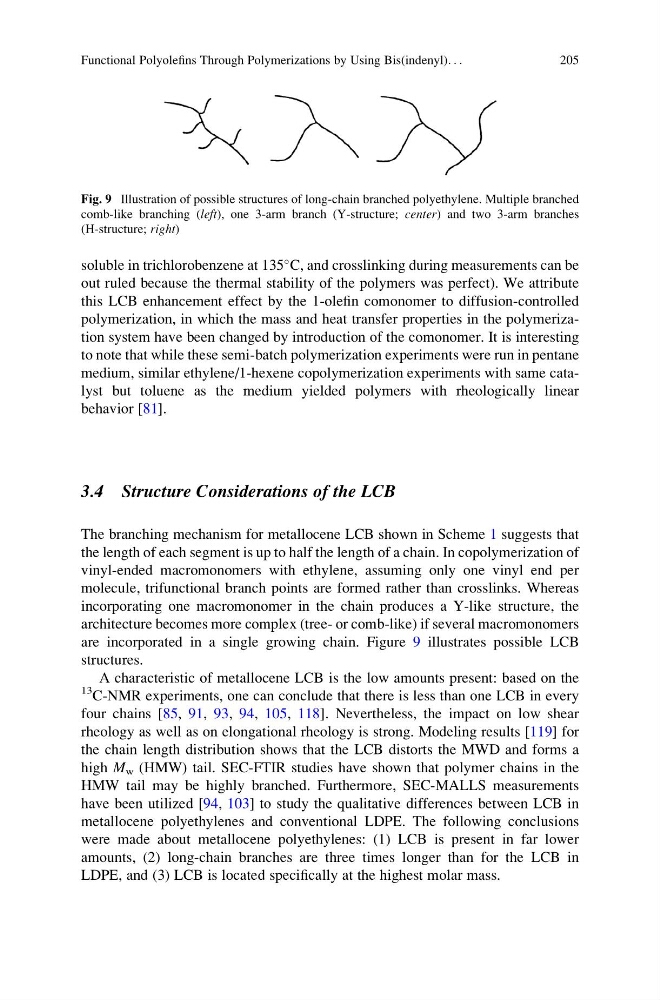
incorporating one macromonomer in the chain produces a Y-like structure, the
architecture becomes more complex (tree- or comb-like) if several macromonomers
are incorporated in a single growing chain. Figure 9 illustrates possible LCB
structures.
A characteristic of metallocene LCB is the low amounts present: based on the
13 C-NMR experiments, one can conclude that there is less than one LCB in every
four chains [85, 91, 93, 94, 105, 118]. Nevertheless, the impact on low shear
rheology as well as on elongational rheology is strong. Modeling results [119] for
the chain length distribution shows that the LCB distorts the MWD and forms a
high M w (HMW) tail. SEC-FTIR studies have shown that polymer chains in the
HMW tail may be highly branched. Furthermore, SEC-MALLS measurements
have been utilized [94, 103] to study the qualitative differences between LCB in
metallocene polyethylenes and conventional LDPE. The following conclusions
were made about metallocene polyethylenes: (1) LCB is present in far lower
amounts, (2) long-chain branches are three times longer than for the LCB in
LDPE, and (3) LCB is located specifically at the highest molar mass.
Fig. 9 Illustration of possible structures of long-chain branched polyethylene. Multiple branched
comb-like branching (left), one 3-arm branch (Y-structure; center) and two 3-arm branches
(H-structure; right)
Functional Polyolefins Through Polymerizations by Using Bis(indenyl). . .
205
C, and crosslinking during measurements can be
out ruled because the thermal stability of the polymers was perfect). We attribute
this LCB enhancement effect by the 1-olefin comonomer to diffusion-controlled
polymerization, in which the mass and heat transfer properties in the polymerization system have been changed by introduction of the comonomer. It is interesting
to note that while these semi-batch polymerization experiments were run in pentane
medium, similar ethylene/1-hexene copolymerization experiments with same catalyst but toluene as the medium yielded polymers with rheologically linear
behavior [81].
3.4 Structure Considerations of the LCB
The branching mechanism for metallocene LCB shown in Scheme 1 suggests that
the length of each segment is up to half the length of a chain. In copolymerization of
vinyl-ended macromonomers with ethylene, assuming only one vinyl end per
molecule, trifunctional branch points are formed rather than crosslinks. Whereas
incorporating one macromonomer in the chain produces a Y-like structure, the
architecture becomes more complex (tree- or comb-like) if several macromonomers
are incorporated in a single growing chain. Figure 9 illustrates possible LCB
structures.
A characteristic of metallocene LCB is the low amounts present: based on the
13 C-NMR experiments, one can conclude that there is less than one LCB in every
four chains [85, 91, 93, 94, 105, 118]. Nevertheless, the impact on low shear
rheology as well as on elongational rheology is strong. Modeling results [119] for
the chain length distribution shows that the LCB distorts the MWD and forms a
high M w (HMW) tail. SEC-FTIR studies have shown that polymer chains in the
HMW tail may be highly branched. Furthermore, SEC-MALLS measurements
have been utilized [94, 103] to study the qualitative differences between LCB in
metallocene polyethylenes and conventional LDPE. The following conclusions
were made about metallocene polyethylenes: (1) LCB is present in far lower
amounts, (2) long-chain branches are three times longer than for the LCB in
LDPE, and (3) LCB is located specifically at the highest molar mass.
Fig. 9 Illustration of possible structures of long-chain branched polyethylene. Multiple branched
comb-like branching (left), one 3-arm branch (Y-structure; center) and two 3-arm branches
(H-structure; right)
Functional Polyolefins Through Polymerizations by Using Bis(indenyl). . .
205