

when the polymer contained about 3.0 vinyl bonds/1,000 carbon atoms [88],
suggesting significant branching at these conditions even using a catalyst with
poor copolymerization ability and vinyl-selectivity.
Very different polymer properties were observed with catalyst 8/MAO, of good
comonomer response. The copolymers had drastically modified rheological
properties even at very low diene content. Slightly higher diene comonomer feed
resulted in the formation of a crosslinked polymer that was difficult to remove from
the reactor due to gelation.
Experiments with a variety of single-site catalysts show that 1-olefin comonomer
at low levels may actually increase the LCB behavior. This behavior has been
reported by several groups using various bridged bis(indenyl) structures [81, 83, 85,
109, 115] in semi-batch slurry polymerizations as well as in the continuous gas
phase [12] with supported and homogeneous catalysts, and with various short chain
comonomers [12, 81, 83, 86, 97]. At large enough comonomer content, the chains
produced appear non-LCB again [83, 86, 115].
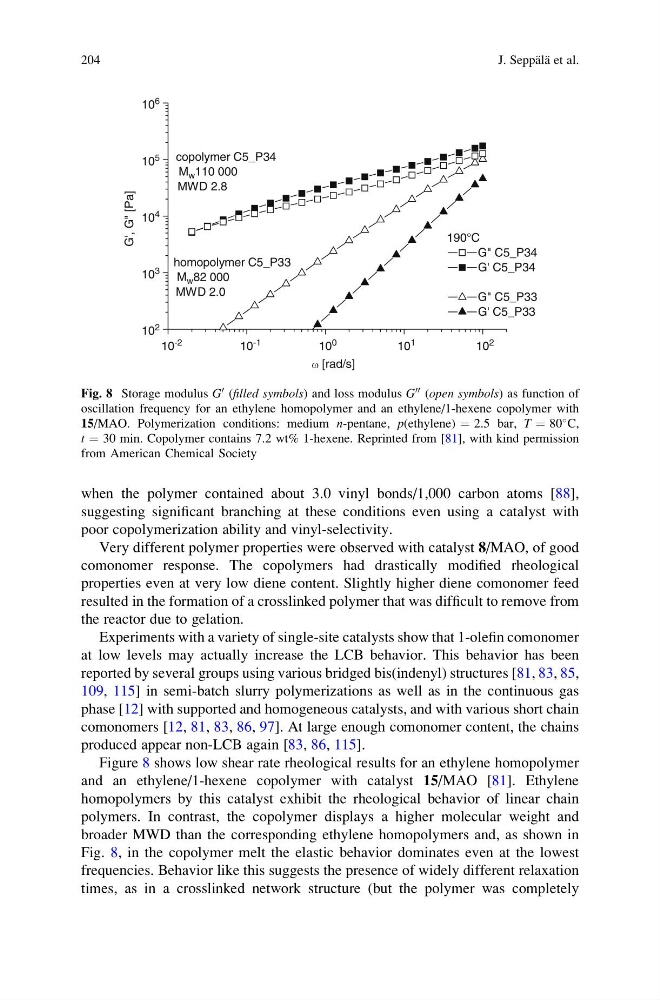
Figure 8 shows low shear rate rheological results for an ethylene homopolymer
and an ethylene/1-hexene copolymer with catalyst 15/MAO [81]. Ethylene
homopolymers by this catalyst exhibit the rheological behavior of linear chain
polymers. In contrast, the copolymer displays a higher molecular weight and
broader MWD than the corresponding ethylene homopolymers and, as shown in
Fig. 8, in the copolymer melt the elastic behavior dominates even at the lowest
frequencies. Behavior like this suggests the presence of widely different relaxation
times, as in a crosslinked network structure (but the polymer was completely
10
-2
10
-1
10
0
10
1
10
2
homopolymer C5_P33
M w 82 000
MWD 2.0
copolymer C5_P34
M w 110 000
MWD 2.8
190°C
G" C5_P34
G' C5_P34
G" C5_P33
G' C5_P33
10 2
10
3
10 4
10 6
10
5
G', G" [Pa]
ω [rad/s]
Fig. 8 Storage modulus G
0 (filled symbols) and loss modulus G
00 (open symbols) as function of
oscillation frequency for an ethylene homopolymer and an ethylene/1-hexene copolymer with
15/MAO. Polymerization conditions: medium n-pentane, p(ethylene) ¼ 2.5 bar, T ¼ 80
C,
t ¼ 30 min. Copolymer contains 7.2 wt% 1-hexene. Reprinted from [81], with kind permission
from American Chemical Society
204
J. Seppa ¨la ¨ et al.
suggesting significant branching at these conditions even using a catalyst with
poor copolymerization ability and vinyl-selectivity.
Very different polymer properties were observed with catalyst 8/MAO, of good
comonomer response. The copolymers had drastically modified rheological
properties even at very low diene content. Slightly higher diene comonomer feed
resulted in the formation of a crosslinked polymer that was difficult to remove from
the reactor due to gelation.
Experiments with a variety of single-site catalysts show that 1-olefin comonomer
at low levels may actually increase the LCB behavior. This behavior has been
reported by several groups using various bridged bis(indenyl) structures [81, 83, 85,
109, 115] in semi-batch slurry polymerizations as well as in the continuous gas
phase [12] with supported and homogeneous catalysts, and with various short chain
comonomers [12, 81, 83, 86, 97]. At large enough comonomer content, the chains
produced appear non-LCB again [83, 86, 115].
Figure 8 shows low shear rate rheological results for an ethylene homopolymer
and an ethylene/1-hexene copolymer with catalyst 15/MAO [81]. Ethylene
homopolymers by this catalyst exhibit the rheological behavior of linear chain
polymers. In contrast, the copolymer displays a higher molecular weight and
broader MWD than the corresponding ethylene homopolymers and, as shown in
Fig. 8, in the copolymer melt the elastic behavior dominates even at the lowest
frequencies. Behavior like this suggests the presence of widely different relaxation
times, as in a crosslinked network structure (but the polymer was completely
10
-2
10
-1
10
0
10
1
10
2
homopolymer C5_P33
M w 82 000
MWD 2.0
copolymer C5_P34
M w 110 000
MWD 2.8
190°C
G" C5_P34
G' C5_P34
G" C5_P33
G' C5_P33
10 2
10
3
10 4
10 6
10
5
G', G" [Pa]
ω [rad/s]
Fig. 8 Storage modulus G
0 (filled symbols) and loss modulus G
00 (open symbols) as function of
oscillation frequency for an ethylene homopolymer and an ethylene/1-hexene copolymer with
15/MAO. Polymerization conditions: medium n-pentane, p(ethylene) ¼ 2.5 bar, T ¼ 80
C,
t ¼ 30 min. Copolymer contains 7.2 wt% 1-hexene. Reprinted from [81], with kind permission
from American Chemical Society
204
J. Seppa ¨la ¨ et al.