

To test the importance of vinyl bond content and copolymerization ability in
LCB formation, we carried out a diene copolymerization series with two catalysts
having very different comonomer responses, low inherent vinyl bond formation
tendency, and very facile hydrogen reactivity. Concentration was kept high to avoid
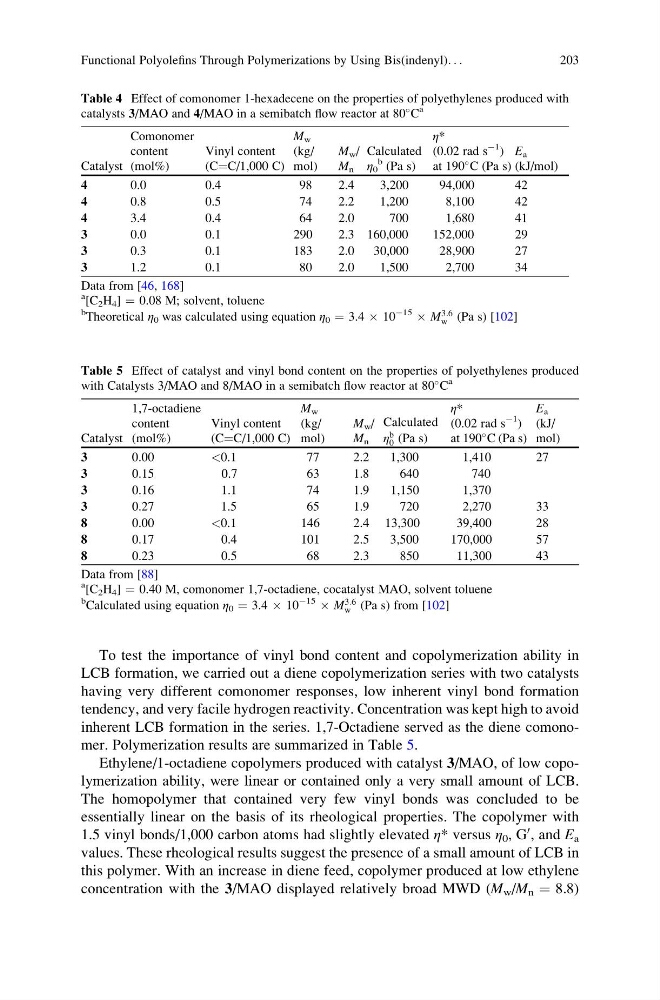
inherent LCB formation in the series. 1,7-Octadiene served as the diene comonomer. Polymerization results are summarized in Table 5.
Ethylene/1-octadiene copolymers produced with catalyst 3/MAO, of low copolymerization ability, were linear or contained only a very small amount of LCB.
The homopolymer that contained very few vinyl bonds was concluded to be
essentially linear on the basis of its rheological properties. The copolymer with
1.5 vinyl bonds/1,000 carbon atoms had slightly elevated η* versus η 0 , G
0 , and E a
values. These rheological results suggest the presence of a small amount of LCB in
this polymer. With an increase in diene feed, copolymer produced at low ethylene
concentration with the 3/MAO displayed relatively broad MWD (M w /M n ¼ 8.8)
Table 4 Effect of comonomer 1-hexadecene on the properties of polyethylenes produced with
catalysts 3/MAO and 4/MAO in a semibatch flow reactor at 80
C
a
Catalyst
Comonomer
content
(mol%)
Vinyl content
(C¼C/1,000 C)
M w
(kg/
mol)
M w /
M n
Calculated
η 0
b (Pa s)
η*
(0.02 rad s
À1
)
at 190
C (Pa s)
E a
(kJ/mol)
4
0.0
0.4
98
2.4
3,200
94,000
42
4
0.8
0.5
74
2.2
1,200
8,100
42
4
3.4
0.4
64
2.0
700
1,680
41
3
0.0
0.1
290
2.3 160,000
152,000
29
3
0.3
0.1
183
2.0
30,000
28,900
27
3
1.2
0.1
80
2.0
1,500
2,700
34
Data from [46, 168]
a
[C 2 H 4 ] ¼ 0.08 M; solvent, toluene
b
Theoretical η 0 was calculated using equation η 0 ¼ 3.4 Â 10
À15 Â M
3:6
w (Pa s) [102]
Table 5 Effect of catalyst and vinyl bond content on the properties of polyethylenes produced
with Catalysts 3/MAO and 8/MAO in a semibatch flow reactor at 80
C
a
Catalyst
1,7-octadiene
content
(mol%)
Vinyl content
(C¼C/1,000 C)
M w
(kg/
mol)
M w /
M n
Calculated
η
b
0 (Pa s)
η*
(0.02 rad s
À1
)
at 190
C (Pa s)
E a
(kJ/
mol)
3
0.00
<0.1
77
2.2
1,300
1,410
27
3
0.15
0.7
63
1.8
640
740
3
0.16
1.1
74
1.9
1,150
1,370
3
0.27
1.5
65
1.9
720
2,270
33
8
0.00
<0.1
146
2.4 13,300
39,400
28
8
0.17
0.4
101
2.5
3,500
170,000
57
8
0.23
0.5
68
2.3
850
11,300
43
Data from [88]
a
[C 2 H 4 ] ¼ 0.40 M, comonomer 1,7-octadiene, cocatalyst MAO, solvent toluene
b
Calculated using equation η 0 ¼ 3.4 Â 10
À15 Â M
3:6
w (Pa s) from [102]
Functional Polyolefins Through Polymerizations by Using Bis(indenyl). . .
203
LCB formation, we carried out a diene copolymerization series with two catalysts
having very different comonomer responses, low inherent vinyl bond formation
tendency, and very facile hydrogen reactivity. Concentration was kept high to avoid
inherent LCB formation in the series. 1,7-Octadiene served as the diene comonomer. Polymerization results are summarized in Table 5.
Ethylene/1-octadiene copolymers produced with catalyst 3/MAO, of low copolymerization ability, were linear or contained only a very small amount of LCB.
The homopolymer that contained very few vinyl bonds was concluded to be
essentially linear on the basis of its rheological properties. The copolymer with
1.5 vinyl bonds/1,000 carbon atoms had slightly elevated η* versus η 0 , G
0 , and E a
values. These rheological results suggest the presence of a small amount of LCB in
this polymer. With an increase in diene feed, copolymer produced at low ethylene
concentration with the 3/MAO displayed relatively broad MWD (M w /M n ¼ 8.8)
Table 4 Effect of comonomer 1-hexadecene on the properties of polyethylenes produced with
catalysts 3/MAO and 4/MAO in a semibatch flow reactor at 80
C
a
Catalyst
Comonomer
content
(mol%)
Vinyl content
(C¼C/1,000 C)
M w
(kg/
mol)
M w /
M n
Calculated
η 0
b (Pa s)
η*
(0.02 rad s
À1
)
at 190
C (Pa s)
E a
(kJ/mol)
4
0.0
0.4
98
2.4
3,200
94,000
42
4
0.8
0.5
74
2.2
1,200
8,100
42
4
3.4
0.4
64
2.0
700
1,680
41
3
0.0
0.1
290
2.3 160,000
152,000
29
3
0.3
0.1
183
2.0
30,000
28,900
27
3
1.2
0.1
80
2.0
1,500
2,700
34
Data from [46, 168]
a
[C 2 H 4 ] ¼ 0.08 M; solvent, toluene
b
Theoretical η 0 was calculated using equation η 0 ¼ 3.4 Â 10
À15 Â M
3:6
w (Pa s) [102]
Table 5 Effect of catalyst and vinyl bond content on the properties of polyethylenes produced
with Catalysts 3/MAO and 8/MAO in a semibatch flow reactor at 80
C
a
Catalyst
1,7-octadiene
content
(mol%)
Vinyl content
(C¼C/1,000 C)
M w
(kg/
mol)
M w /
M n
Calculated
η
b
0 (Pa s)
η*
(0.02 rad s
À1
)
at 190
C (Pa s)
E a
(kJ/
mol)
3
0.00
<0.1
77
2.2
1,300
1,410
27
3
0.15
0.7
63
1.8
640
740
3
0.16
1.1
74
1.9
1,150
1,370
3
0.27
1.5
65
1.9
720
2,270
33
8
0.00
<0.1
146
2.4 13,300
39,400
28
8
0.17
0.4
101
2.5
3,500
170,000
57
8
0.23
0.5
68
2.3
850
11,300
43
Data from [88]
a
[C 2 H 4 ] ¼ 0.40 M, comonomer 1,7-octadiene, cocatalyst MAO, solvent toluene
b
Calculated using equation η 0 ¼ 3.4 Â 10
À15 Â M
3:6
w (Pa s) from [102]
Functional Polyolefins Through Polymerizations by Using Bis(indenyl). . .
203