

nonconjugated α,ω-dienes as comonomer would increase the vinyl bond concentration and thus the probability of LCB formation.
As shown in Table 4, introduction of 1-hexadecene as comonomer has a similar
influence to hydrogen on the rheological properties of the polyethylene: the
η*(ω ¼ 0.02 rad s
À1 ) and G
0 values were lowered, indicating suppression of the
LCB. The flow activation energy value, E a remained almost unchanged due to
two opposite effects at play simultaneously. For flow E a , two different effects of
the comonomer incorporation are present: an increase in the comonomer content
in a linear polymer will increase E a , but for the LCB, a decrease in the LCB
content would decrease the E a value.
The E a values (26–28 kJ/mol) reported for 3/MAO-catalyzed copolymers are
considered to represent the properties of linear polymers in which only short-chain
branching influences the melt behavior [46]. The calculated η 0 values are close to
the measured values, and the flow activation energy E a increases slightly with
comonomer incorporation, as expected for a polymer with short-chain branching.
0.00
0.05
0.10
0.15
0.20
0
100 200
300 400
500
[Ethene] / [Macromonomer]
LCB / 1000 C
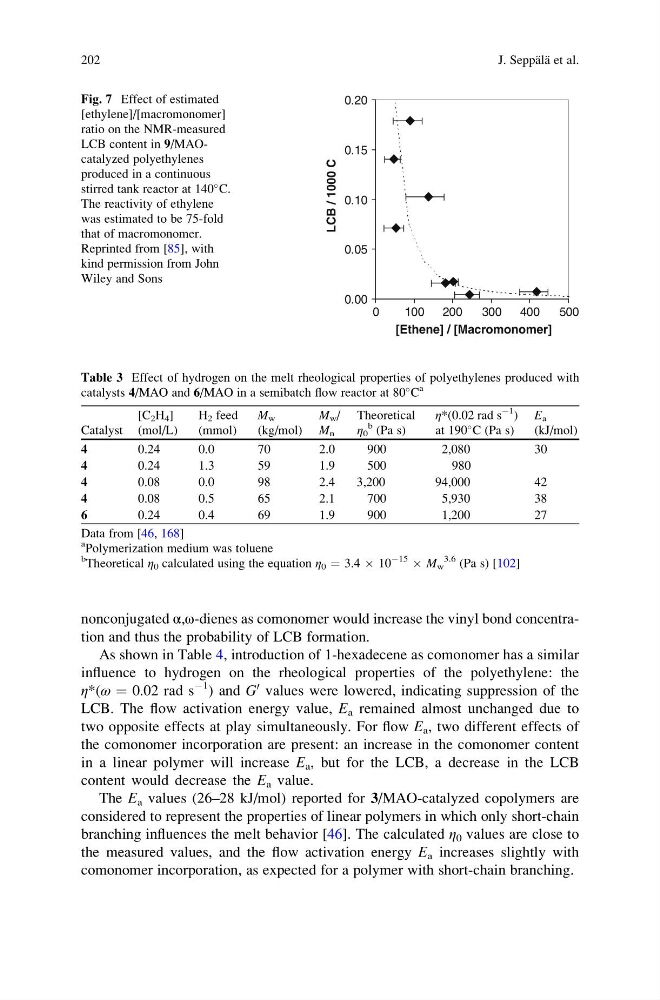
Fig. 7 Effect of estimated
[ethylene]/[macromonomer]
ratio on the NMR-measured
LCB content in 9/MAOcatalyzed polyethylenes
produced in a continuous
stirred tank reactor at 140
C.
The reactivity of ethylene
was estimated to be 75-fold
that of macromonomer.
Reprinted from [85], with
kind permission from John
Wiley and Sons
Table 3 Effect of hydrogen on the melt rheological properties of polyethylenes produced with
catalysts 4/MAO and 6/MAO in a semibatch flow reactor at 80
C
a
Catalyst
[C 2 H 4 ]
(mol/L)
H 2 feed
(mmol)
M w
(kg/mol)
M w /
M n
Theoretical
η 0
b (Pa s)
η*(0.02 rad s
À1
)
at 190
C (Pa s)
E a
(kJ/mol)
4
0.24
0.0
70
2.0
900
2,080
30
4
0.24
1.3
59
1.9
500
980
4
0.08
0.0
98
2.4
3,200
94,000
42
4
0.08
0.5
65
2.1
700
5,930
38
6
0.24
0.4
69
1.9
900
1,200
27
Data from [46, 168]
a
Polymerization medium was toluene
b
Theoretical η 0 calculated using the equation η 0 ¼ 3.4 Â 10
À15 Â M w
3.6 (Pa s) [102]
202
J. Seppa ¨la ¨ et al.
As shown in Table 4, introduction of 1-hexadecene as comonomer has a similar
influence to hydrogen on the rheological properties of the polyethylene: the
η*(ω ¼ 0.02 rad s
À1 ) and G
0 values were lowered, indicating suppression of the
LCB. The flow activation energy value, E a remained almost unchanged due to
two opposite effects at play simultaneously. For flow E a , two different effects of
the comonomer incorporation are present: an increase in the comonomer content
in a linear polymer will increase E a , but for the LCB, a decrease in the LCB
content would decrease the E a value.
The E a values (26–28 kJ/mol) reported for 3/MAO-catalyzed copolymers are
considered to represent the properties of linear polymers in which only short-chain
branching influences the melt behavior [46]. The calculated η 0 values are close to
the measured values, and the flow activation energy E a increases slightly with
comonomer incorporation, as expected for a polymer with short-chain branching.
0.00
0.05
0.10
0.15
0.20
0
100 200
300 400
500
[Ethene] / [Macromonomer]
LCB / 1000 C
Fig. 7 Effect of estimated
[ethylene]/[macromonomer]
ratio on the NMR-measured
LCB content in 9/MAOcatalyzed polyethylenes
produced in a continuous
stirred tank reactor at 140
C.
The reactivity of ethylene
was estimated to be 75-fold
that of macromonomer.
Reprinted from [85], with
kind permission from John
Wiley and Sons
Table 3 Effect of hydrogen on the melt rheological properties of polyethylenes produced with
catalysts 4/MAO and 6/MAO in a semibatch flow reactor at 80
C
a
Catalyst
[C 2 H 4 ]
(mol/L)
H 2 feed
(mmol)
M w
(kg/mol)
M w /
M n
Theoretical
η 0
b (Pa s)
η*(0.02 rad s
À1
)
at 190
C (Pa s)
E a
(kJ/mol)
4
0.24
0.0
70
2.0
900
2,080
30
4
0.24
1.3
59
1.9
500
980
4
0.08
0.0
98
2.4
3,200
94,000
42
4
0.08
0.5
65
2.1
700
5,930
38
6
0.24
0.4
69
1.9
900
1,200
27
Data from [46, 168]
a
Polymerization medium was toluene
b
Theoretical η 0 calculated using the equation η 0 ¼ 3.4 Â 10
À15 Â M w
3.6 (Pa s) [102]
202
J. Seppa ¨la ¨ et al.