

3.3.3 Hydrogen Concentration
From the copolymerization mechanism it also follows that introduction of hydrogen
would suppress LCB formation due to the decreasing number of vinyl ends, as
preferred chain transfer to hydrogen leaves saturated chain ends. Table 3 shows the
effect of hydrogen on the melt rheological properties [46]. For polymer
polymerized with 4/MAO at C E ¼ 0.08 M, introduction of hydrogen as chain
transfer agent decreased the E a value from 42 to 38 kJ/mol, and diminished the
discrepancy between the theoretical and the experimentally measured low shear
rate viscosity. The polymer produced by 6/MAO without hydrogen at C E ¼ 0.24 M
displayed melt rheological properties of a linear polymer with narrow MWD.
3.3.4 Effect of Comonomer
Ethylene copolymerization with 1-olefin comonomers decrease the polymer vinyl
bond concentration because chain transfer to the comonomer ends the polymer
chain with a vinylidene bond. Therefore, introducing a 1-olefin comonomer into the
polymerization is expected to lead to lower LCB content, whereas use of
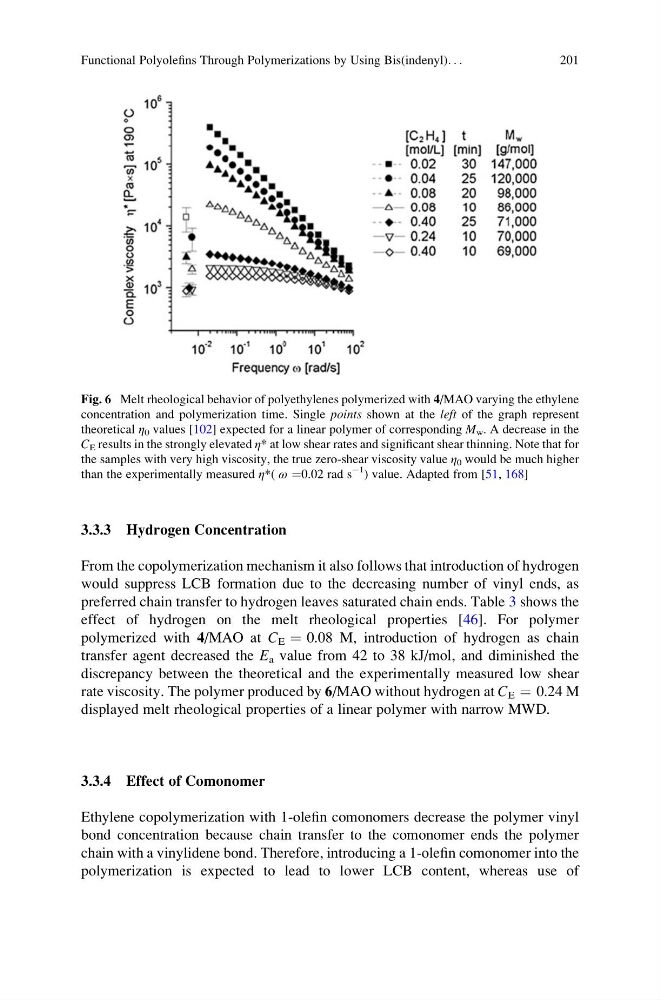
Fig. 6 Melt rheological behavior of polyethylenes polymerized with 4/MAO varying the ethylene
concentration and polymerization time. Single points shown at the left of the graph represent
theoretical η 0 values [102] expected for a linear polymer of corresponding M w . A decrease in the
C E results in the strongly elevated η* at low shear rates and significant shear thinning. Note that for
the samples with very high viscosity, the true zero-shear viscosity value η 0 would be much higher
than the experimentally measured η*( ω ¼0.02 rad s
À1
) value. Adapted from [51, 168]
Functional Polyolefins Through Polymerizations by Using Bis(indenyl). . .
201
From the copolymerization mechanism it also follows that introduction of hydrogen
would suppress LCB formation due to the decreasing number of vinyl ends, as
preferred chain transfer to hydrogen leaves saturated chain ends. Table 3 shows the
effect of hydrogen on the melt rheological properties [46]. For polymer
polymerized with 4/MAO at C E ¼ 0.08 M, introduction of hydrogen as chain
transfer agent decreased the E a value from 42 to 38 kJ/mol, and diminished the
discrepancy between the theoretical and the experimentally measured low shear
rate viscosity. The polymer produced by 6/MAO without hydrogen at C E ¼ 0.24 M
displayed melt rheological properties of a linear polymer with narrow MWD.
3.3.4 Effect of Comonomer
Ethylene copolymerization with 1-olefin comonomers decrease the polymer vinyl
bond concentration because chain transfer to the comonomer ends the polymer
chain with a vinylidene bond. Therefore, introducing a 1-olefin comonomer into the
polymerization is expected to lead to lower LCB content, whereas use of
Fig. 6 Melt rheological behavior of polyethylenes polymerized with 4/MAO varying the ethylene
concentration and polymerization time. Single points shown at the left of the graph represent
theoretical η 0 values [102] expected for a linear polymer of corresponding M w . A decrease in the
C E results in the strongly elevated η* at low shear rates and significant shear thinning. Note that for
the samples with very high viscosity, the true zero-shear viscosity value η 0 would be much higher
than the experimentally measured η*( ω ¼0.02 rad s
À1
) value. Adapted from [51, 168]
Functional Polyolefins Through Polymerizations by Using Bis(indenyl). . .
201