

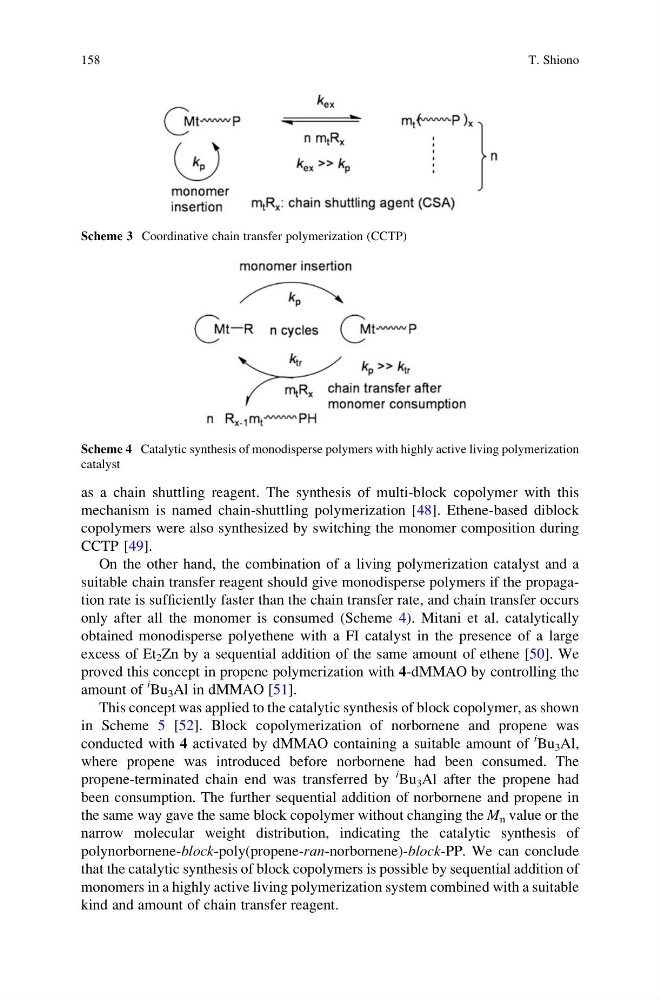
as a chain shuttling reagent. The synthesis of multi-block copolymer with this
mechanism is named chain-shuttling polymerization [48]. Ethene-based diblock
copolymers were also synthesized by switching the monomer composition during
CCTP [49].
On the other hand, the combination of a living polymerization catalyst and a
suitable chain transfer reagent should give monodisperse polymers if the propagation rate is sufficiently faster than the chain transfer rate, and chain transfer occurs
only after all the monomer is consumed (Scheme 4). Mitani et al. catalytically
obtained monodisperse polyethene with a FI catalyst in the presence of a large
excess of Et 2 Zn by a sequential addition of the same amount of ethene [50]. We
proved this concept in propene polymerization with 4-dMMAO by controlling the
amount of
i
Bu 3 Al in dMMAO [51].
This concept was applied to the catalytic synthesis of block copolymer, as shown
in Scheme 5 [52]. Block copolymerization of norbornene and propene was
conducted with 4 activated by dMMAO containing a suitable amount of
i Bu 3 Al,
where propene was introduced before norbornene had been consumed. The
propene-terminated chain end was transferred by
i
Bu 3 Al after the propene had
been consumption. The further sequential addition of norbornene and propene in
the same way gave the same block copolymer without changing the M n value or the
narrow molecular weight distribution, indicating the catalytic synthesis of
polynorbornene-block-poly(propene-ran-norbornene)-block-PP. We can conclude
that the catalytic synthesis of block copolymers is possible by sequential addition of
monomers in a highly active living polymerization system combined with a suitable
kind and amount of chain transfer reagent.
Scheme 3 Coordinative chain transfer polymerization (CCTP)
Scheme 4 Catalytic synthesis of monodisperse polymers with highly active living polymerization
catalyst
158
T. Shiono
mechanism is named chain-shuttling polymerization [48]. Ethene-based diblock
copolymers were also synthesized by switching the monomer composition during
CCTP [49].
On the other hand, the combination of a living polymerization catalyst and a
suitable chain transfer reagent should give monodisperse polymers if the propagation rate is sufficiently faster than the chain transfer rate, and chain transfer occurs
only after all the monomer is consumed (Scheme 4). Mitani et al. catalytically
obtained monodisperse polyethene with a FI catalyst in the presence of a large
excess of Et 2 Zn by a sequential addition of the same amount of ethene [50]. We
proved this concept in propene polymerization with 4-dMMAO by controlling the
amount of
i
Bu 3 Al in dMMAO [51].
This concept was applied to the catalytic synthesis of block copolymer, as shown
in Scheme 5 [52]. Block copolymerization of norbornene and propene was
conducted with 4 activated by dMMAO containing a suitable amount of
i Bu 3 Al,
where propene was introduced before norbornene had been consumed. The
propene-terminated chain end was transferred by
i
Bu 3 Al after the propene had
been consumption. The further sequential addition of norbornene and propene in
the same way gave the same block copolymer without changing the M n value or the
narrow molecular weight distribution, indicating the catalytic synthesis of
polynorbornene-block-poly(propene-ran-norbornene)-block-PP. We can conclude
that the catalytic synthesis of block copolymers is possible by sequential addition of
monomers in a highly active living polymerization system combined with a suitable
kind and amount of chain transfer reagent.
Scheme 3 Coordinative chain transfer polymerization (CCTP)
Scheme 4 Catalytic synthesis of monodisperse polymers with highly active living polymerization
catalyst
158
T. Shiono