

highly active living copolymerization of norbornene and 1-alkene with the
tetraalkyl-substituted fluorenyl complex 5 activated by dMMAO.
4.3 Block Copolymerization of Norbornene and 1-Alkene
The most important role of living polymerization is to synthesize block copolymers.
The Ti complexes 2–5 activated by dMAO or dMMAO were found to conduct
living polymerization of propene, higher 1-alkene, and norbornene as well as their
random living copolymerization. Thus, we can synthesize tailor-made copolymers
composed of 1-alkene and norbornene with this catalytic system.
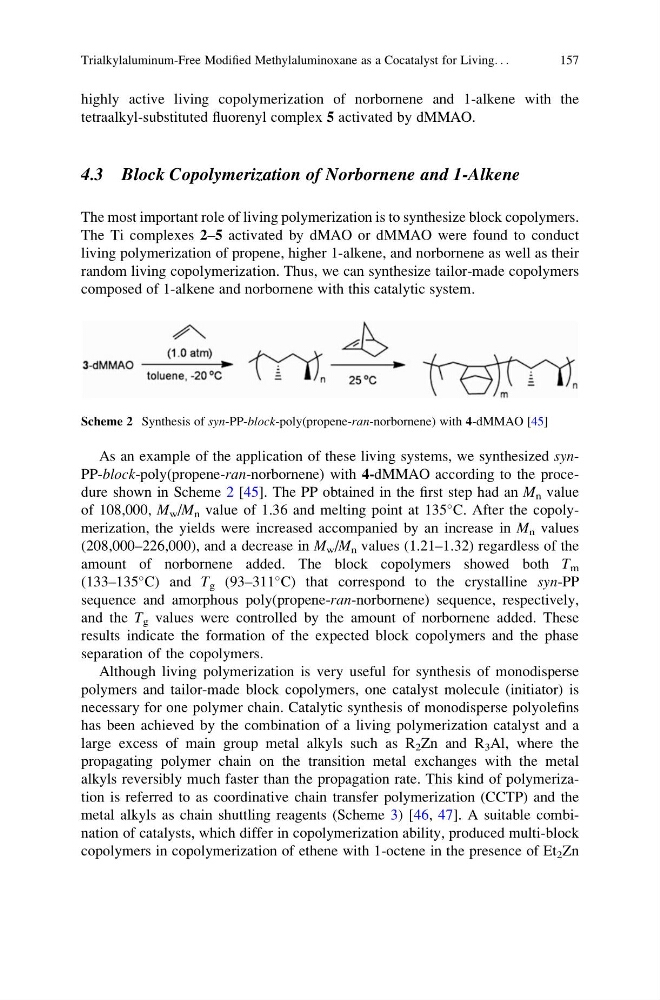
As an example of the application of these living systems, we synthesized synPP-block-poly(propene-ran-norbornene) with 4-dMMAO according to the procedure shown in Scheme 2 [45]. The PP obtained in the first step had an M n value
of 108,000, M w /M n value of 1.36 and melting point at 135
C. After the copolymerization, the yields were increased accompanied by an increase in M n values
(208,000–226,000), and a decrease in M w /M n values (1.21–1.32) regardless of the
amount of norbornene added. The block copolymers showed both T m
(133–135
C) and T g (93–311
C) that correspond to the crystalline syn-PP
sequence and amorphous poly(propene-ran-norbornene) sequence, respectively,
and the T g values were controlled by the amount of norbornene added. These
results indicate the formation of the expected block copolymers and the phase
separation of the copolymers.
Although living polymerization is very useful for synthesis of monodisperse
polymers and tailor-made block copolymers, one catalyst molecule (initiator) is
necessary for one polymer chain. Catalytic synthesis of monodisperse polyolefins
has been achieved by the combination of a living polymerization catalyst and a
large excess of main group metal alkyls such as R 2 Zn and R 3 Al, where the
propagating polymer chain on the transition metal exchanges with the metal
alkyls reversibly much faster than the propagation rate. This kind of polymerization is referred to as coordinative chain transfer polymerization (CCTP) and the
metal alkyls as chain shuttling reagents (Scheme 3) [46, 47]. A suitable combination of catalysts, which differ in copolymerization ability, produced multi-block
copolymers in copolymerization of ethene with 1-octene in the presence of Et 2 Zn
Scheme 2 Synthesis of syn-PP-block-poly(propene-ran-norbornene) with 4-dMMAO [45]
Trialkylaluminum-Free Modified Methylaluminoxane as a Cocatalyst for Living. . .
157
tetraalkyl-substituted fluorenyl complex 5 activated by dMMAO.
4.3 Block Copolymerization of Norbornene and 1-Alkene
The most important role of living polymerization is to synthesize block copolymers.
The Ti complexes 2–5 activated by dMAO or dMMAO were found to conduct
living polymerization of propene, higher 1-alkene, and norbornene as well as their
random living copolymerization. Thus, we can synthesize tailor-made copolymers
composed of 1-alkene and norbornene with this catalytic system.
As an example of the application of these living systems, we synthesized synPP-block-poly(propene-ran-norbornene) with 4-dMMAO according to the procedure shown in Scheme 2 [45]. The PP obtained in the first step had an M n value
of 108,000, M w /M n value of 1.36 and melting point at 135
C. After the copolymerization, the yields were increased accompanied by an increase in M n values
(208,000–226,000), and a decrease in M w /M n values (1.21–1.32) regardless of the
amount of norbornene added. The block copolymers showed both T m
(133–135
C) and T g (93–311
C) that correspond to the crystalline syn-PP
sequence and amorphous poly(propene-ran-norbornene) sequence, respectively,
and the T g values were controlled by the amount of norbornene added. These
results indicate the formation of the expected block copolymers and the phase
separation of the copolymers.
Although living polymerization is very useful for synthesis of monodisperse
polymers and tailor-made block copolymers, one catalyst molecule (initiator) is
necessary for one polymer chain. Catalytic synthesis of monodisperse polyolefins
has been achieved by the combination of a living polymerization catalyst and a
large excess of main group metal alkyls such as R 2 Zn and R 3 Al, where the
propagating polymer chain on the transition metal exchanges with the metal
alkyls reversibly much faster than the propagation rate. This kind of polymerization is referred to as coordinative chain transfer polymerization (CCTP) and the
metal alkyls as chain shuttling reagents (Scheme 3) [46, 47]. A suitable combination of catalysts, which differ in copolymerization ability, produced multi-block
copolymers in copolymerization of ethene with 1-octene in the presence of Et 2 Zn
Scheme 2 Synthesis of syn-PP-block-poly(propene-ran-norbornene) with 4-dMMAO [45]
Trialkylaluminum-Free Modified Methylaluminoxane as a Cocatalyst for Living. . .
157