

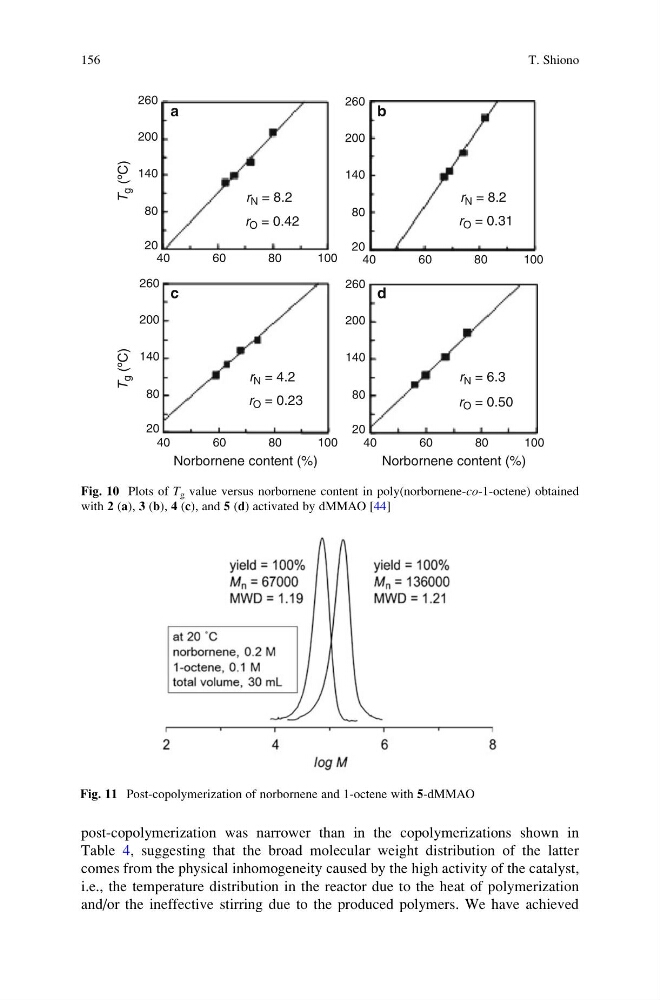
post-copolymerization was narrower than in the copolymerizations shown in
Table 4, suggesting that the broad molecular weight distribution of the latter
comes from the physical inhomogeneity caused by the high activity of the catalyst,
i.e., the temperature distribution in the reactor due to the heat of polymerization
and/or the ineffective stirring due to the produced polymers. We have achieved
200
80
60
80
r O = 0.31
r O = 0.50
r O = 0.23
r O = 0.42
r N = 8.2
r N = 8.2
r N = 6.3
r N = 4.2
Norbornene content (%)
Norbornene content (%)
100
40
60
80
100
40
60
80
100
40
60
80
100
40
20
140
260
200
80
20
T
g (ºC)
T
g (ºC)
140
260
200
80
20
140
260
200
80
20
140
260
d
c
b
a
Fig. 10 Plots of T g value versus norbornene content in poly(norbornene-co-1-octene) obtained
with 2 (a), 3 (b), 4 (c), and 5 (d) activated by dMMAO [44]
Fig. 11 Post-copolymerization of norbornene and 1-octene with 5-dMMAO
156
T. Shiono
Table 4, suggesting that the broad molecular weight distribution of the latter
comes from the physical inhomogeneity caused by the high activity of the catalyst,
i.e., the temperature distribution in the reactor due to the heat of polymerization
and/or the ineffective stirring due to the produced polymers. We have achieved
200
80
60
80
r O = 0.31
r O = 0.50
r O = 0.23
r O = 0.42
r N = 8.2
r N = 8.2
r N = 6.3
r N = 4.2
Norbornene content (%)
Norbornene content (%)
100
40
60
80
100
40
60
80
100
40
60
80
100
40
20
140
260
200
80
20
T
g (ºC)
T
g (ºC)
140
260
200
80
20
140
260
200
80
20
140
260
d
c
b
a
Fig. 10 Plots of T g value versus norbornene content in poly(norbornene-co-1-octene) obtained
with 2 (a), 3 (b), 4 (c), and 5 (d) activated by dMMAO [44]
Fig. 11 Post-copolymerization of norbornene and 1-octene with 5-dMMAO
156
T. Shiono