

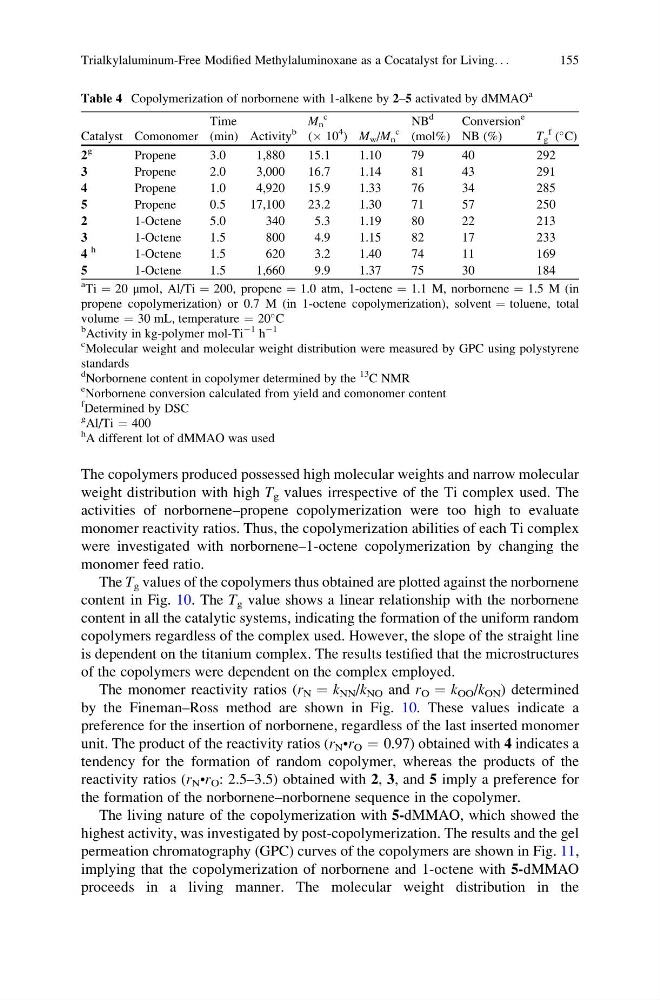
The copolymers produced possessed high molecular weights and narrow molecular
weight distribution with high T g values irrespective of the Ti complex used. The
activities of norbornene–propene copolymerization were too high to evaluate
monomer reactivity ratios. Thus, the copolymerization abilities of each Ti complex
were investigated with norbornene–1-octene copolymerization by changing the
monomer feed ratio.
The T g values of the copolymers thus obtained are plotted against the norbornene
content in Fig. 10. The T g value shows a linear relationship with the norbornene
content in all the catalytic systems, indicating the formation of the uniform random
copolymers regardless of the complex used. However, the slope of the straight line
is dependent on the titanium complex. The results testified that the microstructures
of the copolymers were dependent on the complex employed.
The monomer reactivity ratios (r N ¼ k NN /k NO and r O ¼ k OO /k ON ) determined
by the Fineman–Ross method are shown in Fig. 10. These values indicate a
preference for the insertion of norbornene, regardless of the last inserted monomer
unit. The product of the reactivity ratios (r N •r O ¼ 0.97) obtained with 4 indicates a
tendency for the formation of random copolymer, whereas the products of the
reactivity ratios (r N •r O : 2.5–3.5) obtained with 2, 3, and 5 imply a preference for
the formation of the norbornene–norbornene sequence in the copolymer.
The living nature of the copolymerization with 5-dMMAO, which showed the
highest activity, was investigated by post-copolymerization. The results and the gel
permeation chromatography (GPC) curves of the copolymers are shown in Fig. 11,
implying that the copolymerization of norbornene and 1-octene with 5-dMMAO
proceeds in a living manner. The molecular weight distribution in the
Table 4 Copolymerization of norbornene with 1-alkene by 2–5 activated by dMMAO
a
Catalyst Comonomer
Time
(min) Activity
b
M n
c
(Â 10
4
) M w /M n
c
NB
d
(mol%)
Conversion
e
NB (%)
T g
f (
C)
2
g
Propene
3.0
1,880
15.1
1.10
79
40
292
3
Propene
2.0
3,000
16.7
1.14
81
43
291
4
Propene
1.0
4,920
15.9
1.33
76
34
285
5
Propene
0.5
17,100
23.2
1.30
71
57
250
2
1-Octene
5.0
340
5.3
1.19
80
22
213
3
1-Octene
1.5
800
4.9
1.15
82
17
233
4
h
1-Octene
1.5
620
3.2
1.40
74
11
169
5
1-Octene
1.5
1,660
9.9
1.37
75
30
184
a
Ti ¼ 20 μmol, Al/Ti ¼ 200, propene ¼ 1.0 atm, 1-octene ¼ 1.1 M, norbornene ¼ 1.5 M (in
propene copolymerization) or 0.7 M (in 1-octene copolymerization), solvent ¼ toluene, total
volume ¼ 30 mL, temperature ¼ 20
C
b
Activity in kg-polymer mol-Ti
À1 h
À1
c
Molecular weight and molecular weight distribution were measured by GPC using polystyrene
standards
d
Norbornene content in copolymer determined by the
13
C NMR
e
Norbornene conversion calculated from yield and comonomer content
f
Determined by DSC
g
Al/Ti ¼ 400
h
A different lot of dMMAO was used
Trialkylaluminum-Free Modified Methylaluminoxane as a Cocatalyst for Living. . .
155
weight distribution with high T g values irrespective of the Ti complex used. The
activities of norbornene–propene copolymerization were too high to evaluate
monomer reactivity ratios. Thus, the copolymerization abilities of each Ti complex
were investigated with norbornene–1-octene copolymerization by changing the
monomer feed ratio.
The T g values of the copolymers thus obtained are plotted against the norbornene
content in Fig. 10. The T g value shows a linear relationship with the norbornene
content in all the catalytic systems, indicating the formation of the uniform random
copolymers regardless of the complex used. However, the slope of the straight line
is dependent on the titanium complex. The results testified that the microstructures
of the copolymers were dependent on the complex employed.
The monomer reactivity ratios (r N ¼ k NN /k NO and r O ¼ k OO /k ON ) determined
by the Fineman–Ross method are shown in Fig. 10. These values indicate a
preference for the insertion of norbornene, regardless of the last inserted monomer
unit. The product of the reactivity ratios (r N •r O ¼ 0.97) obtained with 4 indicates a
tendency for the formation of random copolymer, whereas the products of the
reactivity ratios (r N •r O : 2.5–3.5) obtained with 2, 3, and 5 imply a preference for
the formation of the norbornene–norbornene sequence in the copolymer.
The living nature of the copolymerization with 5-dMMAO, which showed the
highest activity, was investigated by post-copolymerization. The results and the gel
permeation chromatography (GPC) curves of the copolymers are shown in Fig. 11,
implying that the copolymerization of norbornene and 1-octene with 5-dMMAO
proceeds in a living manner. The molecular weight distribution in the
Table 4 Copolymerization of norbornene with 1-alkene by 2–5 activated by dMMAO
a
Catalyst Comonomer
Time
(min) Activity
b
M n
c
(Â 10
4
) M w /M n
c
NB
d
(mol%)
Conversion
e
NB (%)
T g
f (
C)
2
g
Propene
3.0
1,880
15.1
1.10
79
40
292
3
Propene
2.0
3,000
16.7
1.14
81
43
291
4
Propene
1.0
4,920
15.9
1.33
76
34
285
5
Propene
0.5
17,100
23.2
1.30
71
57
250
2
1-Octene
5.0
340
5.3
1.19
80
22
213
3
1-Octene
1.5
800
4.9
1.15
82
17
233
4
h
1-Octene
1.5
620
3.2
1.40
74
11
169
5
1-Octene
1.5
1,660
9.9
1.37
75
30
184
a
Ti ¼ 20 μmol, Al/Ti ¼ 200, propene ¼ 1.0 atm, 1-octene ¼ 1.1 M, norbornene ¼ 1.5 M (in
propene copolymerization) or 0.7 M (in 1-octene copolymerization), solvent ¼ toluene, total
volume ¼ 30 mL, temperature ¼ 20
C
b
Activity in kg-polymer mol-Ti
À1 h
À1
c
Molecular weight and molecular weight distribution were measured by GPC using polystyrene
standards
d
Norbornene content in copolymer determined by the
13
C NMR
e
Norbornene conversion calculated from yield and comonomer content
f
Determined by DSC
g
Al/Ti ¼ 400
h
A different lot of dMMAO was used
Trialkylaluminum-Free Modified Methylaluminoxane as a Cocatalyst for Living. . .
155