

4.2 Random Copolymerization of Norbornene and 1-Alkene
Complex 2 conducted random copolymerization of norbornene with ethene or
propene in high activity combined with a suitable cocatalyst, and copolymers
with narrow molecular weight distribution were obtained with dMAO
[35–37]. There are many catalysts that can conduct copolymerization of ethene
and norbornene [38] but very few for copolymerization of norbornene or its
derivatives with 1-alkene [39–43]. We conducted copolymerization of norbornene
with propene or 1-octene with 2–5 activated by dMMAO (Table 4) [44].
The activity of the copolymerization increased by the introduction of alkyl
substituents on the fluorenyl ligand as observed in the propene polymerization.
Table 3 Polymerization of norbornene with 2 using different cocatalysts
a
Cocatalyst
Time
(min) Activity
b
Conversion
c
(%)
M n
d (Â10
4
) M w /M n
d
N/Ti
e
dMAO
5
1,090
56
29.6
1.26
0.30
MAO
5
56
3
0.55
1.26
0.90
MMAO
3
953
29
7.9
1.07
0.60
Ph 3 CB(C 6 F 5 ) 4 + Oct 3 Al
f
2
4,820
95
33.5
1.40
0.50
Ph 3 CB(C 6 F 5 ) 4 +
i
Bu 3 Al
f
2
4,280
85
20.2
1.41
0.70
Ph 3 CB(C 6 F 5 ) 4
g
10
–
–
–
–
–
a
Polymerization conditions: Ti ¼ 20 μmol, Al/Ti ¼ 400, [norbornene] ¼ 1.2 M, solvent ¼ toluene, total vol. ¼ 30 mL. Temperature ¼ 20
C
b
Activity ¼ kg-polymer mol-Ti
À1 h
À1
c
Conversion was calculated from polymer yield
d
Number average molecular weights and molecular weight distributions were measured by GPC
using polystyrene standard
e
Molar ratio of 2 and polymer chain calculated from yield and M n
f
B ¼ 20 μmol, R 3 Al ¼ 400 μmol
g
B ¼ 20 μmol
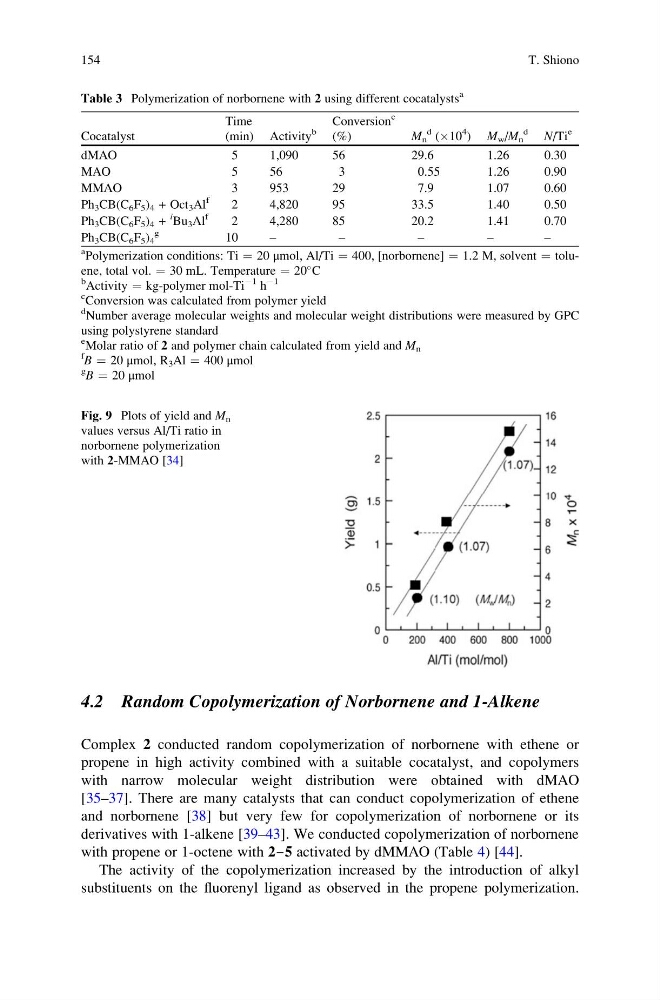
Fig. 9 Plots of yield and M n
values versus Al/Ti ratio in
norbornene polymerization
with 2-MMAO [34]
154
T. Shiono
Complex 2 conducted random copolymerization of norbornene with ethene or
propene in high activity combined with a suitable cocatalyst, and copolymers
with narrow molecular weight distribution were obtained with dMAO
[35–37]. There are many catalysts that can conduct copolymerization of ethene
and norbornene [38] but very few for copolymerization of norbornene or its
derivatives with 1-alkene [39–43]. We conducted copolymerization of norbornene
with propene or 1-octene with 2–5 activated by dMMAO (Table 4) [44].
The activity of the copolymerization increased by the introduction of alkyl
substituents on the fluorenyl ligand as observed in the propene polymerization.
Table 3 Polymerization of norbornene with 2 using different cocatalysts
a
Cocatalyst
Time
(min) Activity
b
Conversion
c
(%)
M n
d (Â10
4
) M w /M n
d
N/Ti
e
dMAO
5
1,090
56
29.6
1.26
0.30
MAO
5
56
3
0.55
1.26
0.90
MMAO
3
953
29
7.9
1.07
0.60
Ph 3 CB(C 6 F 5 ) 4 + Oct 3 Al
f
2
4,820
95
33.5
1.40
0.50
Ph 3 CB(C 6 F 5 ) 4 +
i
Bu 3 Al
f
2
4,280
85
20.2
1.41
0.70
Ph 3 CB(C 6 F 5 ) 4
g
10
–
–
–
–
–
a
Polymerization conditions: Ti ¼ 20 μmol, Al/Ti ¼ 400, [norbornene] ¼ 1.2 M, solvent ¼ toluene, total vol. ¼ 30 mL. Temperature ¼ 20
C
b
Activity ¼ kg-polymer mol-Ti
À1 h
À1
c
Conversion was calculated from polymer yield
d
Number average molecular weights and molecular weight distributions were measured by GPC
using polystyrene standard
e
Molar ratio of 2 and polymer chain calculated from yield and M n
f
B ¼ 20 μmol, R 3 Al ¼ 400 μmol
g
B ¼ 20 μmol
Fig. 9 Plots of yield and M n
values versus Al/Ti ratio in
norbornene polymerization
with 2-MMAO [34]
154
T. Shiono