

5 Conclusion
R 3 Al-free MMAO (dMMAO) was found to be an effective cocatalyst for living
polymerization of olefins with several dimethyltitanium complexes. The most
important advantage of dMMAO is its solubility in aliphatic hydrocarbons. Living
polymerization of propene was achieved with a chelating diamidodimethyltitanium
(1) or ansa-dimethysilylene(fluorenyl)(amido)dimethyltitanium (2) activated by
dMMAO in heptane. The syn-specificity of 2 depended on the polarity of the
solvent, and heptane gave the highest syn-specificity although the activity was
enhanced in halogenated solvents. The syn-specificity and activity of 2 were also
dependent on the alkyl substituent of the fluorenyl ligand. The activity increased
with the number of introduced alkyl groups, whereas the highest syn-specificity was
obtained with the 3,6i
Bu 2 -substituted complex 4. Thus, highly active and synspecific living polymerization of propene was achieved with 4-dMMAO in heptane.
The catalytic system also conducted homo- and copolymerization of norbornene
and higher 1-alkenes in a living manner, with high activity in toluene. The
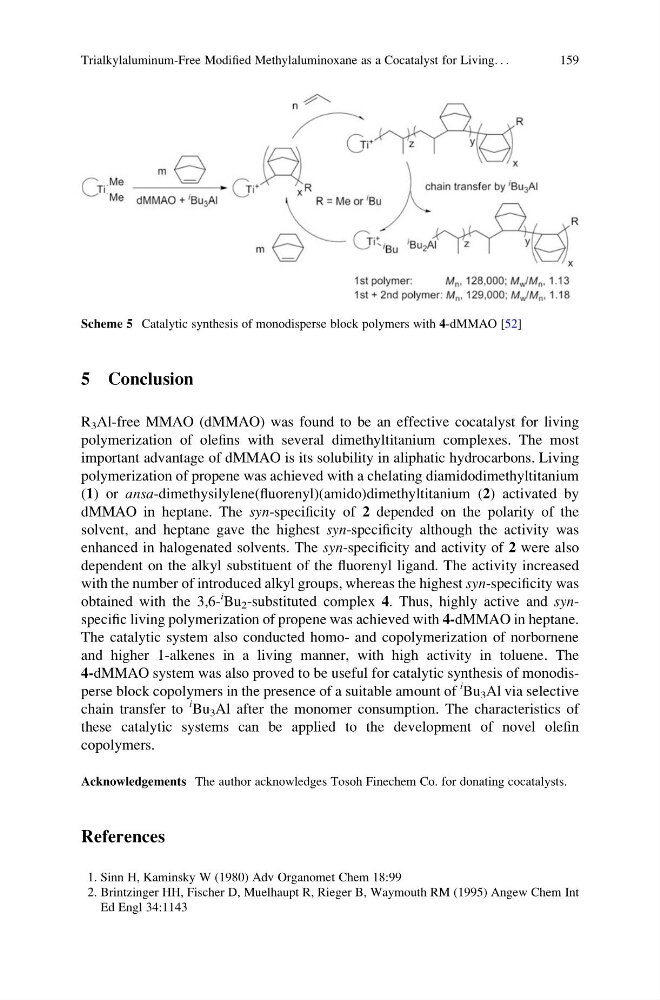
4-dMMAO system was also proved to be useful for catalytic synthesis of monodisperse block copolymers in the presence of a suitable amount of
i
Bu 3 Al via selective
chain transfer to
i Bu 3 Al after the monomer consumption. The characteristics of
these catalytic systems can be applied to the development of novel olefin
copolymers.
Acknowledgements The author acknowledges Tosoh Finechem Co. for donating cocatalysts.
References
1. Sinn H, Kaminsky W (1980) Adv Organomet Chem 18:99
2. Brintzinger HH, Fischer D, Muelhaupt R, Rieger B, Waymouth RM (1995) Angew Chem Int
Ed Engl 34:1143
Scheme 5 Catalytic synthesis of monodisperse block polymers with 4-dMMAO [52]
Trialkylaluminum-Free Modified Methylaluminoxane as a Cocatalyst for Living. . .
159
R 3 Al-free MMAO (dMMAO) was found to be an effective cocatalyst for living
polymerization of olefins with several dimethyltitanium complexes. The most
important advantage of dMMAO is its solubility in aliphatic hydrocarbons. Living
polymerization of propene was achieved with a chelating diamidodimethyltitanium
(1) or ansa-dimethysilylene(fluorenyl)(amido)dimethyltitanium (2) activated by
dMMAO in heptane. The syn-specificity of 2 depended on the polarity of the
solvent, and heptane gave the highest syn-specificity although the activity was
enhanced in halogenated solvents. The syn-specificity and activity of 2 were also
dependent on the alkyl substituent of the fluorenyl ligand. The activity increased
with the number of introduced alkyl groups, whereas the highest syn-specificity was
obtained with the 3,6i
Bu 2 -substituted complex 4. Thus, highly active and synspecific living polymerization of propene was achieved with 4-dMMAO in heptane.
The catalytic system also conducted homo- and copolymerization of norbornene
and higher 1-alkenes in a living manner, with high activity in toluene. The
4-dMMAO system was also proved to be useful for catalytic synthesis of monodisperse block copolymers in the presence of a suitable amount of
i
Bu 3 Al via selective
chain transfer to
i Bu 3 Al after the monomer consumption. The characteristics of
these catalytic systems can be applied to the development of novel olefin
copolymers.
Acknowledgements The author acknowledges Tosoh Finechem Co. for donating cocatalysts.
References
1. Sinn H, Kaminsky W (1980) Adv Organomet Chem 18:99
2. Brintzinger HH, Fischer D, Muelhaupt R, Rieger B, Waymouth RM (1995) Angew Chem Int
Ed Engl 34:1143
Scheme 5 Catalytic synthesis of monodisperse block polymers with 4-dMMAO [52]
Trialkylaluminum-Free Modified Methylaluminoxane as a Cocatalyst for Living. . .
159