

was observed in propene polymerization with C s -symmetric zirconcene catalysts,
where m-dichlorobenzene, bromobenzene or CH 2 Cl 2 was used [18–20].
3.2 Substituent Effects of Fluorenyl Ligand
The use of dMMAO enabled the living polymerization of propene in heptane,
which afforded PP with the highest syndiotacticity among the solvents employed.
We therefore synthesized a series of 2 analogues that possessed alkyl substituents
on the fluorenyl ligand: 2,7t
Bu 2 , 3; 3,6t
Bu 2 , 4; 2,3,6,7t
Bu 4 analogue, 5.
The results of propene polymerizations with these complexes activated by
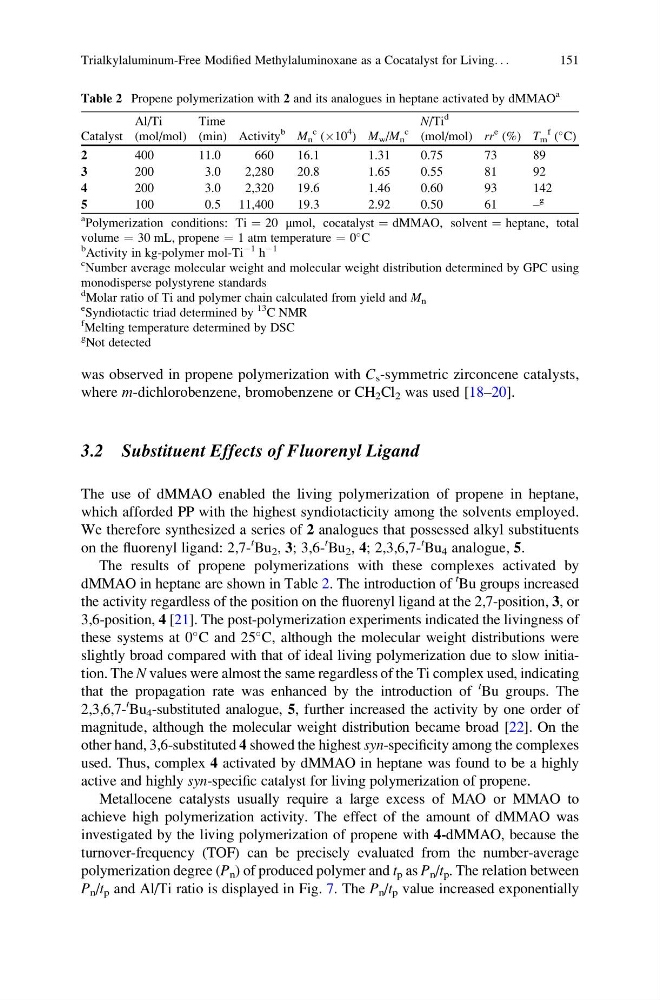
dMMAO in heptane are shown in Table 2. The introduction of
t
Bu groups increased
the activity regardless of the position on the fluorenyl ligand at the 2,7-position, 3, or
3,6-position, 4 [21]. The post-polymerization experiments indicated the livingness of
these systems at 0
C and 25
C, although the molecular weight distributions were
slightly broad compared with that of ideal living polymerization due to slow initiation. The N values were almost the same regardless of the Ti complex used, indicating
that the propagation rate was enhanced by the introduction of
t
Bu groups. The
2,3,6,7t
Bu 4 -substituted analogue, 5, further increased the activity by one order of
magnitude, although the molecular weight distribution became broad [22]. On the
other hand, 3,6-substituted 4 showed the highest syn-specificity among the complexes
used. Thus, complex 4 activated by dMMAO in heptane was found to be a highly
active and highly syn-specific catalyst for living polymerization of propene.
Metallocene catalysts usually require a large excess of MAO or MMAO to
achieve high polymerization activity. The effect of the amount of dMMAO was
investigated by the living polymerization of propene with 4-dMMAO, because the
turnover-frequency (TOF) can be precisely evaluated from the number-average
polymerization degree (P n ) of produced polymer and t p as P n /t p . The relation between
P n /t p and Al/Ti ratio is displayed in Fig. 7. The P n /t p value increased exponentially
Table 2 Propene polymerization with 2 and its analogues in heptane activated by dMMAO
a
Catalyst
Al/Ti
(mol/mol)
Time
(min) Activity
b M n
c (Â10
4
) M w /M n
c
N/Ti
d
(mol/mol) rr
e (%) T m
f (
C)
2
400
11.0
660
16.1
1.31
0.75
73
89
3
200
3.0
2,280
20.8
1.65
0.55
81
92
4
200
3.0
2,320
19.6
1.46
0.60
93
142
5
100
0.5 11,400
19.3
2.92
0.50
61
–
g
a
Polymerization conditions: Ti ¼ 20 μmol, cocatalyst ¼ dMMAO, solvent ¼ heptane, total
volume ¼ 30 mL, propene ¼ 1 atm temperature ¼ 0
C
b
Activity in kg-polymer mol-Ti
À1 h
À1
c
Number average molecular weight and molecular weight distribution determined by GPC using
monodisperse polystyrene standards
d
Molar ratio of Ti and polymer chain calculated from yield and M n
e
Syndiotactic triad determined by
13
C NMR
f
Melting temperature determined by DSC
g
Not detected
Trialkylaluminum-Free Modified Methylaluminoxane as a Cocatalyst for Living. . .
151
where m-dichlorobenzene, bromobenzene or CH 2 Cl 2 was used [18–20].
3.2 Substituent Effects of Fluorenyl Ligand
The use of dMMAO enabled the living polymerization of propene in heptane,
which afforded PP with the highest syndiotacticity among the solvents employed.
We therefore synthesized a series of 2 analogues that possessed alkyl substituents
on the fluorenyl ligand: 2,7t
Bu 2 , 3; 3,6t
Bu 2 , 4; 2,3,6,7t
Bu 4 analogue, 5.
The results of propene polymerizations with these complexes activated by
dMMAO in heptane are shown in Table 2. The introduction of
t
Bu groups increased
the activity regardless of the position on the fluorenyl ligand at the 2,7-position, 3, or
3,6-position, 4 [21]. The post-polymerization experiments indicated the livingness of
these systems at 0
C and 25
C, although the molecular weight distributions were
slightly broad compared with that of ideal living polymerization due to slow initiation. The N values were almost the same regardless of the Ti complex used, indicating
that the propagation rate was enhanced by the introduction of
t
Bu groups. The
2,3,6,7t
Bu 4 -substituted analogue, 5, further increased the activity by one order of
magnitude, although the molecular weight distribution became broad [22]. On the
other hand, 3,6-substituted 4 showed the highest syn-specificity among the complexes
used. Thus, complex 4 activated by dMMAO in heptane was found to be a highly
active and highly syn-specific catalyst for living polymerization of propene.
Metallocene catalysts usually require a large excess of MAO or MMAO to
achieve high polymerization activity. The effect of the amount of dMMAO was
investigated by the living polymerization of propene with 4-dMMAO, because the
turnover-frequency (TOF) can be precisely evaluated from the number-average
polymerization degree (P n ) of produced polymer and t p as P n /t p . The relation between
P n /t p and Al/Ti ratio is displayed in Fig. 7. The P n /t p value increased exponentially
Table 2 Propene polymerization with 2 and its analogues in heptane activated by dMMAO
a
Catalyst
Al/Ti
(mol/mol)
Time
(min) Activity
b M n
c (Â10
4
) M w /M n
c
N/Ti
d
(mol/mol) rr
e (%) T m
f (
C)
2
400
11.0
660
16.1
1.31
0.75
73
89
3
200
3.0
2,280
20.8
1.65
0.55
81
92
4
200
3.0
2,320
19.6
1.46
0.60
93
142
5
100
0.5 11,400
19.3
2.92
0.50
61
–
g
a
Polymerization conditions: Ti ¼ 20 μmol, cocatalyst ¼ dMMAO, solvent ¼ heptane, total
volume ¼ 30 mL, propene ¼ 1 atm temperature ¼ 0
C
b
Activity in kg-polymer mol-Ti
À1 h
À1
c
Number average molecular weight and molecular weight distribution determined by GPC using
monodisperse polystyrene standards
d
Molar ratio of Ti and polymer chain calculated from yield and M n
e
Syndiotactic triad determined by
13
C NMR
f
Melting temperature determined by DSC
g
Not detected
Trialkylaluminum-Free Modified Methylaluminoxane as a Cocatalyst for Living. . .
151