

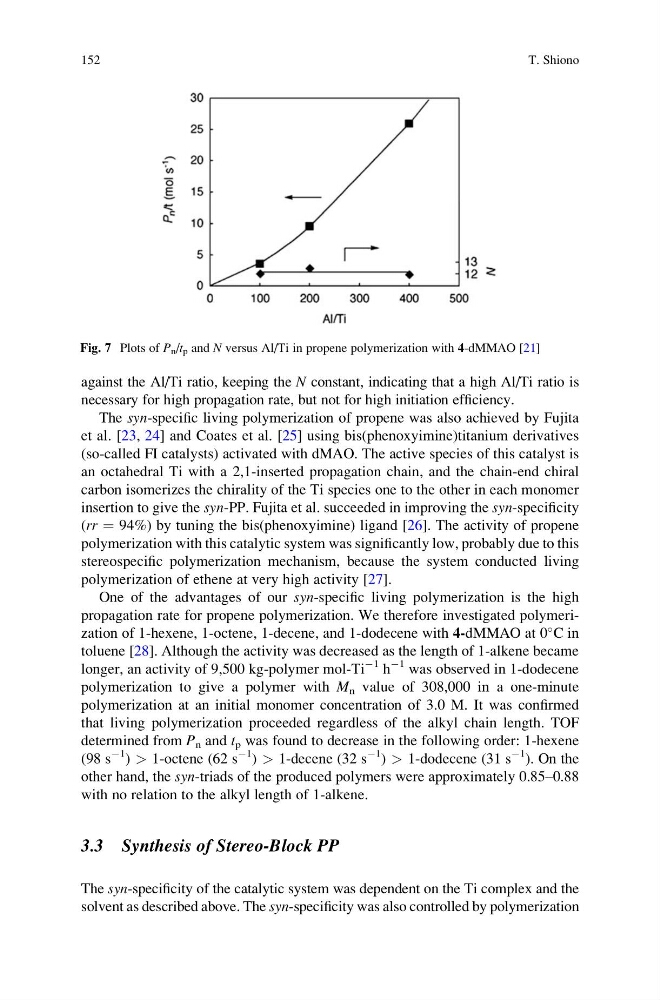
against the Al/Ti ratio, keeping the N constant, indicating that a high Al/Ti ratio is
necessary for high propagation rate, but not for high initiation efficiency.
The syn-specific living polymerization of propene was also achieved by Fujita
et al. [23, 24] and Coates et al. [25] using bis(phenoxyimine)titanium derivatives
(so-called FI catalysts) activated with dMAO. The active species of this catalyst is
an octahedral Ti with a 2,1-inserted propagation chain, and the chain-end chiral
carbon isomerizes the chirality of the Ti species one to the other in each monomer
insertion to give the syn-PP. Fujita et al. succeeded in improving the syn-specificity
(rr ¼ 94%) by tuning the bis(phenoxyimine) ligand [26]. The activity of propene
polymerization with this catalytic system was significantly low, probably due to this
stereospecific polymerization mechanism, because the system conducted living
polymerization of ethene at very high activity [27].
One of the advantages of our syn-specific living polymerization is the high
propagation rate for propene polymerization. We therefore investigated polymerization of 1-hexene, 1-octene, 1-decene, and 1-dodecene with 4-dMMAO at 0
C in
toluene [28]. Although the activity was decreased as the length of 1-alkene became
longer, an activity of 9,500 kg-polymer mol-Ti
À1 h
À1 was observed in 1-dodecene
polymerization to give a polymer with M n value of 308,000 in a one-minute
polymerization at an initial monomer concentration of 3.0 M. It was confirmed
that living polymerization proceeded regardless of the alkyl chain length. TOF
determined from P n and t p was found to decrease in the following order: 1-hexene
(98 s
À1 ) > 1-octene (62 s
À1 ) > 1-decene (32 s
À1 ) > 1-dodecene (31 s
À1 ). On the
other hand, the syn-triads of the produced polymers were approximately 0.85–0.88
with no relation to the alkyl length of 1-alkene.
3.3 Synthesis of Stereo-Block PP
The syn-specificity of the catalytic system was dependent on the Ti complex and the
solvent as described above. The syn-specificity was also controlled by polymerization
Fig. 7 Plots of P n /t p and N versus Al/Ti in propene polymerization with 4-dMMAO [21]
152
T. Shiono
necessary for high propagation rate, but not for high initiation efficiency.
The syn-specific living polymerization of propene was also achieved by Fujita
et al. [23, 24] and Coates et al. [25] using bis(phenoxyimine)titanium derivatives
(so-called FI catalysts) activated with dMAO. The active species of this catalyst is
an octahedral Ti with a 2,1-inserted propagation chain, and the chain-end chiral
carbon isomerizes the chirality of the Ti species one to the other in each monomer
insertion to give the syn-PP. Fujita et al. succeeded in improving the syn-specificity
(rr ¼ 94%) by tuning the bis(phenoxyimine) ligand [26]. The activity of propene
polymerization with this catalytic system was significantly low, probably due to this
stereospecific polymerization mechanism, because the system conducted living
polymerization of ethene at very high activity [27].
One of the advantages of our syn-specific living polymerization is the high
propagation rate for propene polymerization. We therefore investigated polymerization of 1-hexene, 1-octene, 1-decene, and 1-dodecene with 4-dMMAO at 0
C in
toluene [28]. Although the activity was decreased as the length of 1-alkene became
longer, an activity of 9,500 kg-polymer mol-Ti
À1 h
À1 was observed in 1-dodecene
polymerization to give a polymer with M n value of 308,000 in a one-minute
polymerization at an initial monomer concentration of 3.0 M. It was confirmed
that living polymerization proceeded regardless of the alkyl chain length. TOF
determined from P n and t p was found to decrease in the following order: 1-hexene
(98 s
À1 ) > 1-octene (62 s
À1 ) > 1-decene (32 s
À1 ) > 1-dodecene (31 s
À1 ). On the
other hand, the syn-triads of the produced polymers were approximately 0.85–0.88
with no relation to the alkyl length of 1-alkene.
3.3 Synthesis of Stereo-Block PP
The syn-specificity of the catalytic system was dependent on the Ti complex and the
solvent as described above. The syn-specificity was also controlled by polymerization
Fig. 7 Plots of P n /t p and N versus Al/Ti in propene polymerization with 4-dMMAO [21]
152
T. Shiono