

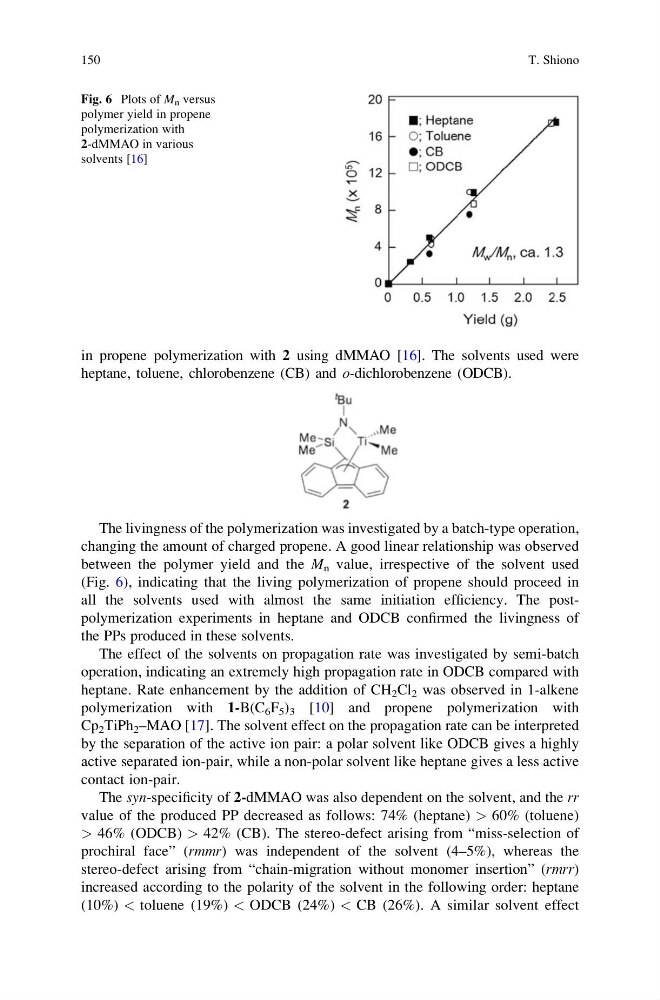
in propene polymerization with 2 using dMMAO [16]. The solvents used were
heptane, toluene, chlorobenzene (CB) and o-dichlorobenzene (ODCB).
The livingness of the polymerization was investigated by a batch-type operation,
changing the amount of charged propene. A good linear relationship was observed
between the polymer yield and the M n value, irrespective of the solvent used
(Fig. 6), indicating that the living polymerization of propene should proceed in
all the solvents used with almost the same initiation efficiency. The postpolymerization experiments in heptane and ODCB confirmed the livingness of
the PPs produced in these solvents.
The effect of the solvents on propagation rate was investigated by semi-batch
operation, indicating an extremely high propagation rate in ODCB compared with
heptane. Rate enhancement by the addition of CH 2 Cl 2 was observed in 1-alkene
polymerization with 1-B(C 6 F 5 ) 3 [10] and propene polymerization with
Cp 2 TiPh 2 –MAO [17]. The solvent effect on the propagation rate can be interpreted
by the separation of the active ion pair: a polar solvent like ODCB gives a highly
active separated ion-pair, while a non-polar solvent like heptane gives a less active
contact ion-pair.
The syn-specificity of 2-dMMAO was also dependent on the solvent, and the rr
value of the produced PP decreased as follows: 74% (heptane) > 60% (toluene)
> 46% (ODCB) > 42% (CB). The stereo-defect arising from “miss-selection of
prochiral face” (rmmr) was independent of the solvent (4–5%), whereas the
stereo-defect arising from “chain-migration without monomer insertion” (rmrr)
increased according to the polarity of the solvent in the following order: heptane
(10%) < toluene (19%) < ODCB (24%) < CB (26%). A similar solvent effect
Fig. 6 Plots of M n versus
polymer yield in propene
polymerization with
2-dMMAO in various
solvents [16]
150
T. Shiono
heptane, toluene, chlorobenzene (CB) and o-dichlorobenzene (ODCB).
The livingness of the polymerization was investigated by a batch-type operation,
changing the amount of charged propene. A good linear relationship was observed
between the polymer yield and the M n value, irrespective of the solvent used
(Fig. 6), indicating that the living polymerization of propene should proceed in
all the solvents used with almost the same initiation efficiency. The postpolymerization experiments in heptane and ODCB confirmed the livingness of
the PPs produced in these solvents.
The effect of the solvents on propagation rate was investigated by semi-batch
operation, indicating an extremely high propagation rate in ODCB compared with
heptane. Rate enhancement by the addition of CH 2 Cl 2 was observed in 1-alkene
polymerization with 1-B(C 6 F 5 ) 3 [10] and propene polymerization with
Cp 2 TiPh 2 –MAO [17]. The solvent effect on the propagation rate can be interpreted
by the separation of the active ion pair: a polar solvent like ODCB gives a highly
active separated ion-pair, while a non-polar solvent like heptane gives a less active
contact ion-pair.
The syn-specificity of 2-dMMAO was also dependent on the solvent, and the rr
value of the produced PP decreased as follows: 74% (heptane) > 60% (toluene)
> 46% (ODCB) > 42% (CB). The stereo-defect arising from “miss-selection of
prochiral face” (rmmr) was independent of the solvent (4–5%), whereas the
stereo-defect arising from “chain-migration without monomer insertion” (rmrr)
increased according to the polarity of the solvent in the following order: heptane
(10%) < toluene (19%) < ODCB (24%) < CB (26%). A similar solvent effect
Fig. 6 Plots of M n versus
polymer yield in propene
polymerization with
2-dMMAO in various
solvents [16]
150
T. Shiono