

i.e., an increase in the Lewis acidity of dMMAO. This order is in good agreement
with that of the M n values. Thus, a cocatalyst with stronger Lewis acidity gives the
active species with higher propagation rate, which can be interpreted by the
separation of the active ion pair formed from the dimethyltitanium complex and
the cocatalyst.
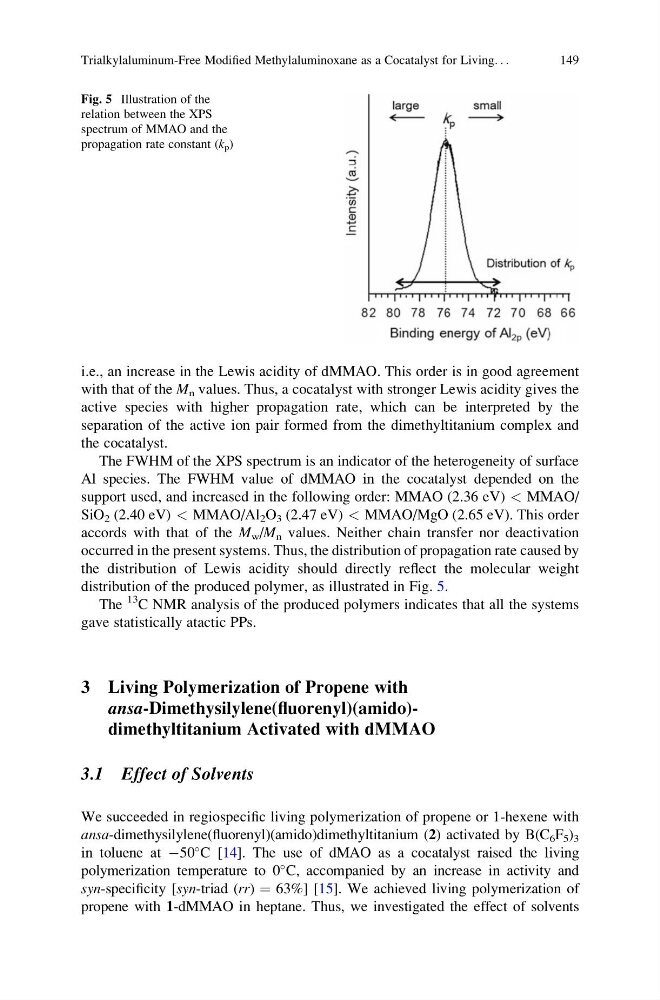
The FWHM of the XPS spectrum is an indicator of the heterogeneity of surface
Al species. The FWHM value of dMMAO in the cocatalyst depended on the
support used, and increased in the following order: MMAO (2.36 eV) < MMAO/
SiO 2 (2.40 eV) < MMAO/Al 2 O 3 (2.47 eV) < MMAO/MgO (2.65 eV). This order
accords with that of the M w /M n values. Neither chain transfer nor deactivation
occurred in the present systems. Thus, the distribution of propagation rate caused by
the distribution of Lewis acidity should directly reflect the molecular weight
distribution of the produced polymer, as illustrated in Fig. 5.
The
13 C NMR analysis of the produced polymers indicates that all the systems
gave statistically atactic PPs.
3 Living Polymerization of Propene with
ansa-Dimethysilylene(fluorenyl)(amido)dimethyltitanium Activated with dMMAO
3.1 Effect of Solvents
We succeeded in regiospecific living polymerization of propene or 1-hexene with
ansa-dimethysilylene(fluorenyl)(amido)dimethyltitanium (2) activated by B(C 6 F 5 ) 3
in toluene at À50
C [14]. The use of dMAO as a cocatalyst raised the living
polymerization temperature to 0
C, accompanied by an increase in activity and
syn-specificity [syn-triad (rr) ¼ 63%] [15]. We achieved living polymerization of
propene with 1-dMMAO in heptane. Thus, we investigated the effect of solvents
Fig. 5 Illustration of the
relation between the XPS
spectrum of MMAO and the
propagation rate constant (k p )
Trialkylaluminum-Free Modified Methylaluminoxane as a Cocatalyst for Living. . .
149
with that of the M n values. Thus, a cocatalyst with stronger Lewis acidity gives the
active species with higher propagation rate, which can be interpreted by the
separation of the active ion pair formed from the dimethyltitanium complex and
the cocatalyst.
The FWHM of the XPS spectrum is an indicator of the heterogeneity of surface
Al species. The FWHM value of dMMAO in the cocatalyst depended on the
support used, and increased in the following order: MMAO (2.36 eV) < MMAO/
SiO 2 (2.40 eV) < MMAO/Al 2 O 3 (2.47 eV) < MMAO/MgO (2.65 eV). This order
accords with that of the M w /M n values. Neither chain transfer nor deactivation
occurred in the present systems. Thus, the distribution of propagation rate caused by
the distribution of Lewis acidity should directly reflect the molecular weight
distribution of the produced polymer, as illustrated in Fig. 5.
The
13 C NMR analysis of the produced polymers indicates that all the systems
gave statistically atactic PPs.
3 Living Polymerization of Propene with
ansa-Dimethysilylene(fluorenyl)(amido)dimethyltitanium Activated with dMMAO
3.1 Effect of Solvents
We succeeded in regiospecific living polymerization of propene or 1-hexene with
ansa-dimethysilylene(fluorenyl)(amido)dimethyltitanium (2) activated by B(C 6 F 5 ) 3
in toluene at À50
C [14]. The use of dMAO as a cocatalyst raised the living
polymerization temperature to 0
C, accompanied by an increase in activity and
syn-specificity [syn-triad (rr) ¼ 63%] [15]. We achieved living polymerization of
propene with 1-dMMAO in heptane. Thus, we investigated the effect of solvents
Fig. 5 Illustration of the
relation between the XPS
spectrum of MMAO and the
propagation rate constant (k p )
Trialkylaluminum-Free Modified Methylaluminoxane as a Cocatalyst for Living. . .
149