

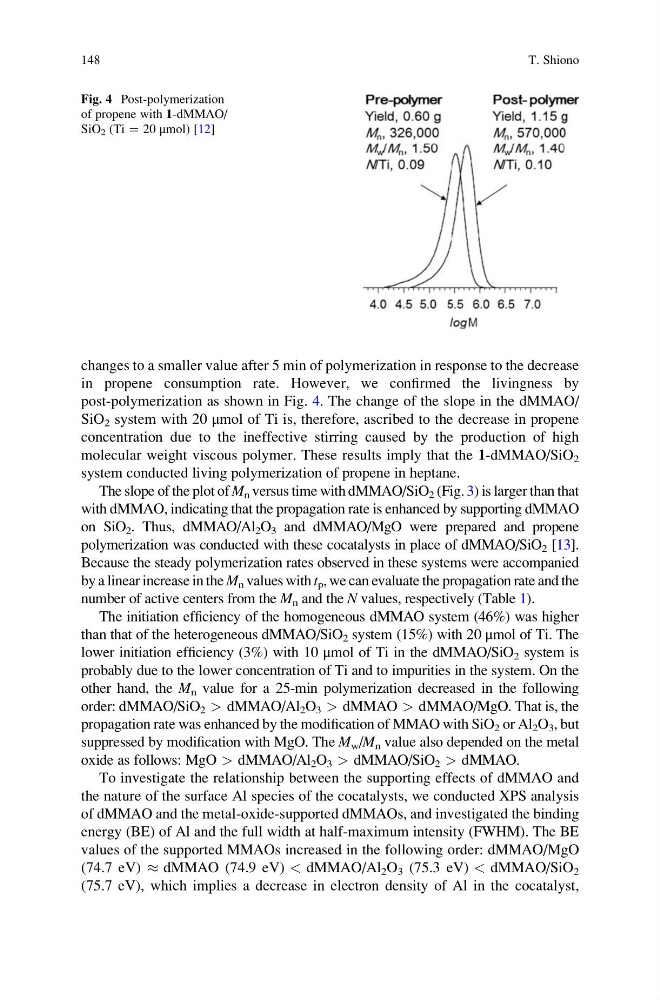
changes to a smaller value after 5 min of polymerization in response to the decrease
in propene consumption rate. However, we confirmed the livingness by
post-polymerization as shown in Fig. 4. The change of the slope in the dMMAO/
SiO 2 system with 20 μmol of Ti is, therefore, ascribed to the decrease in propene
concentration due to the ineffective stirring caused by the production of high
molecular weight viscous polymer. These results imply that the 1-dMMAO/SiO 2
system conducted living polymerization of propene in heptane.
The slope of the plot of M n versus time with dMMAO/SiO 2 (Fig. 3) is larger than that
with dMMAO, indicating that the propagation rate is enhanced by supporting dMMAO
on SiO 2 . Thus, dMMAO/Al 2 O 3 and dMMAO/MgO were prepared and propene
polymerization was conducted with these cocatalysts in place of dMMAO/SiO 2 [13].
Because the steady polymerization rates observed in these systems were accompanied
by a linear increase in the M n values with t p , we can evaluate the propagation rate and the
number of active centers from the M n and the N values, respectively (Table 1).
The initiation efficiency of the homogeneous dMMAO system (46%) was higher
than that of the heterogeneous dMMAO/SiO 2 system (15%) with 20 μmol of Ti. The
lower initiation efficiency (3%) with 10 μmol of Ti in the dMMAO/SiO 2 system is
probably due to the lower concentration of Ti and to impurities in the system. On the
other hand, the M n value for a 25-min polymerization decreased in the following
order: dMMAO/SiO 2 > dMMAO/Al 2 O 3 > dMMAO > dMMAO/MgO. That is, the
propagation rate was enhanced by the modification of MMAO with SiO 2 or Al 2 O 3 , but
suppressed by modification with MgO. The M w /M n value also depended on the metal
oxide as follows: MgO > dMMAO/Al 2 O 3 > dMMAO/SiO 2 > dMMAO.
To investigate the relationship between the supporting effects of dMMAO and
the nature of the surface Al species of the cocatalysts, we conducted XPS analysis
of dMMAO and the metal-oxide-supported dMMAOs, and investigated the binding
energy (BE) of Al and the full width at half-maximum intensity (FWHM). The BE
values of the supported MMAOs increased in the following order: dMMAO/MgO
(74.7 eV) % dMMAO (74.9 eV) < dMMAO/Al 2 O 3 (75.3 eV) < dMMAO/SiO 2
(75.7 eV), which implies a decrease in electron density of Al in the cocatalyst,
Fig. 4 Post-polymerization
of propene with 1-dMMAO/
SiO 2 (Ti ¼ 20 μmol) [12]
148
T. Shiono
in propene consumption rate. However, we confirmed the livingness by
post-polymerization as shown in Fig. 4. The change of the slope in the dMMAO/
SiO 2 system with 20 μmol of Ti is, therefore, ascribed to the decrease in propene
concentration due to the ineffective stirring caused by the production of high
molecular weight viscous polymer. These results imply that the 1-dMMAO/SiO 2
system conducted living polymerization of propene in heptane.
The slope of the plot of M n versus time with dMMAO/SiO 2 (Fig. 3) is larger than that
with dMMAO, indicating that the propagation rate is enhanced by supporting dMMAO
on SiO 2 . Thus, dMMAO/Al 2 O 3 and dMMAO/MgO were prepared and propene
polymerization was conducted with these cocatalysts in place of dMMAO/SiO 2 [13].
Because the steady polymerization rates observed in these systems were accompanied
by a linear increase in the M n values with t p , we can evaluate the propagation rate and the
number of active centers from the M n and the N values, respectively (Table 1).
The initiation efficiency of the homogeneous dMMAO system (46%) was higher
than that of the heterogeneous dMMAO/SiO 2 system (15%) with 20 μmol of Ti. The
lower initiation efficiency (3%) with 10 μmol of Ti in the dMMAO/SiO 2 system is
probably due to the lower concentration of Ti and to impurities in the system. On the
other hand, the M n value for a 25-min polymerization decreased in the following
order: dMMAO/SiO 2 > dMMAO/Al 2 O 3 > dMMAO > dMMAO/MgO. That is, the
propagation rate was enhanced by the modification of MMAO with SiO 2 or Al 2 O 3 , but
suppressed by modification with MgO. The M w /M n value also depended on the metal
oxide as follows: MgO > dMMAO/Al 2 O 3 > dMMAO/SiO 2 > dMMAO.
To investigate the relationship between the supporting effects of dMMAO and
the nature of the surface Al species of the cocatalysts, we conducted XPS analysis
of dMMAO and the metal-oxide-supported dMMAOs, and investigated the binding
energy (BE) of Al and the full width at half-maximum intensity (FWHM). The BE
values of the supported MMAOs increased in the following order: dMMAO/MgO
(74.7 eV) % dMMAO (74.9 eV) < dMMAO/Al 2 O 3 (75.3 eV) < dMMAO/SiO 2
(75.7 eV), which implies a decrease in electron density of Al in the cocatalyst,
Fig. 4 Post-polymerization
of propene with 1-dMMAO/
SiO 2 (Ti ¼ 20 μmol) [12]
148
T. Shiono