

dependence of molecular weight on polymerization time (t p ) was investigated by
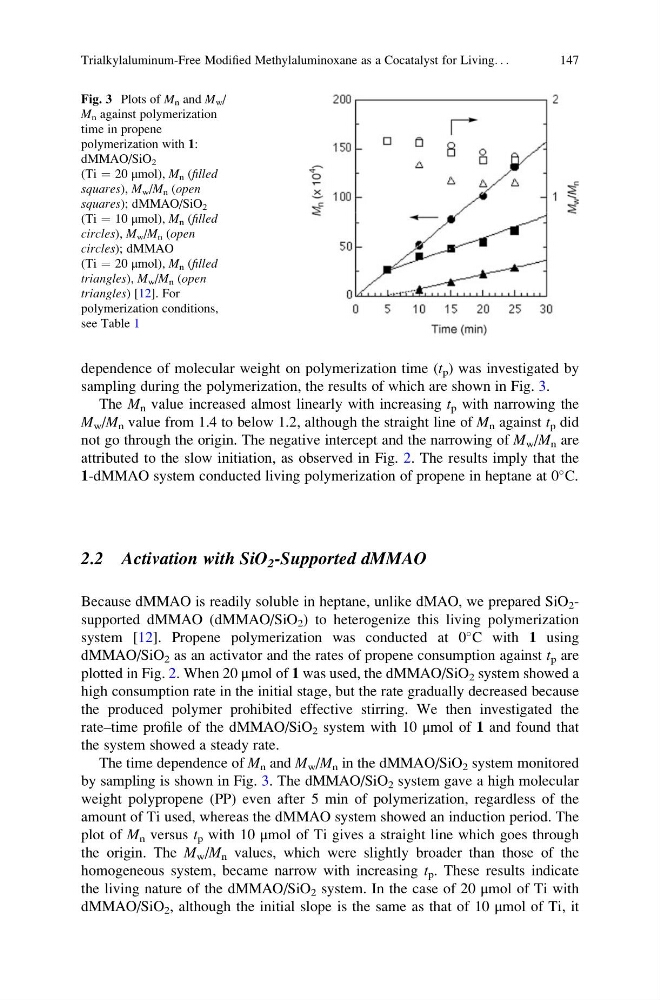
sampling during the polymerization, the results of which are shown in Fig. 3.
The M n value increased almost linearly with increasing t p with narrowing the
M w /M n value from 1.4 to below 1.2, although the straight line of M n against t p did
not go through the origin. The negative intercept and the narrowing of M w /M n are
attributed to the slow initiation, as observed in Fig. 2. The results imply that the
1-dMMAO system conducted living polymerization of propene in heptane at 0
C.
2.2 Activation with SiO 2 -Supported dMMAO
Because dMMAO is readily soluble in heptane, unlike dMAO, we prepared SiO 2 -
supported dMMAO (dMMAO/SiO 2 ) to heterogenize this living polymerization
system [12]. Propene polymerization was conducted at 0
C with 1 using
dMMAO/SiO 2 as an activator and the rates of propene consumption against t p are
plotted in Fig. 2. When 20 μmol of 1 was used, the dMMAO/SiO 2 system showed a
high consumption rate in the initial stage, but the rate gradually decreased because
the produced polymer prohibited effective stirring. We then investigated the
rate–time profile of the dMMAO/SiO 2 system with 10 μmol of 1 and found that
the system showed a steady rate.
The time dependence of M n and M w /M n in the dMMAO/SiO 2 system monitored
by sampling is shown in Fig. 3. The dMMAO/SiO 2 system gave a high molecular
weight polypropene (PP) even after 5 min of polymerization, regardless of the
amount of Ti used, whereas the dMMAO system showed an induction period. The
plot of M n versus t p with 10 μmol of Ti gives a straight line which goes through
the origin. The M w /M n values, which were slightly broader than those of the
homogeneous system, became narrow with increasing t p . These results indicate
the living nature of the dMMAO/SiO 2 system. In the case of 20 μmol of Ti with
dMMAO/SiO 2 , although the initial slope is the same as that of 10 μmol of Ti, it
Fig. 3 Plots of M n and M w /
M n against polymerization
time in propene
polymerization with 1:
dMMAO/SiO 2
(Ti ¼ 20 μmol), M n (filled
squares), M w /M n (open
squares); dMMAO/SiO 2
(Ti ¼ 10 μmol), M n (filled
circles), M w /M n (open
circles); dMMAO
(Ti ¼ 20 μmol), M n (filled
triangles), M w /M n (open
triangles) [12]. For
polymerization conditions,
see Table 1
Trialkylaluminum-Free Modified Methylaluminoxane as a Cocatalyst for Living. . .
147
sampling during the polymerization, the results of which are shown in Fig. 3.
The M n value increased almost linearly with increasing t p with narrowing the
M w /M n value from 1.4 to below 1.2, although the straight line of M n against t p did
not go through the origin. The negative intercept and the narrowing of M w /M n are
attributed to the slow initiation, as observed in Fig. 2. The results imply that the
1-dMMAO system conducted living polymerization of propene in heptane at 0
C.
2.2 Activation with SiO 2 -Supported dMMAO
Because dMMAO is readily soluble in heptane, unlike dMAO, we prepared SiO 2 -
supported dMMAO (dMMAO/SiO 2 ) to heterogenize this living polymerization
system [12]. Propene polymerization was conducted at 0
C with 1 using
dMMAO/SiO 2 as an activator and the rates of propene consumption against t p are
plotted in Fig. 2. When 20 μmol of 1 was used, the dMMAO/SiO 2 system showed a
high consumption rate in the initial stage, but the rate gradually decreased because
the produced polymer prohibited effective stirring. We then investigated the
rate–time profile of the dMMAO/SiO 2 system with 10 μmol of 1 and found that
the system showed a steady rate.
The time dependence of M n and M w /M n in the dMMAO/SiO 2 system monitored
by sampling is shown in Fig. 3. The dMMAO/SiO 2 system gave a high molecular
weight polypropene (PP) even after 5 min of polymerization, regardless of the
amount of Ti used, whereas the dMMAO system showed an induction period. The
plot of M n versus t p with 10 μmol of Ti gives a straight line which goes through
the origin. The M w /M n values, which were slightly broader than those of the
homogeneous system, became narrow with increasing t p . These results indicate
the living nature of the dMMAO/SiO 2 system. In the case of 20 μmol of Ti with
dMMAO/SiO 2 , although the initial slope is the same as that of 10 μmol of Ti, it
Fig. 3 Plots of M n and M w /
M n against polymerization
time in propene
polymerization with 1:
dMMAO/SiO 2
(Ti ¼ 20 μmol), M n (filled
squares), M w /M n (open
squares); dMMAO/SiO 2
(Ti ¼ 10 μmol), M n (filled
circles), M w /M n (open
circles); dMMAO
(Ti ¼ 20 μmol), M n (filled
triangles), M w /M n (open
triangles) [12]. For
polymerization conditions,
see Table 1
Trialkylaluminum-Free Modified Methylaluminoxane as a Cocatalyst for Living. . .
147