

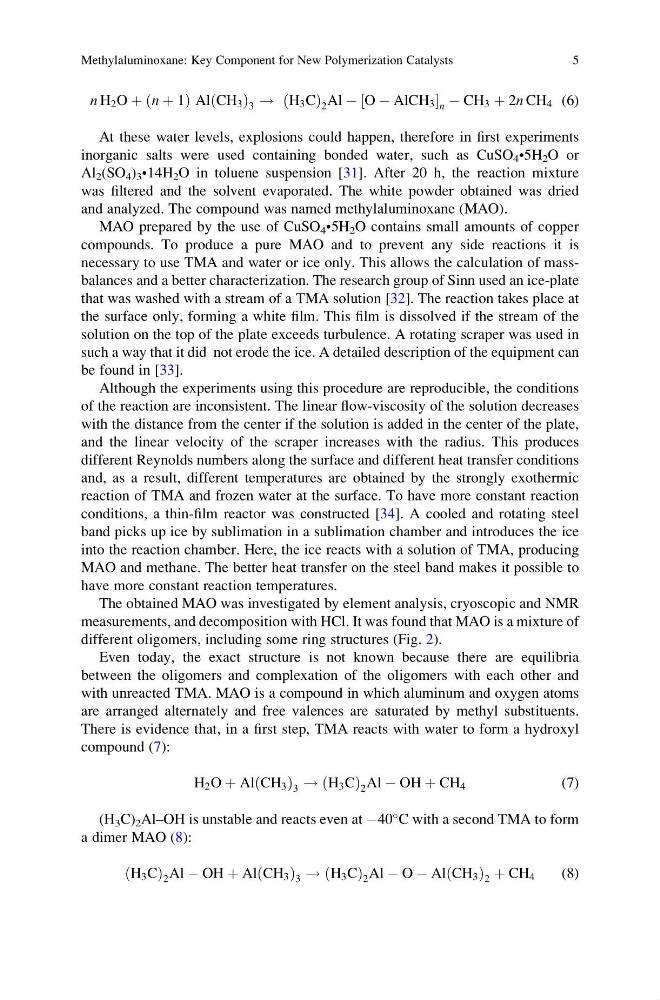
n H 2 O þ n þ 1
ð
Þ Al CH 3
ð
Þ 3 ! ðH 3 CÞ 2 Al À O À AlCH 3
½
n À CH 3 þ 2n CH 4 (6)
At these water levels, explosions could happen, therefore in first experiments
inorganic salts were used containing bonded water, such as CuSO 4 •5H 2 O or
Al 2 (SO 4 ) 3 •14H 2 O in toluene suspension [31]. After 20 h, the reaction mixture
was filtered and the solvent evaporated. The white powder obtained was dried
and analyzed. The compound was named methylaluminoxane (MAO).
MAO prepared by the use of CuSO 4 •5H 2 O contains small amounts of copper
compounds. To produce a pure MAO and to prevent any side reactions it is
necessary to use TMA and water or ice only. This allows the calculation of massbalances and a better characterization. The research group of Sinn used an ice-plate
that was washed with a stream of a TMA solution [32]. The reaction takes place at
the surface only, forming a white film. This film is dissolved if the stream of the
solution on the top of the plate exceeds turbulence. A rotating scraper was used in
such a way that it did not erode the ice. A detailed description of the equipment can
be found in [33].
Although the experiments using this procedure are reproducible, the conditions
of the reaction are inconsistent. The linear flow-viscosity of the solution decreases
with the distance from the center if the solution is added in the center of the plate,
and the linear velocity of the scraper increases with the radius. This produces
different Reynolds numbers along the surface and different heat transfer conditions
and, as a result, different temperatures are obtained by the strongly exothermic
reaction of TMA and frozen water at the surface. To have more constant reaction
conditions, a thin-film reactor was constructed [34]. A cooled and rotating steel
band picks up ice by sublimation in a sublimation chamber and introduces the ice
into the reaction chamber. Here, the ice reacts with a solution of TMA, producing
MAO and methane. The better heat transfer on the steel band makes it possible to
have more constant reaction temperatures.
The obtained MAO was investigated by element analysis, cryoscopic and NMR
measurements, and decomposition with HCl. It was found that MAO is a mixture of
different oligomers, including some ring structures (Fig. 2).
Even today, the exact structure is not known because there are equilibria
between the oligomers and complexation of the oligomers with each other and
with unreacted TMA. MAO is a compound in which aluminum and oxygen atoms
are arranged alternately and free valences are saturated by methyl substituents.
There is evidence that, in a first step, TMA reacts with water to form a hydroxyl
compound (7):
H 2 O þ Al CH 3
ð
Þ 3 ! H 3 C
ð
Þ 2 Al À OH þ CH 4
(7)
(H 3 C) 2 Al–OH is unstable and reacts even at À40
C with a second TMA to form
a dimer MAO (8):
H 3 C
ð
Þ 2 Al À OH þ Al CH 3
ð
Þ 3 ! H 3 C
ð
Þ 2 Al À O À Al CH 3
ð
Þ 2 þ CH 4
(8)
Methylaluminoxane: Key Component for New Polymerization Catalysts
5
ð
Þ Al CH 3
ð
Þ 3 ! ðH 3 CÞ 2 Al À O À AlCH 3
½
n À CH 3 þ 2n CH 4 (6)
At these water levels, explosions could happen, therefore in first experiments
inorganic salts were used containing bonded water, such as CuSO 4 •5H 2 O or
Al 2 (SO 4 ) 3 •14H 2 O in toluene suspension [31]. After 20 h, the reaction mixture
was filtered and the solvent evaporated. The white powder obtained was dried
and analyzed. The compound was named methylaluminoxane (MAO).
MAO prepared by the use of CuSO 4 •5H 2 O contains small amounts of copper
compounds. To produce a pure MAO and to prevent any side reactions it is
necessary to use TMA and water or ice only. This allows the calculation of massbalances and a better characterization. The research group of Sinn used an ice-plate
that was washed with a stream of a TMA solution [32]. The reaction takes place at
the surface only, forming a white film. This film is dissolved if the stream of the
solution on the top of the plate exceeds turbulence. A rotating scraper was used in
such a way that it did not erode the ice. A detailed description of the equipment can
be found in [33].
Although the experiments using this procedure are reproducible, the conditions
of the reaction are inconsistent. The linear flow-viscosity of the solution decreases
with the distance from the center if the solution is added in the center of the plate,
and the linear velocity of the scraper increases with the radius. This produces
different Reynolds numbers along the surface and different heat transfer conditions
and, as a result, different temperatures are obtained by the strongly exothermic
reaction of TMA and frozen water at the surface. To have more constant reaction
conditions, a thin-film reactor was constructed [34]. A cooled and rotating steel
band picks up ice by sublimation in a sublimation chamber and introduces the ice
into the reaction chamber. Here, the ice reacts with a solution of TMA, producing
MAO and methane. The better heat transfer on the steel band makes it possible to
have more constant reaction temperatures.
The obtained MAO was investigated by element analysis, cryoscopic and NMR
measurements, and decomposition with HCl. It was found that MAO is a mixture of
different oligomers, including some ring structures (Fig. 2).
Even today, the exact structure is not known because there are equilibria
between the oligomers and complexation of the oligomers with each other and
with unreacted TMA. MAO is a compound in which aluminum and oxygen atoms
are arranged alternately and free valences are saturated by methyl substituents.
There is evidence that, in a first step, TMA reacts with water to form a hydroxyl
compound (7):
H 2 O þ Al CH 3
ð
Þ 3 ! H 3 C
ð
Þ 2 Al À OH þ CH 4
(7)
(H 3 C) 2 Al–OH is unstable and reacts even at À40
C with a second TMA to form
a dimer MAO (8):
H 3 C
ð
Þ 2 Al À OH þ Al CH 3
ð
Þ 3 ! H 3 C
ð
Þ 2 Al À O À Al CH 3
ð
Þ 2 þ CH 4
(8)
Methylaluminoxane: Key Component for New Polymerization Catalysts
5