

In the case of MAO there is no evidence that the dimer (H 3 C) 2 Al–O–Al(CH 3 ) 2
will be stable unless the reaction is done in homogeneous solution (for instance,
hexadeutero benzene) with concentrations of TMA <100 mmol/L and the products
are stabilized by donors (for instance, diethyl ether).
If highly dispersed water is added to a 20 mM solution of TMA in hexadeutero
benzene (which is able to solve the introduced amount of water) a reaction evolving
methane takes place within <100 s. The H-NMR integral of TMA, which was
found at À0.351 ppm with a value of 778.4, was reduced equivalently to the amount
of water added and showed an integral value of 532.1; only a very small broadening
of the signal could be seen. However, if diethyl ether was added, the signal at
À0.351 ppm disappeared and two new signals were found, one at À0.472 ppm with
an integral value of 324.8 and another at À0.607 ppm with an integral value of
157.3. The signal at À0.607 ppm was identified as TMA-diethyetherate.
The solution with added diethyl ether was stable for some days. A very small
reduction in size of the integral values can be seen within some hours, but the
postulated condensation (9) with evolving TMA has not yet been proved to be simple:
2 H 3 C
ð
Þ 2 Al À O À Al CH 3
ð
Þ 2 ! H 3 C
ð
Þ 2 Al À O À AlðCH 3 Þ À O À Al CH 3
ð
Þ 2
þ Al CH 3
ð
Þ 3
(9)
However, there is no doubt that MAO structures have the ability to condense
with splitting off of TMA. A MAO sample with a vapor tension of <0.001 mbar
was sealed in 1997 under argon and contained, when opened in 2007, serious
amounts of TMA, which were condensed off and characterized [35]. The splitting
off of TMA seems to be a general property of methylaluminum compounds and
able to cause the formation of long-chained, advanced MAO products by curious
reactions [36, 37].
According to investigations by Sinn [38], there is evidence that a compound with
a ratio CH 3 /Al ¼ 1.5 plays an important role in the formation of MAO. If diethyl
ether is added to a solution of MAO and TMA in toluene, a phase separation takes
place. After the separation is finished, all TMA will be found in the upper phase.
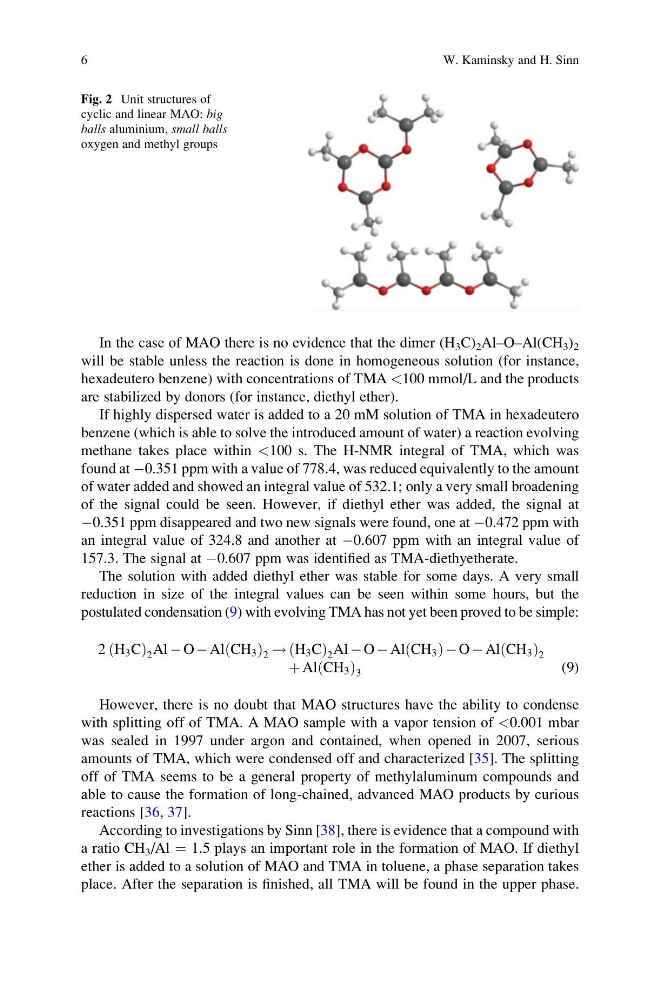
Fig. 2 Unit structures of
cyclic and linear MAO: big
balls aluminium, small balls
oxygen and methyl groups
6
W. Kaminsky and H. Sinn
will be stable unless the reaction is done in homogeneous solution (for instance,
hexadeutero benzene) with concentrations of TMA <100 mmol/L and the products
are stabilized by donors (for instance, diethyl ether).
If highly dispersed water is added to a 20 mM solution of TMA in hexadeutero
benzene (which is able to solve the introduced amount of water) a reaction evolving
methane takes place within <100 s. The H-NMR integral of TMA, which was
found at À0.351 ppm with a value of 778.4, was reduced equivalently to the amount
of water added and showed an integral value of 532.1; only a very small broadening
of the signal could be seen. However, if diethyl ether was added, the signal at
À0.351 ppm disappeared and two new signals were found, one at À0.472 ppm with
an integral value of 324.8 and another at À0.607 ppm with an integral value of
157.3. The signal at À0.607 ppm was identified as TMA-diethyetherate.
The solution with added diethyl ether was stable for some days. A very small
reduction in size of the integral values can be seen within some hours, but the
postulated condensation (9) with evolving TMA has not yet been proved to be simple:
2 H 3 C
ð
Þ 2 Al À O À Al CH 3
ð
Þ 2 ! H 3 C
ð
Þ 2 Al À O À AlðCH 3 Þ À O À Al CH 3
ð
Þ 2
þ Al CH 3
ð
Þ 3
(9)
However, there is no doubt that MAO structures have the ability to condense
with splitting off of TMA. A MAO sample with a vapor tension of <0.001 mbar
was sealed in 1997 under argon and contained, when opened in 2007, serious
amounts of TMA, which were condensed off and characterized [35]. The splitting
off of TMA seems to be a general property of methylaluminum compounds and
able to cause the formation of long-chained, advanced MAO products by curious
reactions [36, 37].
According to investigations by Sinn [38], there is evidence that a compound with
a ratio CH 3 /Al ¼ 1.5 plays an important role in the formation of MAO. If diethyl
ether is added to a solution of MAO and TMA in toluene, a phase separation takes
place. After the separation is finished, all TMA will be found in the upper phase.
Fig. 2 Unit structures of
cyclic and linear MAO: big
balls aluminium, small balls
oxygen and methyl groups
6
W. Kaminsky and H. Sinn