

To decrease the reduction rate of the titanium system, we investigated (instead of
the ethyl-containing system) the reaction of biscyclopentadienyl–titanium dimethyl
and trimethylaluminum (TMA), mainly by NMR analysis at low temperatures. The
formation of new CH 2 -bridged titanium aluminum complexes were observed by a
slow α-hydrogen transfer (5) [20]:
Cp 2 Ti CH 3
ð
Þ 2 þ Al CH 3
ð
Þ 3 ! Cp 2 CH 3
ð
ÞTi À CH 2 À Al CH 3
ð
Þ 2 þ CH 4
(5)
This slow reaction and the complexation by ethene was analyzed by NMR
measurements, because no reduction of titanium(IV) and no polymerization take
place. The unintentional condensation of water into the NMR tube led in 1975 to
the astonishing formation of polyethylene [21]. This unexpected observation was
confirmed in a larger scale experiment in a 1 L autoclave [22]. More details of this
discovery can be found in [23–26]. Some years before, Reichert [26] had found an
approximately twofold increase in the activity through the addition of small amounts
of water to the halogen-rich homogeneous system Cp 2 TiEtCl/EtAlCl 2 , and Breslow
[27] obtained similar results with the Cp 2 TiCl 2 /Me 2 AlCl system. Obviously, there are
great differences between the halogen-free and the halogen-containing catalysts.
The polymerization rate in the halogen-free Cp 2 Ti(CH 3 ) 2 /Al(CH 3 ) 3 /H 2 O catalyst
reaches a maximum when high amounts of water, up to a molar ratio water/TMA
of 1:1, are added.
2 Formation and Structure of MAO
Karl Ziegler describes the formation of alkyl aluminum oxides and the subsequent
reaction of the primary produced dialkyl aluminum hydroxide [28]. It was also
recognized that bis(diethylaluminum)oxide decomposes by disproportionation into
triethyl-aluminum and a solid, non-volatile compound [29]. Bis(dimethylaluminum)
oxide is mentioned in the literature but not exactly described [30].
It was clear that TMA reacts rapidly with water in a toluene solution. The next
step was therefore to isolate the product formed in a 1:1 mixture of water and TMA.
The general reaction is shown by (6):
C
C
Zr
Zr
Cp
Cp
Cp
Cp
H 2
H 2
75.9°
75.9°
1.55 Å
Cl
Al Et
Et
Et
Cl
Al
Et
Et
Et
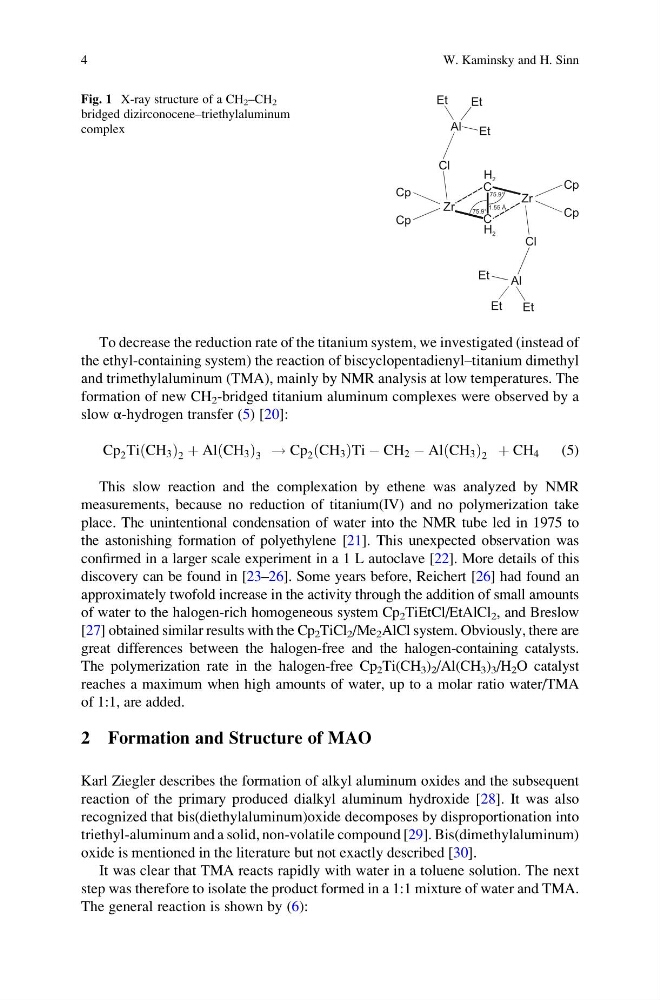
Fig. 1 X-ray structure of a CH 2 –CH 2
bridged dizirconocene–triethylaluminum
complex
4
W. Kaminsky and H. Sinn
the ethyl-containing system) the reaction of biscyclopentadienyl–titanium dimethyl
and trimethylaluminum (TMA), mainly by NMR analysis at low temperatures. The
formation of new CH 2 -bridged titanium aluminum complexes were observed by a
slow α-hydrogen transfer (5) [20]:
Cp 2 Ti CH 3
ð
Þ 2 þ Al CH 3
ð
Þ 3 ! Cp 2 CH 3
ð
ÞTi À CH 2 À Al CH 3
ð
Þ 2 þ CH 4
(5)
This slow reaction and the complexation by ethene was analyzed by NMR
measurements, because no reduction of titanium(IV) and no polymerization take
place. The unintentional condensation of water into the NMR tube led in 1975 to
the astonishing formation of polyethylene [21]. This unexpected observation was
confirmed in a larger scale experiment in a 1 L autoclave [22]. More details of this
discovery can be found in [23–26]. Some years before, Reichert [26] had found an
approximately twofold increase in the activity through the addition of small amounts
of water to the halogen-rich homogeneous system Cp 2 TiEtCl/EtAlCl 2 , and Breslow
[27] obtained similar results with the Cp 2 TiCl 2 /Me 2 AlCl system. Obviously, there are
great differences between the halogen-free and the halogen-containing catalysts.
The polymerization rate in the halogen-free Cp 2 Ti(CH 3 ) 2 /Al(CH 3 ) 3 /H 2 O catalyst
reaches a maximum when high amounts of water, up to a molar ratio water/TMA
of 1:1, are added.
2 Formation and Structure of MAO
Karl Ziegler describes the formation of alkyl aluminum oxides and the subsequent
reaction of the primary produced dialkyl aluminum hydroxide [28]. It was also
recognized that bis(diethylaluminum)oxide decomposes by disproportionation into
triethyl-aluminum and a solid, non-volatile compound [29]. Bis(dimethylaluminum)
oxide is mentioned in the literature but not exactly described [30].
It was clear that TMA reacts rapidly with water in a toluene solution. The next
step was therefore to isolate the product formed in a 1:1 mixture of water and TMA.
The general reaction is shown by (6):
C
C
Zr
Zr
Cp
Cp
Cp
Cp
H 2
H 2
75.9°
75.9°
1.55 Å
Cl
Al Et
Et
Et
Cl
Al
Et
Et
Et
Fig. 1 X-ray structure of a CH 2 –CH 2
bridged dizirconocene–triethylaluminum
complex
4
W. Kaminsky and H. Sinn