

with 11/MAO at 60
C shows a stereoregularity-related rrrr pentad distribution of
higher than 88% and a melting point of 143
C, with a molecular weight of
240 kDa [177].
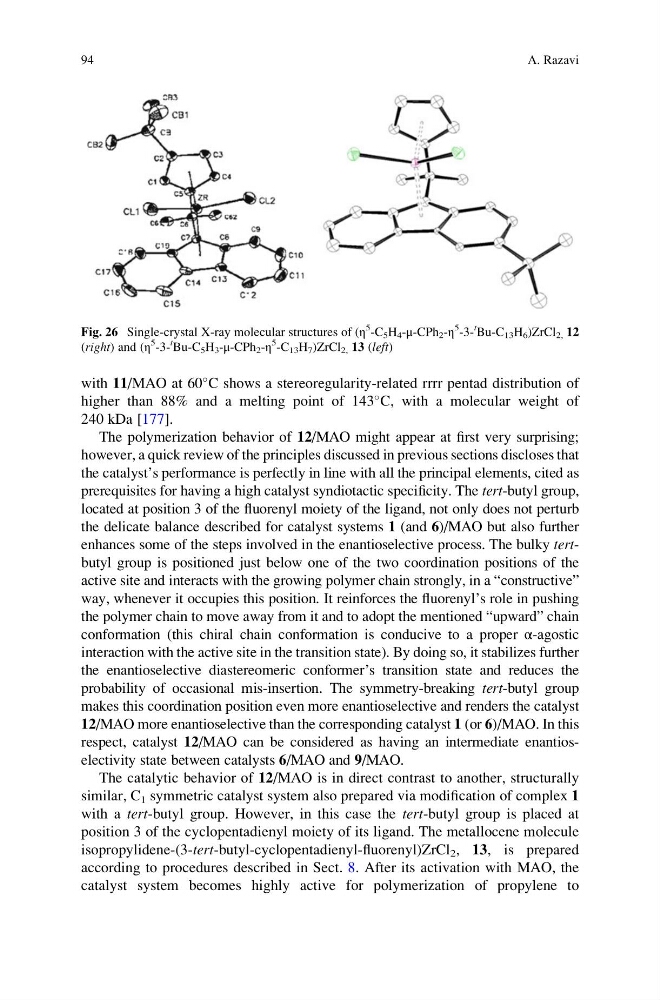
The polymerization behavior of 12/MAO might appear at first very surprising;
however, a quick review of the principles discussed in previous sections discloses that
the catalyst’s performance is perfectly in line with all the principal elements, cited as
prerequisites for having a high catalyst syndiotactic specificity. The tert-butyl group,
located at position 3 of the fluorenyl moiety of the ligand, not only does not perturb
the delicate balance described for catalyst systems 1 (and 6)/MAO but also further
enhances some of the steps involved in the enantioselective process. The bulky tertbutyl group is positioned just below one of the two coordination positions of the
active site and interacts with the growing polymer chain strongly, in a “constructive”
way, whenever it occupies this position. It reinforces the fluorenyl’s role in pushing
the polymer chain to move away from it and to adopt the mentioned “upward” chain
conformation (this chiral chain conformation is conducive to a proper α-agostic
interaction with the active site in the transition state). By doing so, it stabilizes further
the enantioselective diastereomeric conformer’s transition state and reduces the
probability of occasional mis-insertion. The symmetry-breaking tert-butyl group
makes this coordination position even more enantioselective and renders the catalyst
12/MAO more enantioselective than the corresponding catalyst 1 (or 6)/MAO. In this
respect, catalyst 12/MAO can be considered as having an intermediate enantioselectivity state between catalysts 6/MAO and 9/MAO.
The catalytic behavior of 12/MAO is in direct contrast to another, structurally
similar, C 1 symmetric catalyst system also prepared via modification of complex 1
with a tert-butyl group. However, in this case the tert-butyl group is placed at
position 3 of the cyclopentadienyl moiety of its ligand. The metallocene molecule
isopropylidene-(3-tert-butyl-cyclopentadienyl-fluorenyl)ZrCl 2 , 13, is prepared
according to procedures described in Sect. 8. After its activation with MAO, the
catalyst system becomes highly active for polymerization of propylene to
Fig. 26 Single-crystal X-ray molecular structures of (η
5
-C 5 H 4 -μ-CPh 2 -η
5
-3t
Bu-C 13 H 6 )ZrCl 2, 12
(right) and (η
5
-3t
Bu-C 5 H 3 -μ-CPh 2 -η
5
-C 13 H 7 )ZrCl 2, 13 (left)
94
A. Razavi
C shows a stereoregularity-related rrrr pentad distribution of
higher than 88% and a melting point of 143
C, with a molecular weight of
240 kDa [177].
The polymerization behavior of 12/MAO might appear at first very surprising;
however, a quick review of the principles discussed in previous sections discloses that
the catalyst’s performance is perfectly in line with all the principal elements, cited as
prerequisites for having a high catalyst syndiotactic specificity. The tert-butyl group,
located at position 3 of the fluorenyl moiety of the ligand, not only does not perturb
the delicate balance described for catalyst systems 1 (and 6)/MAO but also further
enhances some of the steps involved in the enantioselective process. The bulky tertbutyl group is positioned just below one of the two coordination positions of the
active site and interacts with the growing polymer chain strongly, in a “constructive”
way, whenever it occupies this position. It reinforces the fluorenyl’s role in pushing
the polymer chain to move away from it and to adopt the mentioned “upward” chain
conformation (this chiral chain conformation is conducive to a proper α-agostic
interaction with the active site in the transition state). By doing so, it stabilizes further
the enantioselective diastereomeric conformer’s transition state and reduces the
probability of occasional mis-insertion. The symmetry-breaking tert-butyl group
makes this coordination position even more enantioselective and renders the catalyst
12/MAO more enantioselective than the corresponding catalyst 1 (or 6)/MAO. In this
respect, catalyst 12/MAO can be considered as having an intermediate enantioselectivity state between catalysts 6/MAO and 9/MAO.
The catalytic behavior of 12/MAO is in direct contrast to another, structurally
similar, C 1 symmetric catalyst system also prepared via modification of complex 1
with a tert-butyl group. However, in this case the tert-butyl group is placed at
position 3 of the cyclopentadienyl moiety of its ligand. The metallocene molecule
isopropylidene-(3-tert-butyl-cyclopentadienyl-fluorenyl)ZrCl 2 , 13, is prepared
according to procedures described in Sect. 8. After its activation with MAO, the
catalyst system becomes highly active for polymerization of propylene to
Fig. 26 Single-crystal X-ray molecular structures of (η
5
-C 5 H 4 -μ-CPh 2 -η
5
-3t
Bu-C 13 H 6 )ZrCl 2, 12
(right) and (η
5
-3t
Bu-C 5 H 3 -μ-CPh 2 -η
5
-C 13 H 7 )ZrCl 2, 13 (left)
94
A. Razavi