

crystalline i-PP. In contrast to complex 12, the bulky tert-butyl group in position
3 of the cyclopentadienyl in complex 13 poses a huge steric challenge to the
polymer chain conformational orientation and blocks its systematic migration
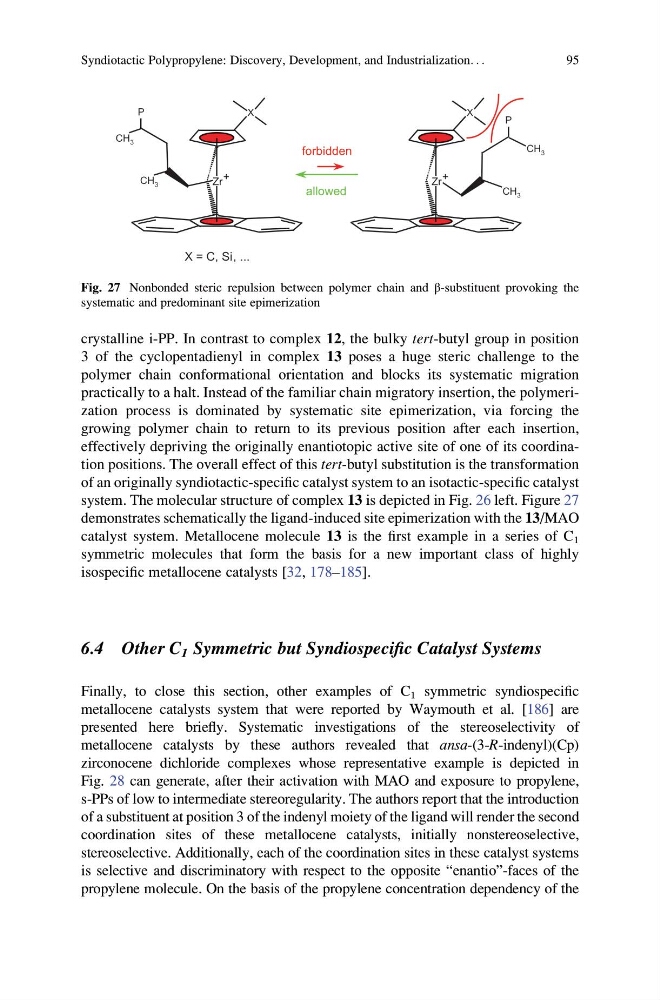
practically to a halt. Instead of the familiar chain migratory insertion, the polymerization process is dominated by systematic site epimerization, via forcing the
growing polymer chain to return to its previous position after each insertion,
effectively depriving the originally enantiotopic active site of one of its coordination positions. The overall effect of this tert-butyl substitution is the transformation
of an originally syndiotactic-specific catalyst system to an isotactic-specific catalyst
system. The molecular structure of complex 13 is depicted in Fig. 26 left. Figure 27
demonstrates schematically the ligand-induced site epimerization with the 13/MAO
catalyst system. Metallocene molecule 13 is the first example in a series of C 1
symmetric molecules that form the basis for a new important class of highly
isospecific metallocene catalysts [32, 178–185].
6.4 Other C 1 Symmetric but Syndiospecific Catalyst Systems
Finally, to close this section, other examples of C 1 symmetric syndiospecific
metallocene catalysts system that were reported by Waymouth et al. [186] are
presented here briefly. Systematic investigations of the stereoselectivity of
metallocene catalysts by these authors revealed that ansa-(3-R-indenyl)(Cp)
zirconocene dichloride complexes whose representative example is depicted in
Fig. 28 can generate, after their activation with MAO and exposure to propylene,
s-PPs of low to intermediate stereoregularity. The authors report that the introduction
of a substituent at position 3 of the indenyl moiety of the ligand will render the second
coordination sites of these metallocene catalysts, initially nonstereoselective,
stereoselective. Additionally, each of the coordination sites in these catalyst systems
is selective and discriminatory with respect to the opposite “enantio”-faces of the
propylene molecule. On the basis of the propylene concentration dependency of the
Zr +
X
X = C, Si, ...
forbidden
allowed
Zr +
X
CH 3
CH 3
P
P
CH 3
CH 3
Fig. 27 Nonbonded steric repulsion between polymer chain and β-substituent provoking the
systematic and predominant site epimerization
Syndiotactic Polypropylene: Discovery, Development, and Industrialization. . .
95
3 of the cyclopentadienyl in complex 13 poses a huge steric challenge to the
polymer chain conformational orientation and blocks its systematic migration
practically to a halt. Instead of the familiar chain migratory insertion, the polymerization process is dominated by systematic site epimerization, via forcing the
growing polymer chain to return to its previous position after each insertion,
effectively depriving the originally enantiotopic active site of one of its coordination positions. The overall effect of this tert-butyl substitution is the transformation
of an originally syndiotactic-specific catalyst system to an isotactic-specific catalyst
system. The molecular structure of complex 13 is depicted in Fig. 26 left. Figure 27
demonstrates schematically the ligand-induced site epimerization with the 13/MAO
catalyst system. Metallocene molecule 13 is the first example in a series of C 1
symmetric molecules that form the basis for a new important class of highly
isospecific metallocene catalysts [32, 178–185].
6.4 Other C 1 Symmetric but Syndiospecific Catalyst Systems
Finally, to close this section, other examples of C 1 symmetric syndiospecific
metallocene catalysts system that were reported by Waymouth et al. [186] are
presented here briefly. Systematic investigations of the stereoselectivity of
metallocene catalysts by these authors revealed that ansa-(3-R-indenyl)(Cp)
zirconocene dichloride complexes whose representative example is depicted in
Fig. 28 can generate, after their activation with MAO and exposure to propylene,
s-PPs of low to intermediate stereoregularity. The authors report that the introduction
of a substituent at position 3 of the indenyl moiety of the ligand will render the second
coordination sites of these metallocene catalysts, initially nonstereoselective,
stereoselective. Additionally, each of the coordination sites in these catalyst systems
is selective and discriminatory with respect to the opposite “enantio”-faces of the
propylene molecule. On the basis of the propylene concentration dependency of the
Zr +
X
X = C, Si, ...
forbidden
allowed
Zr +
X
CH 3
CH 3
P
P
CH 3
CH 3
Fig. 27 Nonbonded steric repulsion between polymer chain and β-substituent provoking the
systematic and predominant site epimerization
Syndiotactic Polypropylene: Discovery, Development, and Industrialization. . .
95