

6.3 C 1 Symmetric Structures: Syndio- and Nonsyndiospecific
Catalyst Systems
In the preceding section, the lack of syndiospecificity in certain catalyst systems
prepared with bilaterally symmetric, prochiral metallocene molecules was
discussed. On the other side of the spectrum, there are reports supporting the
existence of many examples of syndiotactic-selective catalyst systems that are
produced with metallocene molecules lacking any symmetry. These C 1 symmetric
metallocene molecule precursors are capable of producing highly syndiotactic
polypropylene [132, 133, 176, 177]. Several syndiotactic-specific catalysts
produced with a C 1 symmetric metallocene precursor have been reported by several
groups [132, 133, 176]. In these systems, the fluorenyl moiety of the ligand in
complexes 1 and 6 is expanded via substitution, in a lop-sided manner, e.g., by
fusing another aliphatic or aromatic six-membered ring to it. In these reported
cases, the lack of C s symmetry does not perturb the enantioselectivity of the
resulting catalysts and even leads to a slight improvement in their enantioselectivity
with respect to the parent catalysts made from complex 1/MAO.
The most striking example for a C 1 symmetric syndiotactic-specific case is,
however, the catalysts prepared with metallocene molecule, diphenylmethylidene(cyclopentadienyl-3-tert-butyl-fluorenyl)zirconium dichloride 12, with chemical
formula (η
5 -C 5 H 4 -μ-CPh 2 -η
5
-3t
Bu-C 13 H 6 )ZrCl 2 . Complex 12 is clearly a C 1
symmetric molecule, as can be seen from its single-crystal X-ray molecular
structure depicted in Fig. 26 (right) [132, 133, 176, 177]. The symmetry-breaking
substituent, a large tert-butyl group, is positioned at close proximity to the active
transitional metal coordination sphere and one of its coordination positions; it
interferes strongly with the growing polymer chain in a nonbonded steric manner.
Nonetheless, after its activation with MAO, metallocene complex 12 polymerizes
propylene to highly stereoregular s-PP chains. The syndiotacticities of the polymers
produced with the 12/MAO catalyst system are higher than of all the syndiotactic
polymers produced with 1/MAO, 5/MAO, and 6/MAO catalyst systems and ranks
only below polymers produced with the 9/MAO catalyst system. The s-PP produced
Me
Me ZrCl 2
SiMe 2
R
Me 2 Si
ZrCl 2
N
Si
R
R TiCl 2
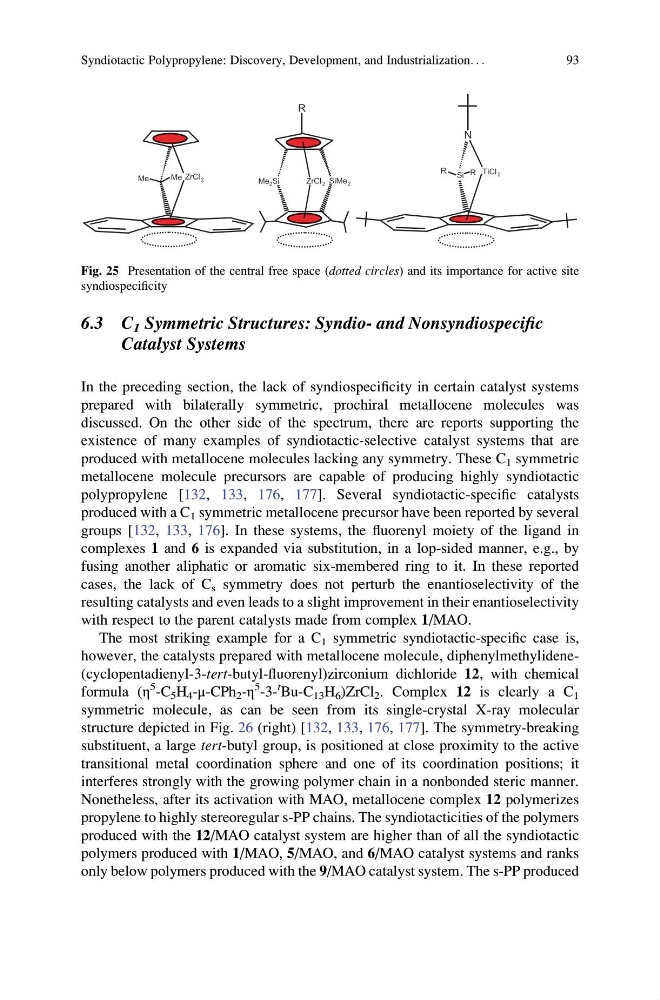
Fig. 25 Presentation of the central free space (dotted circles) and its importance for active site
syndiospecificity
Syndiotactic Polypropylene: Discovery, Development, and Industrialization. . .
93
Catalyst Systems
In the preceding section, the lack of syndiospecificity in certain catalyst systems
prepared with bilaterally symmetric, prochiral metallocene molecules was
discussed. On the other side of the spectrum, there are reports supporting the
existence of many examples of syndiotactic-selective catalyst systems that are
produced with metallocene molecules lacking any symmetry. These C 1 symmetric
metallocene molecule precursors are capable of producing highly syndiotactic
polypropylene [132, 133, 176, 177]. Several syndiotactic-specific catalysts
produced with a C 1 symmetric metallocene precursor have been reported by several
groups [132, 133, 176]. In these systems, the fluorenyl moiety of the ligand in
complexes 1 and 6 is expanded via substitution, in a lop-sided manner, e.g., by
fusing another aliphatic or aromatic six-membered ring to it. In these reported
cases, the lack of C s symmetry does not perturb the enantioselectivity of the
resulting catalysts and even leads to a slight improvement in their enantioselectivity
with respect to the parent catalysts made from complex 1/MAO.
The most striking example for a C 1 symmetric syndiotactic-specific case is,
however, the catalysts prepared with metallocene molecule, diphenylmethylidene(cyclopentadienyl-3-tert-butyl-fluorenyl)zirconium dichloride 12, with chemical
formula (η
5 -C 5 H 4 -μ-CPh 2 -η
5
-3t
Bu-C 13 H 6 )ZrCl 2 . Complex 12 is clearly a C 1
symmetric molecule, as can be seen from its single-crystal X-ray molecular
structure depicted in Fig. 26 (right) [132, 133, 176, 177]. The symmetry-breaking
substituent, a large tert-butyl group, is positioned at close proximity to the active
transitional metal coordination sphere and one of its coordination positions; it
interferes strongly with the growing polymer chain in a nonbonded steric manner.
Nonetheless, after its activation with MAO, metallocene complex 12 polymerizes
propylene to highly stereoregular s-PP chains. The syndiotacticities of the polymers
produced with the 12/MAO catalyst system are higher than of all the syndiotactic
polymers produced with 1/MAO, 5/MAO, and 6/MAO catalyst systems and ranks
only below polymers produced with the 9/MAO catalyst system. The s-PP produced
Me
Me ZrCl 2
SiMe 2
R
Me 2 Si
ZrCl 2
N
Si
R
R TiCl 2
Fig. 25 Presentation of the central free space (dotted circles) and its importance for active site
syndiospecificity
Syndiotactic Polypropylene: Discovery, Development, and Industrialization. . .
93