

6.2 Other Types of C s Symmetric Metallocene Catalysts with
Syndio- and Nonsyndiospecific Behavior
The double-bridged bis-cyclopentadienyl-based metallocene catalyst systems
developed by Bercaw et al. [173–175] are excellent examples that can be employed
to test further the universality of the syndiospecificity requirements for an independent check and verification by a new catalysts system with different ligand settings.
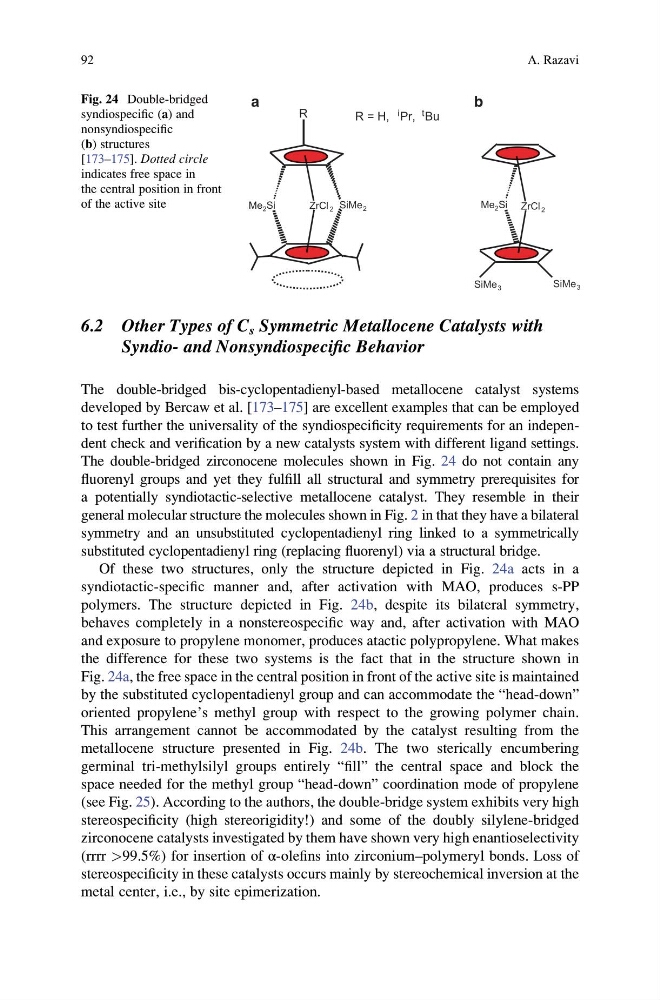
The double-bridged zirconocene molecules shown in Fig. 24 do not contain any
fluorenyl groups and yet they fulfill all structural and symmetry prerequisites for
a potentially syndiotactic-selective metallocene catalyst. They resemble in their
general molecular structure the molecules shown in Fig. 2 in that they have a bilateral
symmetry and an unsubstituted cyclopentadienyl ring linked to a symmetrically
substituted cyclopentadienyl ring (replacing fluorenyl) via a structural bridge.
Of these two structures, only the structure depicted in Fig. 24a acts in a
syndiotactic-specific manner and, after activation with MAO, produces s-PP
polymers. The structure depicted in Fig. 24b, despite its bilateral symmetry,
behaves completely in a nonstereospecific way and, after activation with MAO
and exposure to propylene monomer, produces atactic polypropylene. What makes
the difference for these two systems is the fact that in the structure shown in
Fig. 24a, the free space in the central position in front of the active site is maintained
by the substituted cyclopentadienyl group and can accommodate the “head-down”
oriented propylene’s methyl group with respect to the growing polymer chain.
This arrangement cannot be accommodated by the catalyst resulting from the
metallocene structure presented in Fig. 24b. The two sterically encumbering
germinal tri-methylsilyl groups entirely “fill” the central space and block the
space needed for the methyl group “head-down” coordination mode of propylene
(see Fig. 25). According to the authors, the double-bridge system exhibits very high
stereospecificity (high stereorigidity!) and some of the doubly silylene-bridged
zirconocene catalysts investigated by them have shown very high enantioselectivity
(rrrr >99.5%) for insertion of α-olefins into zirconium–polymeryl bonds. Loss of
stereospecificity in these catalysts occurs mainly by stereochemical inversion at the
metal center, i.e., by site epimerization.
SiMe 2
R
Me 2 Si
ZrCl 2
SiMe 3
Me 2 Si ZrCl 2
SiMe 3
R = H, i Pr, t Bu
a
b
Fig. 24 Double-bridged
syndiospecific (a) and
nonsyndiospecific
(b) structures
[173–175]. Dotted circle
indicates free space in
the central position in front
of the active site
92
A. Razavi
Syndio- and Nonsyndiospecific Behavior
The double-bridged bis-cyclopentadienyl-based metallocene catalyst systems
developed by Bercaw et al. [173–175] are excellent examples that can be employed
to test further the universality of the syndiospecificity requirements for an independent check and verification by a new catalysts system with different ligand settings.
The double-bridged zirconocene molecules shown in Fig. 24 do not contain any
fluorenyl groups and yet they fulfill all structural and symmetry prerequisites for
a potentially syndiotactic-selective metallocene catalyst. They resemble in their
general molecular structure the molecules shown in Fig. 2 in that they have a bilateral
symmetry and an unsubstituted cyclopentadienyl ring linked to a symmetrically
substituted cyclopentadienyl ring (replacing fluorenyl) via a structural bridge.
Of these two structures, only the structure depicted in Fig. 24a acts in a
syndiotactic-specific manner and, after activation with MAO, produces s-PP
polymers. The structure depicted in Fig. 24b, despite its bilateral symmetry,
behaves completely in a nonstereospecific way and, after activation with MAO
and exposure to propylene monomer, produces atactic polypropylene. What makes
the difference for these two systems is the fact that in the structure shown in
Fig. 24a, the free space in the central position in front of the active site is maintained
by the substituted cyclopentadienyl group and can accommodate the “head-down”
oriented propylene’s methyl group with respect to the growing polymer chain.
This arrangement cannot be accommodated by the catalyst resulting from the
metallocene structure presented in Fig. 24b. The two sterically encumbering
germinal tri-methylsilyl groups entirely “fill” the central space and block the
space needed for the methyl group “head-down” coordination mode of propylene
(see Fig. 25). According to the authors, the double-bridge system exhibits very high
stereospecificity (high stereorigidity!) and some of the doubly silylene-bridged
zirconocene catalysts investigated by them have shown very high enantioselectivity
(rrrr >99.5%) for insertion of α-olefins into zirconium–polymeryl bonds. Loss of
stereospecificity in these catalysts occurs mainly by stereochemical inversion at the
metal center, i.e., by site epimerization.
SiMe 2
R
Me 2 Si
ZrCl 2
SiMe 3
Me 2 Si ZrCl 2
SiMe 3
R = H, i Pr, t Bu
a
b
Fig. 24 Double-bridged
syndiospecific (a) and
nonsyndiospecific
(b) structures
[173–175]. Dotted circle
indicates free space in
the central position in front
of the active site
92
A. Razavi