

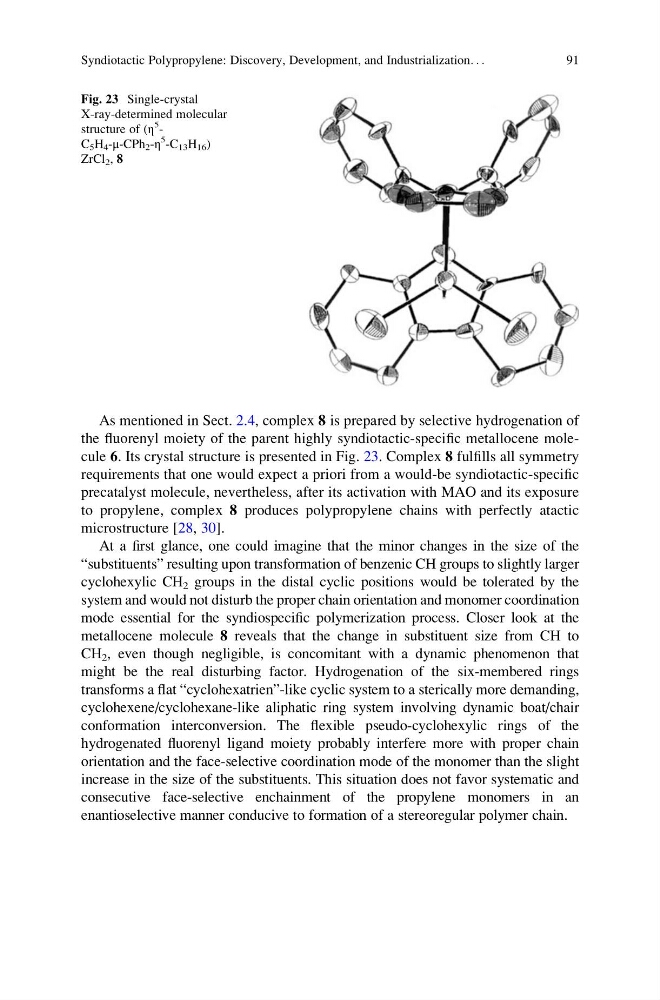
As mentioned in Sect. 2.4, complex 8 is prepared by selective hydrogenation of
the fluorenyl moiety of the parent highly syndiotactic-specific metallocene molecule 6. Its crystal structure is presented in Fig. 23. Complex 8 fulfills all symmetry
requirements that one would expect a priori from a would-be syndiotactic-specific
precatalyst molecule, nevertheless, after its activation with MAO and its exposure
to propylene, complex 8 produces polypropylene chains with perfectly atactic
microstructure [28, 30].
At a first glance, one could imagine that the minor changes in the size of the
“substituents” resulting upon transformation of benzenic CH groups to slightly larger
cyclohexylic CH 2 groups in the distal cyclic positions would be tolerated by the
system and would not disturb the proper chain orientation and monomer coordination
mode essential for the syndiospecific polymerization process. Closer look at the
metallocene molecule 8 reveals that the change in substituent size from CH to
CH 2 , even though negligible, is concomitant with a dynamic phenomenon that
might be the real disturbing factor. Hydrogenation of the six-membered rings
transforms a flat “cyclohexatrien”-like cyclic system to a sterically more demanding,
cyclohexene/cyclohexane-like aliphatic ring system involving dynamic boat/chair
conformation interconversion. The flexible pseudo-cyclohexylic rings of the
hydrogenated fluorenyl ligand moiety probably interfere more with proper chain
orientation and the face-selective coordination mode of the monomer than the slight
increase in the size of the substituents. This situation does not favor systematic and
consecutive face-selective enchainment of the propylene monomers in an
enantioselective manner conducive to formation of a stereoregular polymer chain.
Fig. 23 Single-crystal
X-ray-determined molecular
structure of (η
5
-
C 5 H 4 -μ-CPh 2 -η
5
-C 13 H 16 )
ZrCl 2 , 8
Syndiotactic Polypropylene: Discovery, Development, and Industrialization. . .
91
the fluorenyl moiety of the parent highly syndiotactic-specific metallocene molecule 6. Its crystal structure is presented in Fig. 23. Complex 8 fulfills all symmetry
requirements that one would expect a priori from a would-be syndiotactic-specific
precatalyst molecule, nevertheless, after its activation with MAO and its exposure
to propylene, complex 8 produces polypropylene chains with perfectly atactic
microstructure [28, 30].
At a first glance, one could imagine that the minor changes in the size of the
“substituents” resulting upon transformation of benzenic CH groups to slightly larger
cyclohexylic CH 2 groups in the distal cyclic positions would be tolerated by the
system and would not disturb the proper chain orientation and monomer coordination
mode essential for the syndiospecific polymerization process. Closer look at the
metallocene molecule 8 reveals that the change in substituent size from CH to
CH 2 , even though negligible, is concomitant with a dynamic phenomenon that
might be the real disturbing factor. Hydrogenation of the six-membered rings
transforms a flat “cyclohexatrien”-like cyclic system to a sterically more demanding,
cyclohexene/cyclohexane-like aliphatic ring system involving dynamic boat/chair
conformation interconversion. The flexible pseudo-cyclohexylic rings of the
hydrogenated fluorenyl ligand moiety probably interfere more with proper chain
orientation and the face-selective coordination mode of the monomer than the slight
increase in the size of the substituents. This situation does not favor systematic and
consecutive face-selective enchainment of the propylene monomers in an
enantioselective manner conducive to formation of a stereoregular polymer chain.
Fig. 23 Single-crystal
X-ray-determined molecular
structure of (η
5
-
C 5 H 4 -μ-CPh 2 -η
5
-C 13 H 16 )
ZrCl 2 , 8
Syndiotactic Polypropylene: Discovery, Development, and Industrialization. . .
91