

For the derivatives soluble in CHCl 3 , a detailed discussion on the mechanism of
the chiral recognition is made possible by the NMR spectral measurements in this
solvent [57, 58]. Other methods have also been used to understand the mechanism
of chiral recognition by the polysaccharide derivatives [59].
10.5 Other Polysaccharide Derivatives
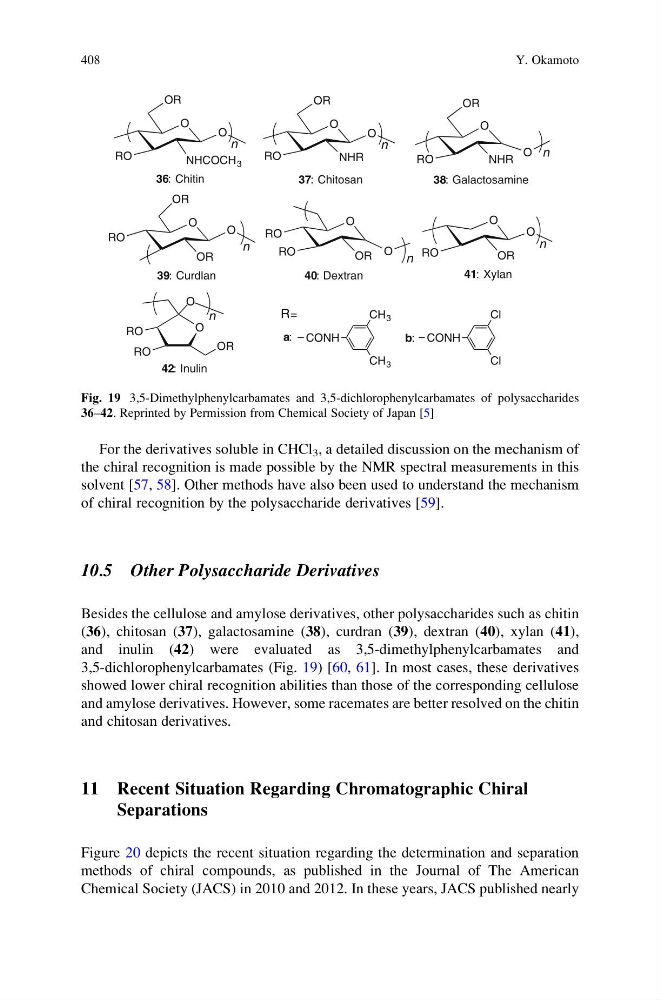
Besides the cellulose and amylose derivatives, other polysaccharides such as chitin
(36), chitosan (37), galactosamine (38), curdran (39), dextran (40), xylan (41),
and inulin (42) were evaluated as 3,5-dimethylphenylcarbamates and
3,5-dichlorophenylcarbamates (Fig. 19) [60, 61]. In most cases, these derivatives
showed lower chiral recognition abilities than those of the corresponding cellulose
and amylose derivatives. However, some racemates are better resolved on the chitin
and chitosan derivatives.
11 Recent Situation Regarding Chromatographic Chiral
Separations
Figure 20 depicts the recent situation regarding the determination and separation
methods of chiral compounds, as published in the Journal of The American
Chemical Society (JACS) in 2010 and 2012. In these years, JACS published nearly
CONH
CH 3
CH 3
CONH
Cl
Cl
O
O
RO
OR
OR
O
O
RO
RO
OR
O
O
OR
RO
RO
R=
40: Dextran
42: Inulin
39: Curdlan
O
O
RO
OR
41: Xylan
a:
b:
O
O
OR
RO
NHR
O
O
OR
RO
NHR
37: Chitosan
38: Galactosamine
O
O
OR
RO
NHCOCH 3
36: Chitin
n
n
n
n
n
n
n
Fig. 19 3,5-Dimethylphenylcarbamates and 3,5-dichlorophenylcarbamates of polysaccharides
36–42. Reprinted by Permission from Chemical Society of Japan [5]
408
Y. Okamoto
the chiral recognition is made possible by the NMR spectral measurements in this
solvent [57, 58]. Other methods have also been used to understand the mechanism
of chiral recognition by the polysaccharide derivatives [59].
10.5 Other Polysaccharide Derivatives
Besides the cellulose and amylose derivatives, other polysaccharides such as chitin
(36), chitosan (37), galactosamine (38), curdran (39), dextran (40), xylan (41),
and inulin (42) were evaluated as 3,5-dimethylphenylcarbamates and
3,5-dichlorophenylcarbamates (Fig. 19) [60, 61]. In most cases, these derivatives
showed lower chiral recognition abilities than those of the corresponding cellulose
and amylose derivatives. However, some racemates are better resolved on the chitin
and chitosan derivatives.
11 Recent Situation Regarding Chromatographic Chiral
Separations
Figure 20 depicts the recent situation regarding the determination and separation
methods of chiral compounds, as published in the Journal of The American
Chemical Society (JACS) in 2010 and 2012. In these years, JACS published nearly
CONH
CH 3
CH 3
CONH
Cl
Cl
O
O
RO
OR
OR
O
O
RO
RO
OR
O
O
OR
RO
RO
R=
40: Dextran
42: Inulin
39: Curdlan
O
O
RO
OR
41: Xylan
a:
b:
O
O
OR
RO
NHR
O
O
OR
RO
NHR
37: Chitosan
38: Galactosamine
O
O
OR
RO
NHCOCH 3
36: Chitin
n
n
n
n
n
n
n
Fig. 19 3,5-Dimethylphenylcarbamates and 3,5-dichlorophenylcarbamates of polysaccharides
36–42. Reprinted by Permission from Chemical Society of Japan [5]
408
Y. Okamoto