

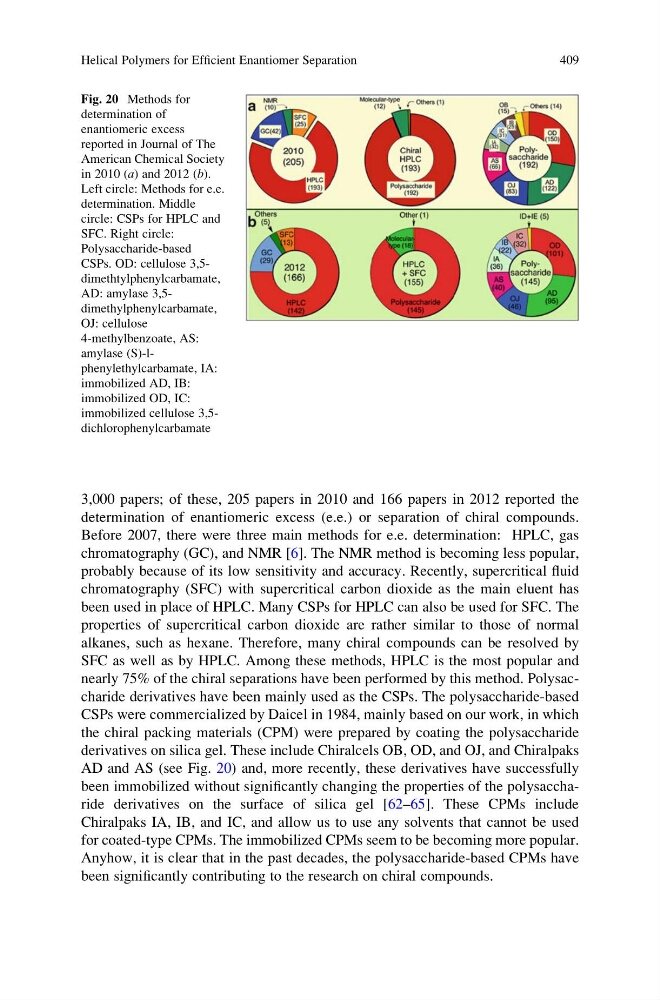
3,000 papers; of these, 205 papers in 2010 and 166 papers in 2012 reported the
determination of enantiomeric excess (e.e.) or separation of chiral compounds.
Before 2007, there were three main methods for e.e. determination: HPLC, gas
chromatography (GC), and NMR [6]. The NMR method is becoming less popular,
probably because of its low sensitivity and accuracy. Recently, supercritical fluid
chromatography (SFC) with supercritical carbon dioxide as the main eluent has
been used in place of HPLC. Many CSPs for HPLC can also be used for SFC. The
properties of supercritical carbon dioxide are rather similar to those of normal
alkanes, such as hexane. Therefore, many chiral compounds can be resolved by
SFC as well as by HPLC. Among these methods, HPLC is the most popular and
nearly 75% of the chiral separations have been performed by this method. Polysaccharide derivatives have been mainly used as the CSPs. The polysaccharide-based
CSPs were commercialized by Daicel in 1984, mainly based on our work, in which
the chiral packing materials (CPM) were prepared by coating the polysaccharide
derivatives on silica gel. These include Chiralcels OB, OD, and OJ, and Chiralpaks
AD and AS (see Fig. 20) and, more recently, these derivatives have successfully
been immobilized without significantly changing the properties of the polysaccharide derivatives on the surface of silica gel [62–65]. These CPMs include
Chiralpaks IA, IB, and IC, and allow us to use any solvents that cannot be used
for coated-type CPMs. The immobilized CPMs seem to be becoming more popular.
Anyhow, it is clear that in the past decades, the polysaccharide-based CPMs have
been significantly contributing to the research on chiral compounds.
Fig. 20 Methods for
determination of
enantiomeric excess
reported in Journal of The
American Chemical Society
in 2010 (a) and 2012 (b).
Left circle: Methods for e.e.
determination. Middle
circle: CSPs for HPLC and
SFC. Right circle:
Polysaccharide-based
CSPs. OD: cellulose 3,5dimethtylphenylcarbamate,
AD: amylase 3,5dimethylphenylcarbamate,
OJ: cellulose
4-methylbenzoate, AS:
amylase (S)-lphenylethylcarbamate, IA:
immobilized AD, IB:
immobilized OD, IC:
immobilized cellulose 3,5dichlorophenylcarbamate
Helical Polymers for Efficient Enantiomer Separation
409
determination of enantiomeric excess (e.e.) or separation of chiral compounds.
Before 2007, there were three main methods for e.e. determination: HPLC, gas
chromatography (GC), and NMR [6]. The NMR method is becoming less popular,
probably because of its low sensitivity and accuracy. Recently, supercritical fluid
chromatography (SFC) with supercritical carbon dioxide as the main eluent has
been used in place of HPLC. Many CSPs for HPLC can also be used for SFC. The
properties of supercritical carbon dioxide are rather similar to those of normal
alkanes, such as hexane. Therefore, many chiral compounds can be resolved by
SFC as well as by HPLC. Among these methods, HPLC is the most popular and
nearly 75% of the chiral separations have been performed by this method. Polysaccharide derivatives have been mainly used as the CSPs. The polysaccharide-based
CSPs were commercialized by Daicel in 1984, mainly based on our work, in which
the chiral packing materials (CPM) were prepared by coating the polysaccharide
derivatives on silica gel. These include Chiralcels OB, OD, and OJ, and Chiralpaks
AD and AS (see Fig. 20) and, more recently, these derivatives have successfully
been immobilized without significantly changing the properties of the polysaccharide derivatives on the surface of silica gel [62–65]. These CPMs include
Chiralpaks IA, IB, and IC, and allow us to use any solvents that cannot be used
for coated-type CPMs. The immobilized CPMs seem to be becoming more popular.
Anyhow, it is clear that in the past decades, the polysaccharide-based CPMs have
been significantly contributing to the research on chiral compounds.
Fig. 20 Methods for
determination of
enantiomeric excess
reported in Journal of The
American Chemical Society
in 2010 (a) and 2012 (b).
Left circle: Methods for e.e.
determination. Middle
circle: CSPs for HPLC and
SFC. Right circle:
Polysaccharide-based
CSPs. OD: cellulose 3,5dimethtylphenylcarbamate,
AD: amylase 3,5dimethylphenylcarbamate,
OJ: cellulose
4-methylbenzoate, AS:
amylase (S)-lphenylethylcarbamate, IA:
immobilized AD, IB:
immobilized OD, IC:
immobilized cellulose 3,5dichlorophenylcarbamate
Helical Polymers for Efficient Enantiomer Separation
409