

have a rather polar helical groove along the polymer chain. Many polar racemates
can interact with the helical polymers inside of the groove through molecular
interactions such as hydrogen bonding, dipole–dipole interactions, π–π interactions,
and hydrophobic interactions. The latter two interactions must also play an important role in the separation of nonpolar compounds, which are also often efficiently
resolved on the phenylcarbamates. The interaction inside the groove seems important for efficient chiral recognition because the cellulose phenylcarbamate
derivatives with a polar substituent at the 4-position, like the nitro group, exhibit
a very poor chiral recognition [41]. The polar substituents existing on the outside of
the polymer chain may strongly interact with racemates to prevent them from going
into the groove.
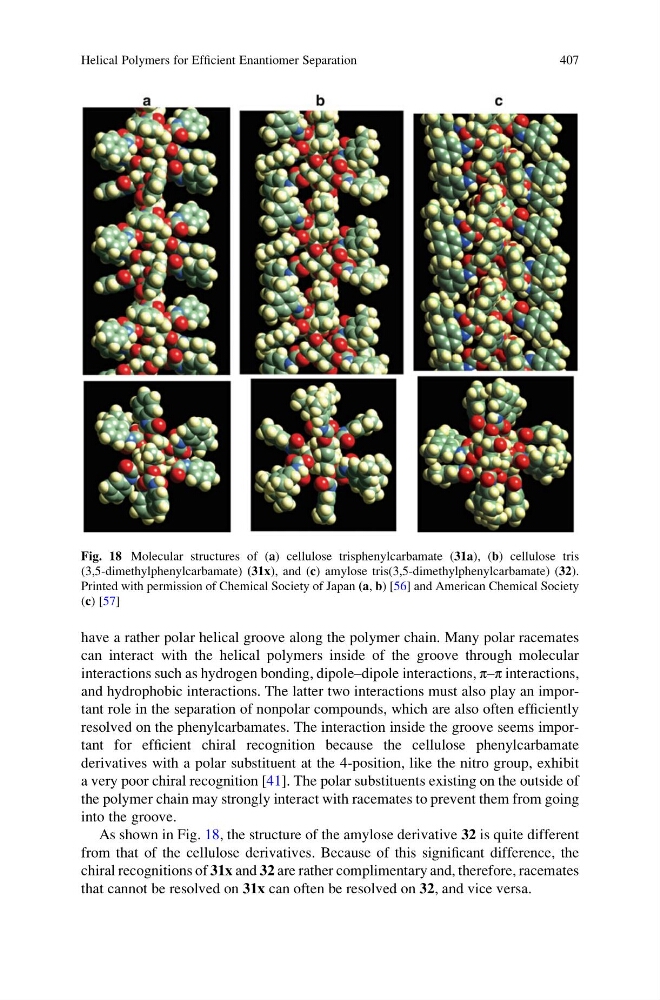
As shown in Fig. 18, the structure of the amylose derivative 32 is quite different
from that of the cellulose derivatives. Because of this significant difference, the
chiral recognitions of 31x and 32 are rather complimentary and, therefore, racemates
that cannot be resolved on 31x can often be resolved on 32, and vice versa.
Fig. 18 Molecular structures of (a) cellulose trisphenylcarbamate (31a), (b) cellulose tris
(3,5-dimethylphenylcarbamate) (31x), and (c) amylose tris(3,5-dimethylphenylcarbamate) (32).
Printed with permission of Chemical Society of Japan (a, b) [56] and American Chemical Society
(c) [57]
Helical Polymers for Efficient Enantiomer Separation
407
can interact with the helical polymers inside of the groove through molecular
interactions such as hydrogen bonding, dipole–dipole interactions, π–π interactions,
and hydrophobic interactions. The latter two interactions must also play an important role in the separation of nonpolar compounds, which are also often efficiently
resolved on the phenylcarbamates. The interaction inside the groove seems important for efficient chiral recognition because the cellulose phenylcarbamate
derivatives with a polar substituent at the 4-position, like the nitro group, exhibit
a very poor chiral recognition [41]. The polar substituents existing on the outside of
the polymer chain may strongly interact with racemates to prevent them from going
into the groove.
As shown in Fig. 18, the structure of the amylose derivative 32 is quite different
from that of the cellulose derivatives. Because of this significant difference, the
chiral recognitions of 31x and 32 are rather complimentary and, therefore, racemates
that cannot be resolved on 31x can often be resolved on 32, and vice versa.
Fig. 18 Molecular structures of (a) cellulose trisphenylcarbamate (31a), (b) cellulose tris
(3,5-dimethylphenylcarbamate) (31x), and (c) amylose tris(3,5-dimethylphenylcarbamate) (32).
Printed with permission of Chemical Society of Japan (a, b) [56] and American Chemical Society
(c) [57]
Helical Polymers for Efficient Enantiomer Separation
407