

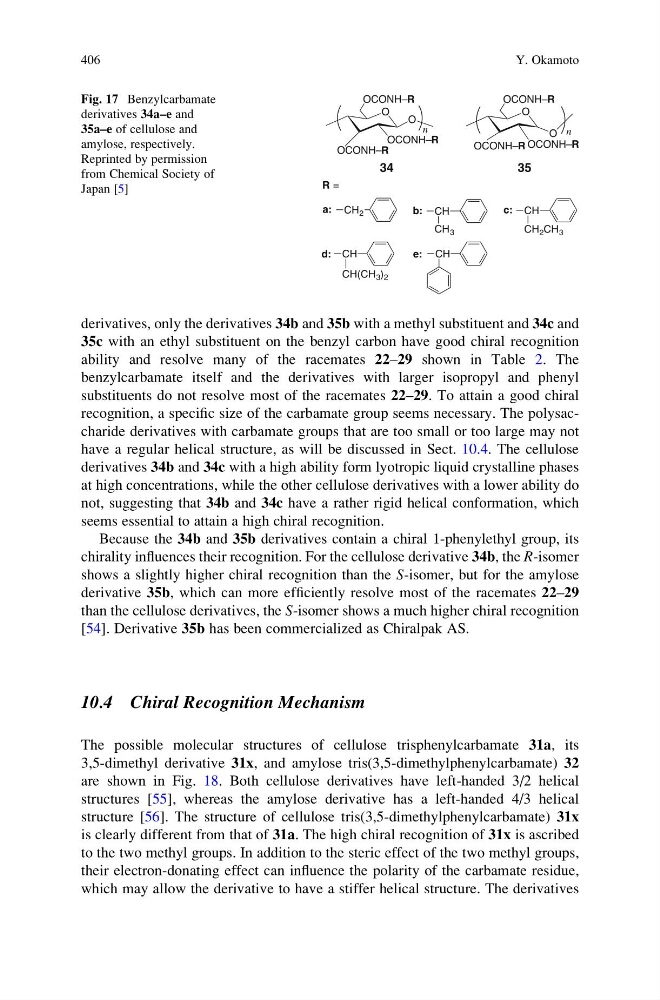
derivatives, only the derivatives 34b and 35b with a methyl substituent and 34c and
35c with an ethyl substituent on the benzyl carbon have good chiral recognition
ability and resolve many of the racemates 22–29 shown in Table 2. The
benzylcarbamate itself and the derivatives with larger isopropyl and phenyl
substituents do not resolve most of the racemates 22–29. To attain a good chiral
recognition, a specific size of the carbamate group seems necessary. The polysaccharide derivatives with carbamate groups that are too small or too large may not
have a regular helical structure, as will be discussed in Sect. 10.4. The cellulose
derivatives 34b and 34c with a high ability form lyotropic liquid crystalline phases
at high concentrations, while the other cellulose derivatives with a lower ability do
not, suggesting that 34b and 34c have a rather rigid helical conformation, which
seems essential to attain a high chiral recognition.
Because the 34b and 35b derivatives contain a chiral 1-phenylethyl group, its
chirality influences their recognition. For the cellulose derivative 34b, the R-isomer
shows a slightly higher chiral recognition than the S-isomer, but for the amylose
derivative 35b, which can more efficiently resolve most of the racemates 22–29
than the cellulose derivatives, the S-isomer shows a much higher chiral recognition
[54]. Derivative 35b has been commercialized as Chiralpak AS.
10.4 Chiral Recognition Mechanism
The possible molecular structures of cellulose trisphenylcarbamate 31a, its
3,5-dimethyl derivative 31x, and amylose tris(3,5-dimethylphenylcarbamate) 32
are shown in Fig. 18. Both cellulose derivatives have left-handed 3/2 helical
structures [55], whereas the amylose derivative has a left-handed 4/3 helical
structure [56]. The structure of cellulose tris(3,5-dimethylphenylcarbamate) 31x
is clearly different from that of 31a. The high chiral recognition of 31x is ascribed
to the two methyl groups. In addition to the steric effect of the two methyl groups,
their electron-donating effect can influence the polarity of the carbamate residue,
which may allow the derivative to have a stiffer helical structure. The derivatives
CH 2
CH
CH 3
CH
CH 2 CH 3
CH
CH
CH(CH 3 ) 2
a:
b:
c:
d:
e:
34
35
O
O
R
R
R
O
O
R
R
R
R =
n
n
Fig. 17 Benzylcarbamate
derivatives 34a–e and
35a–e of cellulose and
amylose, respectively.
Reprinted by permission
from Chemical Society of
Japan [5]
406
Y. Okamoto
35c with an ethyl substituent on the benzyl carbon have good chiral recognition
ability and resolve many of the racemates 22–29 shown in Table 2. The
benzylcarbamate itself and the derivatives with larger isopropyl and phenyl
substituents do not resolve most of the racemates 22–29. To attain a good chiral
recognition, a specific size of the carbamate group seems necessary. The polysaccharide derivatives with carbamate groups that are too small or too large may not
have a regular helical structure, as will be discussed in Sect. 10.4. The cellulose
derivatives 34b and 34c with a high ability form lyotropic liquid crystalline phases
at high concentrations, while the other cellulose derivatives with a lower ability do
not, suggesting that 34b and 34c have a rather rigid helical conformation, which
seems essential to attain a high chiral recognition.
Because the 34b and 35b derivatives contain a chiral 1-phenylethyl group, its
chirality influences their recognition. For the cellulose derivative 34b, the R-isomer
shows a slightly higher chiral recognition than the S-isomer, but for the amylose
derivative 35b, which can more efficiently resolve most of the racemates 22–29
than the cellulose derivatives, the S-isomer shows a much higher chiral recognition
[54]. Derivative 35b has been commercialized as Chiralpak AS.
10.4 Chiral Recognition Mechanism
The possible molecular structures of cellulose trisphenylcarbamate 31a, its
3,5-dimethyl derivative 31x, and amylose tris(3,5-dimethylphenylcarbamate) 32
are shown in Fig. 18. Both cellulose derivatives have left-handed 3/2 helical
structures [55], whereas the amylose derivative has a left-handed 4/3 helical
structure [56]. The structure of cellulose tris(3,5-dimethylphenylcarbamate) 31x
is clearly different from that of 31a. The high chiral recognition of 31x is ascribed
to the two methyl groups. In addition to the steric effect of the two methyl groups,
their electron-donating effect can influence the polarity of the carbamate residue,
which may allow the derivative to have a stiffer helical structure. The derivatives
CH 2
CH
CH 3
CH
CH 2 CH 3
CH
CH
CH(CH 3 ) 2
a:
b:
c:
d:
e:
34
35
O
O
R
R
R
O
O
R
R
R
R =
n
n
Fig. 17 Benzylcarbamate
derivatives 34a–e and
35a–e of cellulose and
amylose, respectively.
Reprinted by permission
from Chemical Society of
Japan [5]
406
Y. Okamoto