

10.3 Other Carbamate Derivatives of Cellulose and Amylose
Although the simple alkylcarbamates, such as the methyl- and ethylcarbamates of
cellulose and amylose, show a poor chiral recognition, the cyclohexylcarbamates
(33 in Fig. 15) have characteristic abilities and can resolve many racemates
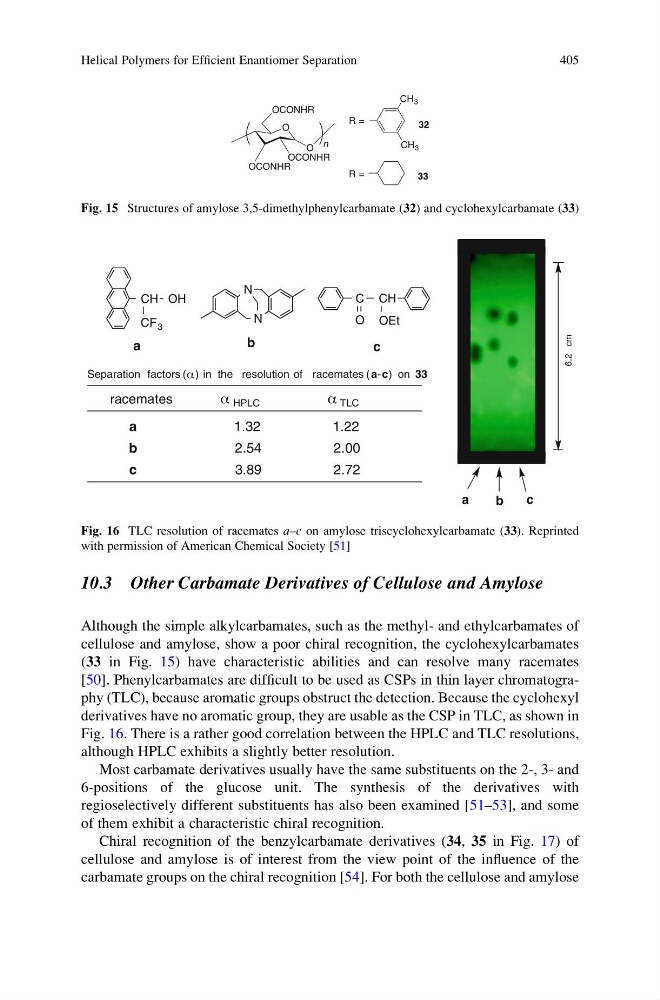
[50]. Phenylcarbamates are difficult to be used as CSPs in thin layer chromatography (TLC), because aromatic groups obstruct the detection. Because the cyclohexyl
derivatives have no aromatic group, they are usable as the CSP in TLC, as shown in
Fig. 16. There is a rather good correlation between the HPLC and TLC resolutions,
although HPLC exhibits a slightly better resolution.
Most carbamate derivatives usually have the same substituents on the 2-, 3- and
6-positions of the glucose unit. The synthesis of the derivatives with
regioselectively different substituents has also been examined [51–53], and some
of them exhibit a characteristic chiral recognition.
Chiral recognition of the benzylcarbamate derivatives (34, 35 in Fig. 17) of
cellulose and amylose is of interest from the view point of the influence of the
carbamate groups on the chiral recognition [54]. For both the cellulose and amylose
O
O
OCONHR
OCONHR
OCONHR
n
32
R =
CH 3
CH 3
R =
33
Fig. 15 Structures of amylose 3,5-dimethylphenylcarbamate (32) and cyclohexylcarbamate (33)
CH OH
CF 3
N
N
C CH
OEt
O
Separation factors ( ) in the resolution of racemates ( a-c) on 33
HPLC
TLC
a
b
c
1.32
2.54
3.89
1.22
2.00
2.72
b
c
a
c
6.2 cm
a
b
racemates
Fig. 16 TLC resolution of racemates a–c on amylose triscyclohexylcarbamate (33). Reprinted
with permission of American Chemical Society [51]
Helical Polymers for Efficient Enantiomer Separation
405
Although the simple alkylcarbamates, such as the methyl- and ethylcarbamates of
cellulose and amylose, show a poor chiral recognition, the cyclohexylcarbamates
(33 in Fig. 15) have characteristic abilities and can resolve many racemates
[50]. Phenylcarbamates are difficult to be used as CSPs in thin layer chromatography (TLC), because aromatic groups obstruct the detection. Because the cyclohexyl
derivatives have no aromatic group, they are usable as the CSP in TLC, as shown in
Fig. 16. There is a rather good correlation between the HPLC and TLC resolutions,
although HPLC exhibits a slightly better resolution.
Most carbamate derivatives usually have the same substituents on the 2-, 3- and
6-positions of the glucose unit. The synthesis of the derivatives with
regioselectively different substituents has also been examined [51–53], and some
of them exhibit a characteristic chiral recognition.
Chiral recognition of the benzylcarbamate derivatives (34, 35 in Fig. 17) of
cellulose and amylose is of interest from the view point of the influence of the
carbamate groups on the chiral recognition [54]. For both the cellulose and amylose
O
O
OCONHR
OCONHR
OCONHR
n
32
R =
CH 3
CH 3
R =
33
Fig. 15 Structures of amylose 3,5-dimethylphenylcarbamate (32) and cyclohexylcarbamate (33)
CH OH
CF 3
N
N
C CH
OEt
O
Separation factors ( ) in the resolution of racemates ( a-c) on 33
HPLC
TLC
a
b
c
1.32
2.54
3.89
1.22
2.00
2.72
b
c
a
c
6.2 cm
a
b
racemates
Fig. 16 TLC resolution of racemates a–c on amylose triscyclohexylcarbamate (33). Reprinted
with permission of American Chemical Society [51]
Helical Polymers for Efficient Enantiomer Separation
405