

practically useful chiral CSP [40]. This finding encouraged us to synthesize a series
of phenylcarbamate derivatives, as exemplified in Fig. 13. The chiral recognition of
these derivatives depends very much on the substituents, and all the derivatives
show more or less different recognitions. Among the many derivatives,
3,5-dimethylphenylcarbamate (31x, commercial name Chiralcel OD) is one of the
most attractive [41]. This can resolve most types of compounds if they are soluble
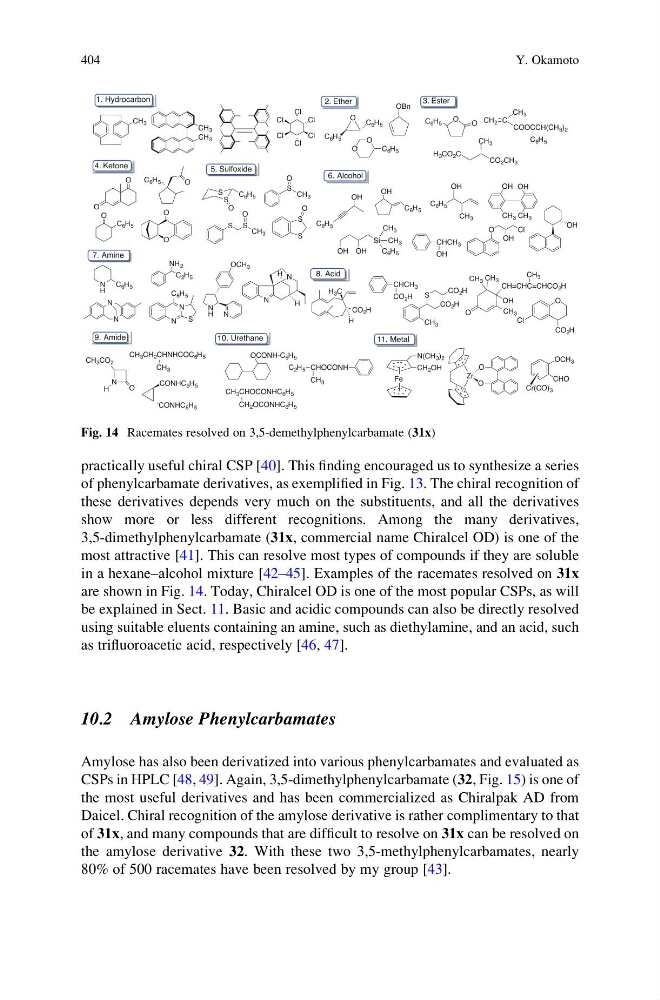
in a hexane–alcohol mixture [42–45]. Examples of the racemates resolved on 31x
are shown in Fig. 14. Today, Chiralcel OD is one of the most popular CSPs, as will
be explained in Sect. 11. Basic and acidic compounds can also be directly resolved
using suitable eluents containing an amine, such as diethylamine, and an acid, such
as trifluoroacetic acid, respectively [46, 47].
10.2 Amylose Phenylcarbamates
Amylose has also been derivatized into various phenylcarbamates and evaluated as
CSPs in HPLC [48, 49]. Again, 3,5-dimethylphenylcarbamate (32, Fig. 15) is one of
the most useful derivatives and has been commercialized as Chiralpak AD from
Daicel. Chiral recognition of the amylose derivative is rather complimentary to that
of 31x, and many compounds that are difficult to resolve on 31x can be resolved on
the amylose derivative 32. With these two 3,5-methylphenylcarbamates, nearly
80% of 500 racemates have been resolved by my group [43].
Fig. 14 Racemates resolved on 3,5-demethylphenylcarbamate (31x)
404
Y. Okamoto
of phenylcarbamate derivatives, as exemplified in Fig. 13. The chiral recognition of
these derivatives depends very much on the substituents, and all the derivatives
show more or less different recognitions. Among the many derivatives,
3,5-dimethylphenylcarbamate (31x, commercial name Chiralcel OD) is one of the
most attractive [41]. This can resolve most types of compounds if they are soluble
in a hexane–alcohol mixture [42–45]. Examples of the racemates resolved on 31x
are shown in Fig. 14. Today, Chiralcel OD is one of the most popular CSPs, as will
be explained in Sect. 11. Basic and acidic compounds can also be directly resolved
using suitable eluents containing an amine, such as diethylamine, and an acid, such
as trifluoroacetic acid, respectively [46, 47].
10.2 Amylose Phenylcarbamates
Amylose has also been derivatized into various phenylcarbamates and evaluated as
CSPs in HPLC [48, 49]. Again, 3,5-dimethylphenylcarbamate (32, Fig. 15) is one of
the most useful derivatives and has been commercialized as Chiralpak AD from
Daicel. Chiral recognition of the amylose derivative is rather complimentary to that
of 31x, and many compounds that are difficult to resolve on 31x can be resolved on
the amylose derivative 32. With these two 3,5-methylphenylcarbamates, nearly
80% of 500 racemates have been resolved by my group [43].
Fig. 14 Racemates resolved on 3,5-demethylphenylcarbamate (31x)
404
Y. Okamoto