

introducing a methyl group on the benzoate [39]. The ability of these benzoate
derivatives is dependent on the coating conditions on the silica gel, which can
influence the higher order structure of the polymers.
10.1.2 Cellulose Phenylcarbamates
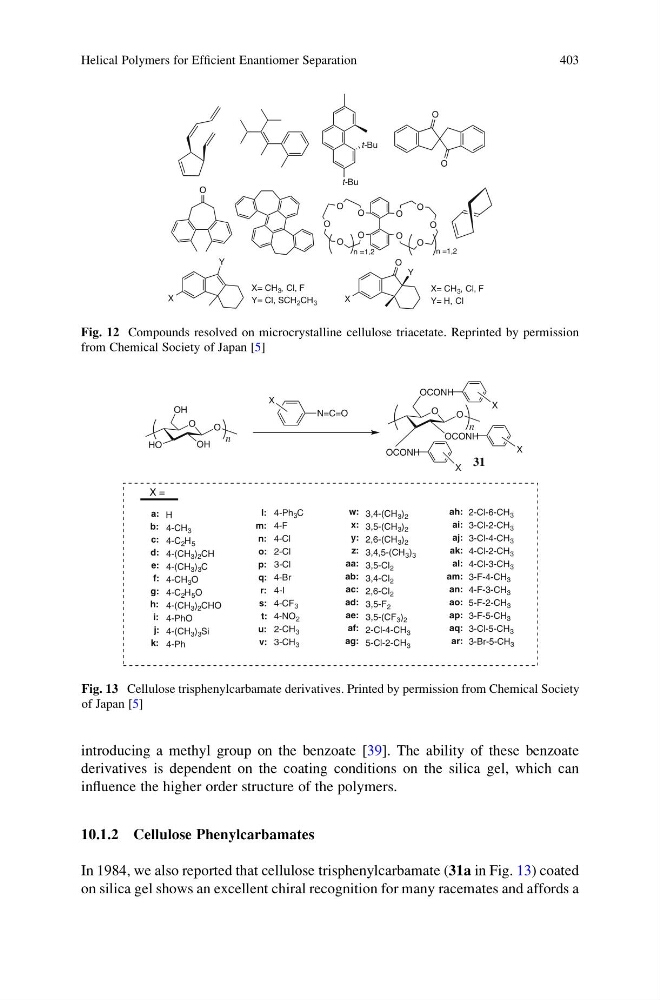
In 1984, we also reported that cellulose trisphenylcarbamate (31a in Fig. 13) coated
on silica gel shows an excellent chiral recognition for many racemates and affords a
O
O
O
O
O
O
O
O
O
O
t-Bu
t-Bu
O
O
O
n =1,2
n =1,2
Y
X
O
X
Y
X= CH 3 , Cl, F
Y= Cl, SCH 2 CH 3
X= CH 3 , Cl, F
Y= H, Cl
Fig. 12 Compounds resolved on microcrystalline cellulose triacetate. Reprinted by permission
from Chemical Society of Japan [5]
O
HO
OH
O
OH
N=C=O
H
4-CH 3
4-C 2 H 5
4-(CH 3 ) 2 CH
4-(CH 3 ) 3 C
4-CH 3 O
4-C 2 H 5 O
4-(CH 3 ) 2 CHO
4-PhO
4-(CH 3 ) 3 Si
4-Ph
a:
b:
c:
d:
e:
f:
g:
h:
i:
j:
k:
l:
m:
n:
o:
p:
q:
r:
s:
t:
u:
v:
w:
x:
y:
z:
aa:
ab:
ac:
ad:
ae:
af:
ag:
3,4-(CH 3 ) 2
3,5-(CH 3 ) 2
2,6-(CH 3 ) 2
3,4,5-(CH 3 ) 3
3,5-Cl 2
3,4-Cl 2
2,6-Cl 2
3,5-F 2
3,5-(CF 3 ) 2
2-Cl-4-CH 3
5-Cl-2-CH 3
4-Ph 3 C
4-F
4-Cl
2-Cl
3-Cl
4-Br
4-I
4-CF 3
4-NO 2
2-CH 3
3-CH 3
X =
2-Cl-6-CH 3
3-Cl-2-CH 3
3-Cl-4-CH 3
4-Cl-2-CH 3
4-Cl-3-CH 3
3-F-4-CH 3
4-F-3-CH 3
5-F-2-CH 3
3-F-5-CH 3
3-Cl-5-CH 3
3-Br-5-CH 3
ah:
ai:
aj:
ak:
al:
am:
an:
ao:
ap:
aq:
ar:
X
O
OCONH
OCONH
O
OCONH
X
X
X
n
n
31
Fig. 13 Cellulose trisphenylcarbamate derivatives. Printed by permission from Chemical Society
of Japan [5]
Helical Polymers for Efficient Enantiomer Separation
403
derivatives is dependent on the coating conditions on the silica gel, which can
influence the higher order structure of the polymers.
10.1.2 Cellulose Phenylcarbamates
In 1984, we also reported that cellulose trisphenylcarbamate (31a in Fig. 13) coated
on silica gel shows an excellent chiral recognition for many racemates and affords a
O
O
O
O
O
O
O
O
O
O
t-Bu
t-Bu
O
O
O
n =1,2
n =1,2
Y
X
O
X
Y
X= CH 3 , Cl, F
Y= Cl, SCH 2 CH 3
X= CH 3 , Cl, F
Y= H, Cl
Fig. 12 Compounds resolved on microcrystalline cellulose triacetate. Reprinted by permission
from Chemical Society of Japan [5]
O
HO
OH
O
OH
N=C=O
H
4-CH 3
4-C 2 H 5
4-(CH 3 ) 2 CH
4-(CH 3 ) 3 C
4-CH 3 O
4-C 2 H 5 O
4-(CH 3 ) 2 CHO
4-PhO
4-(CH 3 ) 3 Si
4-Ph
a:
b:
c:
d:
e:
f:
g:
h:
i:
j:
k:
l:
m:
n:
o:
p:
q:
r:
s:
t:
u:
v:
w:
x:
y:
z:
aa:
ab:
ac:
ad:
ae:
af:
ag:
3,4-(CH 3 ) 2
3,5-(CH 3 ) 2
2,6-(CH 3 ) 2
3,4,5-(CH 3 ) 3
3,5-Cl 2
3,4-Cl 2
2,6-Cl 2
3,5-F 2
3,5-(CF 3 ) 2
2-Cl-4-CH 3
5-Cl-2-CH 3
4-Ph 3 C
4-F
4-Cl
2-Cl
3-Cl
4-Br
4-I
4-CF 3
4-NO 2
2-CH 3
3-CH 3
X =
2-Cl-6-CH 3
3-Cl-2-CH 3
3-Cl-4-CH 3
4-Cl-2-CH 3
4-Cl-3-CH 3
3-F-4-CH 3
4-F-3-CH 3
5-F-2-CH 3
3-F-5-CH 3
3-Cl-5-CH 3
3-Br-5-CH 3
ah:
ai:
aj:
ak:
al:
am:
an:
ao:
ap:
aq:
ar:
X
O
OCONH
OCONH
O
OCONH
X
X
X
n
n
31
Fig. 13 Cellulose trisphenylcarbamate derivatives. Printed by permission from Chemical Society
of Japan [5]
Helical Polymers for Efficient Enantiomer Separation
403