

adsorbing sites and the contents of the effective sites may not be high, which means
that the CSPs are not suitable for the preparative separation of racemates. These are
the weak points of the protein-based CSPs.
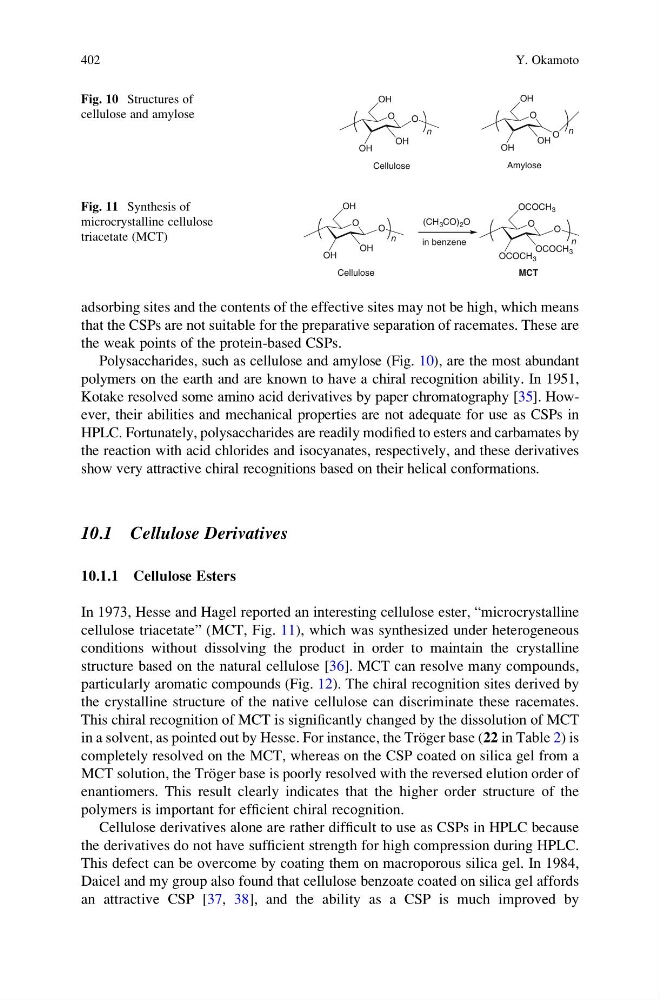
Polysaccharides, such as cellulose and amylose (Fig. 10), are the most abundant
polymers on the earth and are known to have a chiral recognition ability. In 1951,
Kotake resolved some amino acid derivatives by paper chromatography [35]. However, their abilities and mechanical properties are not adequate for use as CSPs in
HPLC. Fortunately, polysaccharides are readily modified to esters and carbamates by
the reaction with acid chlorides and isocyanates, respectively, and these derivatives
show very attractive chiral recognitions based on their helical conformations.
10.1 Cellulose Derivatives
10.1.1 Cellulose Esters
In 1973, Hesse and Hagel reported an interesting cellulose ester, “microcrystalline
cellulose triacetate” (MCT, Fig. 11), which was synthesized under heterogeneous
conditions without dissolving the product in order to maintain the crystalline
structure based on the natural cellulose [36]. MCT can resolve many compounds,
particularly aromatic compounds (Fig. 12). The chiral recognition sites derived by
the crystalline structure of the native cellulose can discriminate these racemates.
This chiral recognition of MCT is significantly changed by the dissolution of MCT
in a solvent, as pointed out by Hesse. For instance, the Tro ¨ger base (22 in Table 2) is
completely resolved on the MCT, whereas on the CSP coated on silica gel from a
MCT solution, the Tro ¨ger base is poorly resolved with the reversed elution order of
enantiomers. This result clearly indicates that the higher order structure of the
polymers is important for efficient chiral recognition.
Cellulose derivatives alone are rather difficult to use as CSPs in HPLC because
the derivatives do not have sufficient strength for high compression during HPLC.
This defect can be overcome by coating them on macroporous silica gel. In 1984,
Daicel and my group also found that cellulose benzoate coated on silica gel affords
an attractive CSP [37, 38], and the ability as a CSP is much improved by
O
O
OH
OH
OH
n
Cellulose
O
O
OH
OH
OH
n
Amylose
Fig. 10 Structures of
cellulose and amylose
O
O
OCOCH 3
OCOCH 3
OCOCH 3
MCT
O
O
OH
OH
OH
n
n
Cellulose
(CH 3 CO) 2 O
in benzene
Fig. 11 Synthesis of
microcrystalline cellulose
triacetate (MCT)
402
Y. Okamoto
that the CSPs are not suitable for the preparative separation of racemates. These are
the weak points of the protein-based CSPs.
Polysaccharides, such as cellulose and amylose (Fig. 10), are the most abundant
polymers on the earth and are known to have a chiral recognition ability. In 1951,
Kotake resolved some amino acid derivatives by paper chromatography [35]. However, their abilities and mechanical properties are not adequate for use as CSPs in
HPLC. Fortunately, polysaccharides are readily modified to esters and carbamates by
the reaction with acid chlorides and isocyanates, respectively, and these derivatives
show very attractive chiral recognitions based on their helical conformations.
10.1 Cellulose Derivatives
10.1.1 Cellulose Esters
In 1973, Hesse and Hagel reported an interesting cellulose ester, “microcrystalline
cellulose triacetate” (MCT, Fig. 11), which was synthesized under heterogeneous
conditions without dissolving the product in order to maintain the crystalline
structure based on the natural cellulose [36]. MCT can resolve many compounds,
particularly aromatic compounds (Fig. 12). The chiral recognition sites derived by
the crystalline structure of the native cellulose can discriminate these racemates.
This chiral recognition of MCT is significantly changed by the dissolution of MCT
in a solvent, as pointed out by Hesse. For instance, the Tro ¨ger base (22 in Table 2) is
completely resolved on the MCT, whereas on the CSP coated on silica gel from a
MCT solution, the Tro ¨ger base is poorly resolved with the reversed elution order of
enantiomers. This result clearly indicates that the higher order structure of the
polymers is important for efficient chiral recognition.
Cellulose derivatives alone are rather difficult to use as CSPs in HPLC because
the derivatives do not have sufficient strength for high compression during HPLC.
This defect can be overcome by coating them on macroporous silica gel. In 1984,
Daicel and my group also found that cellulose benzoate coated on silica gel affords
an attractive CSP [37, 38], and the ability as a CSP is much improved by
O
O
OH
OH
OH
n
Cellulose
O
O
OH
OH
OH
n
Amylose
Fig. 10 Structures of
cellulose and amylose
O
O
OCOCH 3
OCOCH 3
OCOCH 3
MCT
O
O
OH
OH
OH
n
n
Cellulose
(CH 3 CO) 2 O
in benzene
Fig. 11 Synthesis of
microcrystalline cellulose
triacetate (MCT)
402
Y. Okamoto