

Chiral recognition of the polymer-type CSPs is often influenced by the higherorder structure of the polymers. Consequently, the stereoregularity of a polymer
structure is an important factor in controlling the chiral recognition ability of the
polymer-based CSPs.
5 Polymethacrylates
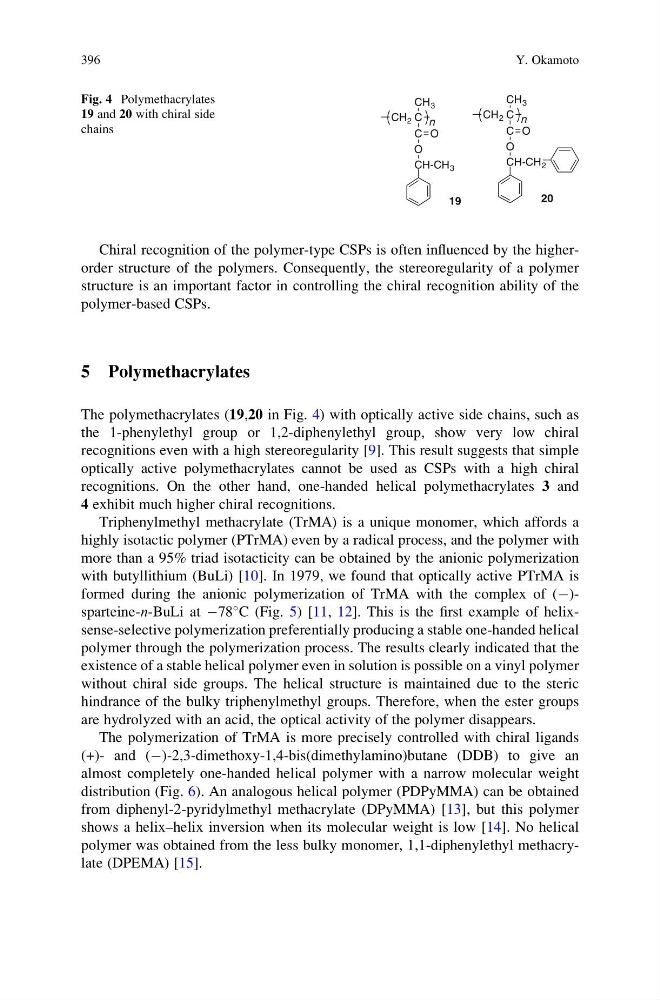
The polymethacrylates (19,20 in Fig. 4) with optically active side chains, such as
the 1-phenylethyl group or 1,2-diphenylethyl group, show very low chiral
recognitions even with a high stereoregularity [9]. This result suggests that simple
optically active polymethacrylates cannot be used as CSPs with a high chiral
recognitions. On the other hand, one-handed helical polymethacrylates 3 and
4 exhibit much higher chiral recognitions.
Triphenylmethyl methacrylate (TrMA) is a unique monomer, which affords a
highly isotactic polymer (PTrMA) even by a radical process, and the polymer with
more than a 95% triad isotacticity can be obtained by the anionic polymerization
with butyllithium (BuLi) [10]. In 1979, we found that optically active PTrMA is
formed during the anionic polymerization of TrMA with the complex of (À)sparteine-n-BuLi at À78
C (Fig. 5) [11, 12]. This is the first example of helixsense-selective polymerization preferentially producing a stable one-handed helical
polymer through the polymerization process. The results clearly indicated that the
existence of a stable helical polymer even in solution is possible on a vinyl polymer
without chiral side groups. The helical structure is maintained due to the steric
hindrance of the bulky triphenylmethyl groups. Therefore, when the ester groups
are hydrolyzed with an acid, the optical activity of the polymer disappears.
The polymerization of TrMA is more precisely controlled with chiral ligands
(+)- and (À)-2,3-dimethoxy-1,4-bis(dimethylamino)butane (DDB) to give an
almost completely one-handed helical polymer with a narrow molecular weight
distribution (Fig. 6). An analogous helical polymer (PDPyMMA) can be obtained
from diphenyl-2-pyridylmethyl methacrylate (DPyMMA) [13], but this polymer
shows a helix–helix inversion when its molecular weight is low [14]. No helical
polymer was obtained from the less bulky monomer, 1,1-diphenylethyl methacrylate (DPEMA) [15].
C
C O
O
CH-CH 3
CH 2
CH 3
n
19
C
C O
O
CH-CH 2
CH 2
CH 3
n
20
Fig. 4 Polymethacrylates
19 and 20 with chiral side
chains
396
Y. Okamoto
structure is an important factor in controlling the chiral recognition ability of the
polymer-based CSPs.
5 Polymethacrylates
The polymethacrylates (19,20 in Fig. 4) with optically active side chains, such as
the 1-phenylethyl group or 1,2-diphenylethyl group, show very low chiral
recognitions even with a high stereoregularity [9]. This result suggests that simple
optically active polymethacrylates cannot be used as CSPs with a high chiral
recognitions. On the other hand, one-handed helical polymethacrylates 3 and
4 exhibit much higher chiral recognitions.
Triphenylmethyl methacrylate (TrMA) is a unique monomer, which affords a
highly isotactic polymer (PTrMA) even by a radical process, and the polymer with
more than a 95% triad isotacticity can be obtained by the anionic polymerization
with butyllithium (BuLi) [10]. In 1979, we found that optically active PTrMA is
formed during the anionic polymerization of TrMA with the complex of (À)sparteine-n-BuLi at À78
C (Fig. 5) [11, 12]. This is the first example of helixsense-selective polymerization preferentially producing a stable one-handed helical
polymer through the polymerization process. The results clearly indicated that the
existence of a stable helical polymer even in solution is possible on a vinyl polymer
without chiral side groups. The helical structure is maintained due to the steric
hindrance of the bulky triphenylmethyl groups. Therefore, when the ester groups
are hydrolyzed with an acid, the optical activity of the polymer disappears.
The polymerization of TrMA is more precisely controlled with chiral ligands
(+)- and (À)-2,3-dimethoxy-1,4-bis(dimethylamino)butane (DDB) to give an
almost completely one-handed helical polymer with a narrow molecular weight
distribution (Fig. 6). An analogous helical polymer (PDPyMMA) can be obtained
from diphenyl-2-pyridylmethyl methacrylate (DPyMMA) [13], but this polymer
shows a helix–helix inversion when its molecular weight is low [14]. No helical
polymer was obtained from the less bulky monomer, 1,1-diphenylethyl methacrylate (DPEMA) [15].
C
C O
O
CH-CH 3
CH 2
CH 3
n
19
C
C O
O
CH-CH 2
CH 2
CH 3
n
20
Fig. 4 Polymethacrylates
19 and 20 with chiral side
chains
396
Y. Okamoto